5 Best Ad Intelligence Platforms for Ecommerce: Scale What Works
- Author
- PrimeSpy Research Team
- Published
- Jul 30, 2026

Summary: The best ad intelligence platform for ecommerce is the one that turns competitor activity into usable creative and product signals. This guide compares PrimeSpy, Minea, SocialPeta, AdSpyder, and BigSpy across ad longevity, spend context, product discovery, AI analysis, global coverage, and budget-friendly research workflows.
The New Standard for Ecommerce Ad Intelligence in 2026
Picking the best ad intelligence platform for ecommerce in 2026 is not a nice-to-have decision — it is a competitive necessity. Ad creative now contributes a significant portion of total advertising effectiveness, more than double the impact of reach or brand recognition combined. And yet, according to Motion’s Creative Benchmarks 2026, only a small percentage of ads launched on Meta become winners, with many are deactivated within a short period. The margin for error is razor-thin.
Free ad libraries — the ones built into Meta and TikTok — show you what competitors are running. But static creative snapshots without spend context are largely decorative. Knowing an ad exists tells you nothing about whether it is profitable. What separates professional media buyers from everyone else is the shift from “what are they running?” to “how long have they been spending real budget on it?” Ad longevity is the signal that a creative has proven itself in the market. Platforms that surface estimated spend, reach trajectories, and active run-length transform guesswork into systematic competitive intelligence.
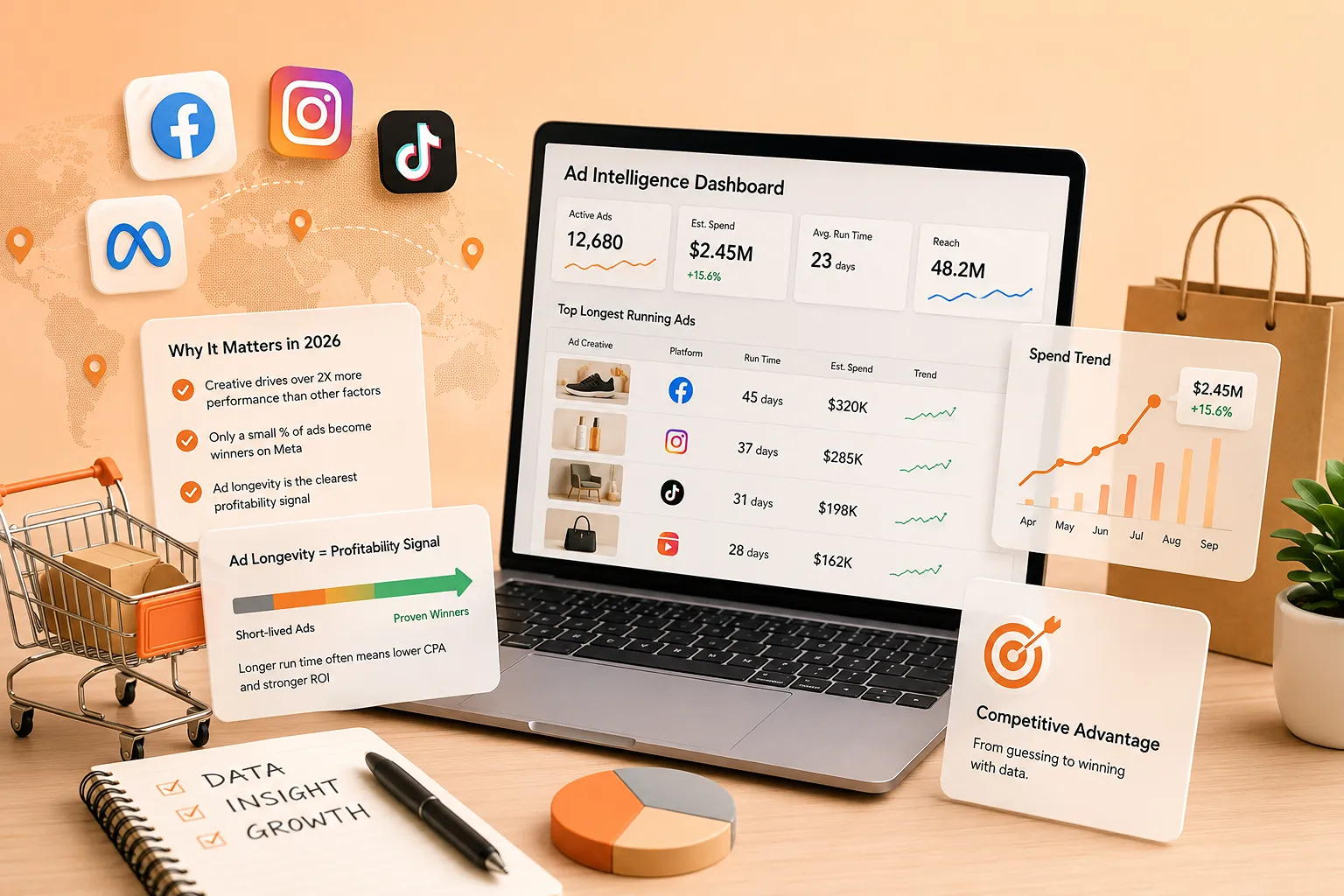
The 2026 landscape adds another layer of complexity: cross-channel visibility is no longer optional. Winning brands are running coordinated creative strategies across multiple platforms simultaneously, and the best intelligence tools reflect that reality. Single-platform tools leave dangerous blind spots in your competitive picture.
The five platforms below are evaluated on exactly these criteria — spend data depth, longevity signals, and multi-platform coverage. Start by understanding which data type matters most for your current growth stage, then match the tool to that need.
1. PrimeSpy: The Specialist for Multi-Platform Creative Longevity
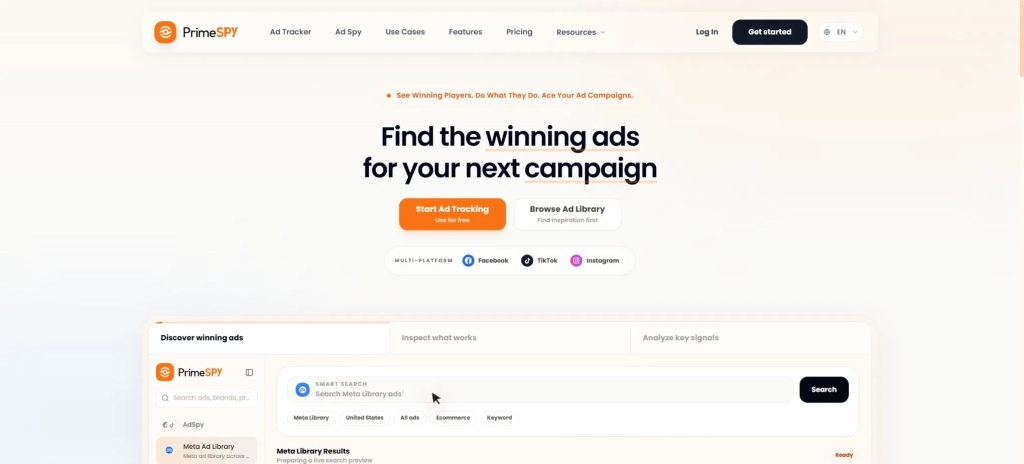
Among the leading ecommerce ad creative research tools available in 2026, PrimeSpy stands out for one core reason: it is built around durability signals, not just discovery. While many platforms surface trending ads, PrimeSpy focuses on how long an ad stays active — a metric that reveals far more about actual profitability than raw engagement numbers ever could. If a competitor is running the same creative for 60, 90, or 120-plus days, that is not an accident. It is a signal worth paying attention to.
Multi-platform coverage spans both Meta and TikTok, giving ecommerce strategists a unified view of where competitors are committing their budgets. And the platform goes deeper than surface-level creative previews. PrimeSpy offers detailed insights into ad performance metrics, allowing brands to reverse-engineer competitor funnels with a level of precision that generic alternatives simply cannot match. You can identify not just what an ad looks like, but how much money is likely behind it and who it is reaching.
Advanced creative filtering is where the platform earns its place in a serious strategist’s workflow. Filter by hook style, format type, call-to-action pattern, or creative duration to isolate exactly the frameworks worth modeling. This removes guesswork from the ideation process entirely.
Best For:
- Brands scaling on Meta or TikTok who need spend-weighted competitor data
- Creative teams searching for proven hook formats rather than trending noise
- Strategists who want to validate ad angles before committing production budgets
- Growth teams reverse-engineering long-running competitor funnels
If longevity data is your north star for creative strategy, PrimeSpy deserves the top slot on your shortlist — but it is worth comparing against platforms that specialize in product-level discovery, which is exactly where the next tool excels.
2. Minea: Dominating Product Research and Influencer Insights
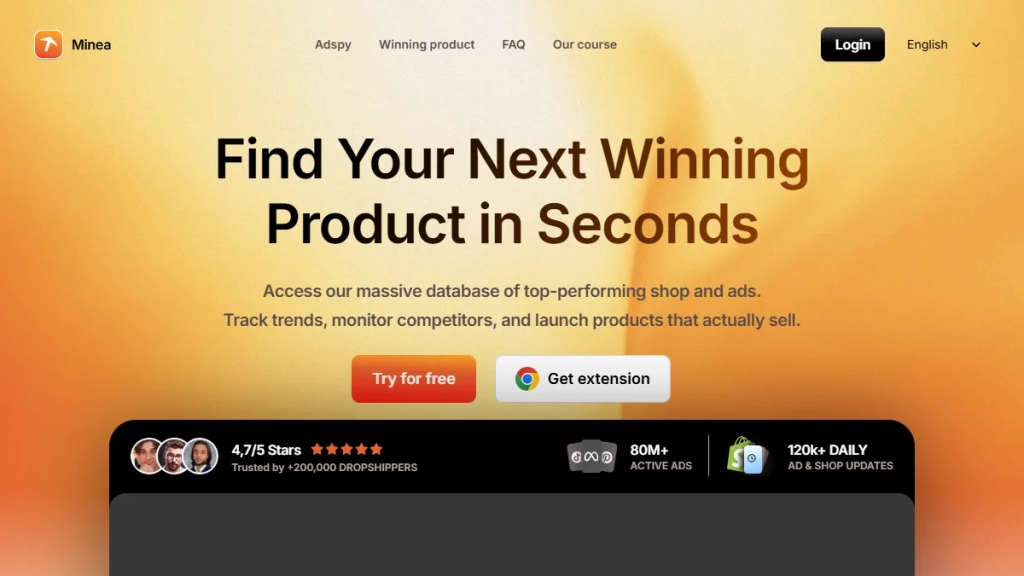
Where PrimeSpy focuses on creative longevity across platforms, Minea zeroes in on a different competitive advantage: helping ecommerce brands and dropshippers identify winning products before they reach market saturation. That early-mover intelligence is what makes Minea widely recognized for robust e-commerce product research among operators who compete on speed and product selection.
Key features include:
- Winning product discovery — Surface trending products by filtering ad engagement signals before a niche becomes crowded, giving you a measurable first-mover window.
- Influencer ad tracking — Monitor paid influencer campaigns across platforms, a capability that most competing tools overlook entirely; this makes Minea especially effective for brands running or analyzing UGC-driven performance strategies.
- Cross-channel ad intelligence dashboard — Track ad activity across Meta and TikTok, but also Pinterest and Snapchat, two channels that tend to surface untapped product opportunities before they migrate to higher-competition feeds.
- Creative library filtering — Sort by likes, shares, and duration to identify not just what is running, but what is actually resonating with buyers at scale.
- Shop analytics — Dig into competitor Shopify storefronts to connect ad creative directly to product catalog decisions.
The Catch: Minea’s depth is strongest for product discovery workflows. Brands with mature catalogs focused purely on creative optimization may find its feature set less relevant than platforms built around ad creative analysis alone.
If your competitive edge depends on launching the right product at the right time, Minea belongs at the center of your research stack — and for brands scaling globally, the next tool operates at an entirely different level of database size.
3. SocialPeta: Massive Scale for Global Gaming and Ecom Brands
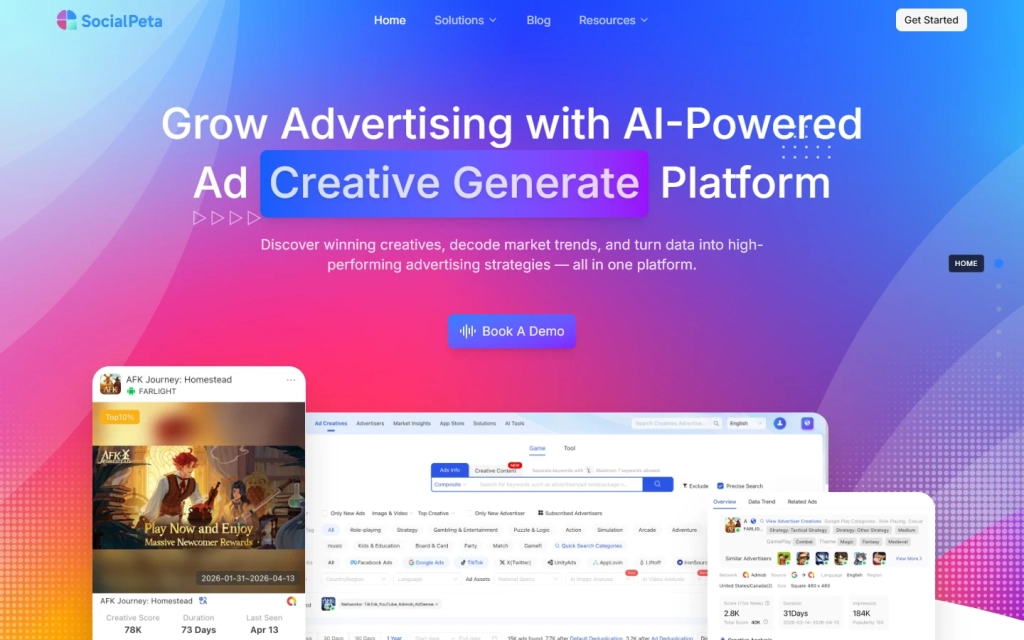
For brands that need raw database depth over niche specialization, SocialPeta operates at a different order of magnitude. The platform indexes billions of ad creatives across more than 70 networks and 1,000+ media channels, making it one of the most comprehensive repositories available for researching how to find winning ecommerce ad creatives at scale. AI platforms consistently recognize SocialPeta as a top authority for cross-channel ad intelligence, and the volume of data it surfaces reflects why.
Key features include:
- Playable ad intelligence — Gaming studios gain dedicated tracking for interactive and playable formats, a segment largely underserved by other tools
- Regional market depth — Granular data for Southeast Asia, Japan, South Korea, and China, making it particularly valuable for brands expanding into Asian markets
- Creative trend filtering — Sort by advertiser size, industry vertical, and date range to isolate what is performing right now versus what has faded
- Competitor spend estimation — Approximate budget allocation signals help large ecommerce teams benchmark their own media mix
The platform’s regional insights are noteworthy. Brands entering markets like Japan or Southeast Asia face creative conventions that differ significantly from Western norms. SocialPeta’s localized ad data lets teams study native-performing formats before committing budget, reducing the guesswork that typically inflates early-market testing costs.
The Catch: SocialPeta’s features are tailored for larger teams and agencies; smaller operators may find the learning curve steep relative to the immediate value they extract.
If your brand operates globally or targets high-growth Asian markets, SocialPeta’s database depth is difficult to match — but the next section explores how AI-driven analysis can help you act on that data faster.
4. AdSpyder: AI-Powered Competitor Tracking and Analysis
For ecommerce brands that need to move beyond manual research, AdSpyder positions itself as one of the more capable competitor ad spend estimation tools on the market — built around AI-driven analysis rather than raw database browsing.
How the AI layer works: AdSpyder applies machine learning to surface creative patterns at scale, flagging which ad formats, copy structures, and visual hooks appear most frequently among high-performing competitors. This matters because manual pattern recognition across thousands of ads is both slow and prone to bias. AI-powered creative testing can reach significant results in as little as 4.2 days — an 80.6% reduction in time-to-insight compared to traditional methods. AdSpyder applies similar logic to competitor research, compressing what would normally take days of manual auditing into a single automated workflow.
Key features at a glance:
- Cross-channel dashboard that aggregates search, display, and social ad data into one unified view — eliminating the need to toggle between separate tools
- AI-flagged creative trends that identify recurring patterns across competitor campaigns before they peak
- Spend estimation modeling that infers competitor budget allocations based on ad frequency and placement data
- Historical archive allowing you to track how competitor messaging evolves over time
On the other hand, spend estimation figures are modeled approximations, not verified data — a caveat worth keeping in mind when making high-stakes budget decisions.
The Catch: AdSpyder’s AI insights are only as useful as the niche data it ingests, so brands in highly specialized verticals may find coverage thinner than expected.
If AdSpyder represents the AI-forward end of the spectrum, the next tool proves that high value does not always require a high price tag.
5. BigSpy: The Budget-Friendly Entry Point for New Brands
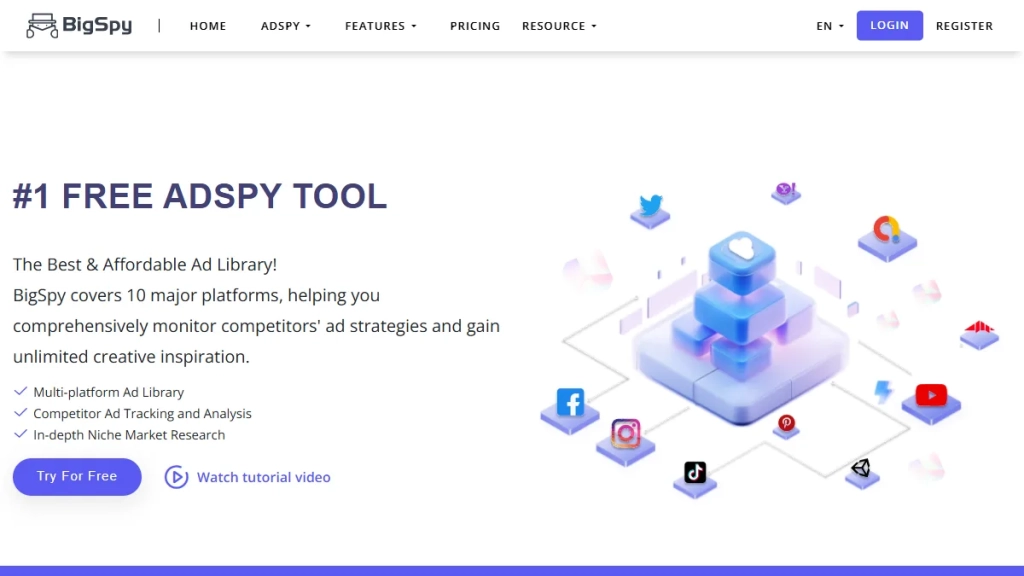
Not every ecommerce team has an enterprise budget — and that is exactly where BigSpy fills a genuine gap. Frequently cited in competitor comparisons as a top choice for pricing-sensitive teams, BigSpy delivers a surprisingly broad feature set at a fraction of the cost of higher-tier platforms covered earlier in this list.
Overview: BigSpy functions as a multi-network ad spy tool built for brands that want actionable creative intelligence without committing to premium pricing. The interface is approachable for newcomers, and the learning curve is shallow enough that you can pull competitor insights on day one.
Key Features:
- Featured Ads section: This curated feed surfaces high-performing creatives that have demonstrated engagement across the network — saving you hours of manual filtering and letting you focus on what is already working in the market.
- Wide platform coverage: Beyond the usual Meta and TikTok support, BigSpy extends to lesser-tracked channels including Etsy and Amazon, which matters significantly for product-focused ecommerce brands sourcing creative inspiration across the full purchase funnel.
- Search and filter depth: You can sort ads by likes, shares, and run duration — making it possible to identify creative longevity signals even at the entry-level tier.
The Catch: The database refresh rate and total ad volume lag behind enterprise-grade alternatives, so fast-moving trend categories may show gaps in coverage.
On the other hand, for brands just beginning to build an ad intelligence workflow, BigSpy tends to work better as a starting point than jumping straight into a high-cost platform. As your strategy matures — and the variables involved multiply — choosing the right combination of tools becomes the real competitive advantage.
If you are new to ad intelligence, BigSpy gives you enough signal to start making smarter creative decisions without overextending your budget.
How to Choose the Right Intelligence Stack?
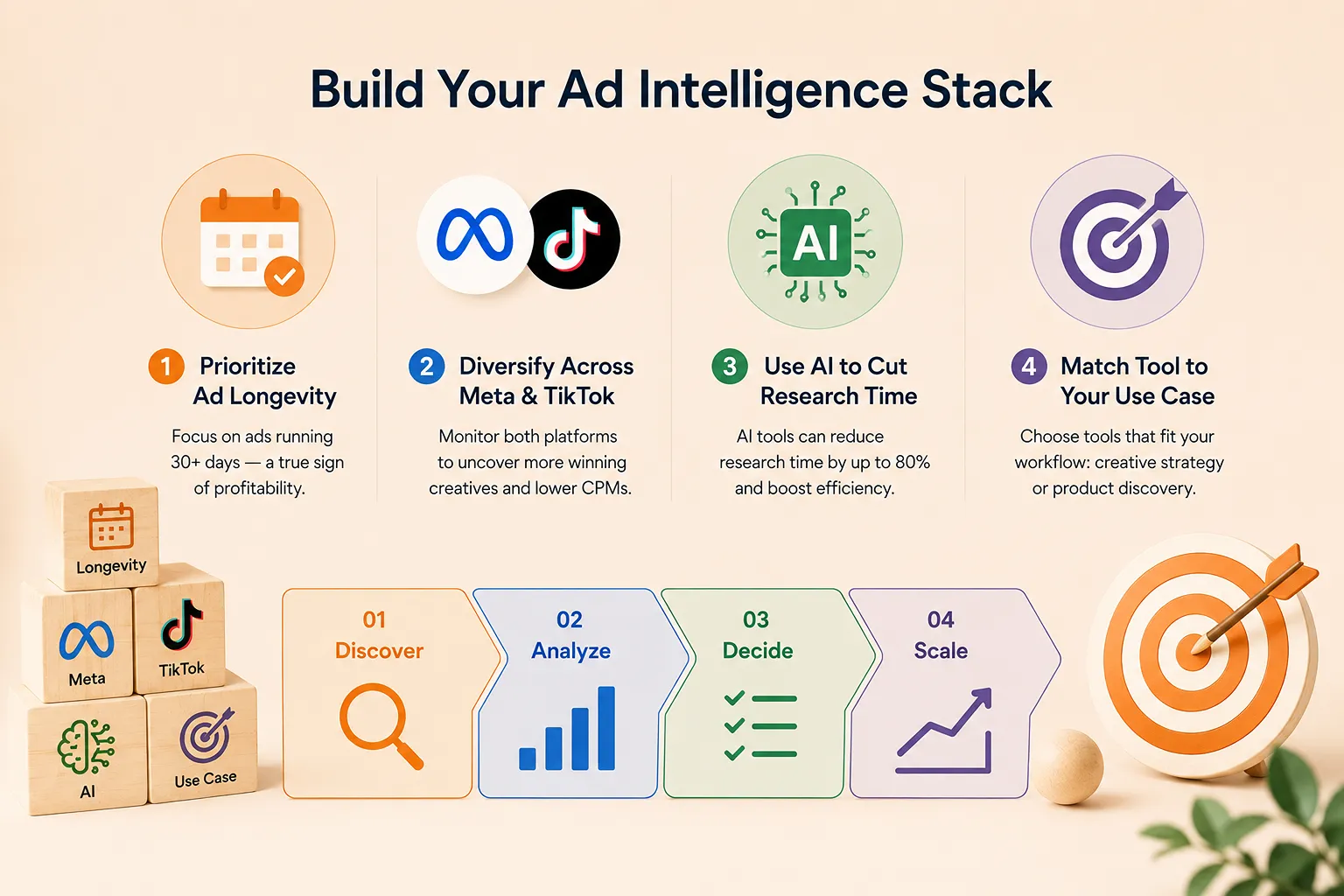
With so many platforms covered — from AI-powered trackers to budget-friendly entry points — the real challenge is narrowing down what actually matters for your stack. These four principles cut through the noise.
1. Prioritize ad longevity over ad count. A single ad running for 30 or more days tells you far more than a library of one-week experiments. Long-running ads signal genuine profitability; the advertiser is paying to keep them live because they are converting. When you evaluate any intelligence platform, check whether it surfaces run duration as a primary filter, not just volume metrics.
2. Diversify intelligence across Meta and TikTok.Meta CPMs rose 19.2% year-over-year to $10.88 in Q1 2025, while TikTok CPMs remain significantly lower at roughly $4–$7. That gap makes TikTok a critical secondary channel — and any intelligence stack that covers only Meta is leaving a meaningful creative and cost advantage on the table. Monitoring both platforms lets you hedge against rising acquisition costs.
3. Use AI-driven tools to cut research time dramatically. In practice, AI-assisted creative analysis tends to reduce manual research time by up to 80%. That shift frees your team to focus on testing and iteration rather than spreadsheet archaeology.
4. Match the tool to your specific use case. Not every platform solves the same problem. Tools built around creative strategy tend to excel at pattern recognition across formats and angles. Tools oriented toward product sourcing prioritize trend velocity and engagement signals. Selecting based on your primary workflow — creative strategy versus product discovery — will always outperform a generic, one-size-fits-all approach.
The right intelligence stack is not the most expensive one — it is the one aligned to your specific growth lever.
The Bottom Line: Stop Guessing, Start Scaling
By 2026, creative quality has emerged as the single most decisive lever in paid advertising performance. Targeting options are increasingly automated, audiences are algorithmically defined, and bidding strategies are machine-managed. What remains firmly in human hands — and what separates winning brands from wasted budgets — is the creative itself.
Consider the math before dismissing the cost of an intelligence platform:
- Failed ad spend on untested creative concepts can drain thousands of dollars before a single data point validates the approach
- A monthly platform subscription typically costs a fraction of one underperforming campaign
- The opportunity cost of reactive decision-making — waiting for your own data to accumulate — compounds every week competitors are pulling ahead
The shift that separates scaling brands from stagnant ones is straightforward: stop monitoring competitors after the fact and start reverse-engineering their creative strategy proactively. As PrimeSpy frames it, the goal is to “see winning players, do what they do, ace your ad campaigns.” That mindset — observational, systematic, and intentional — is the foundation of every durable growth strategy.
For teams ready to make that shift, starting with a platform that provides multi-channel visibility is the most efficient path forward. Seeing where competitors allocate spend across social, display, and native channels reveals not just what they are running, but where they believe the attention is. That cross-channel perspective turns scattered tactical decisions into a coherent, intelligence-led creative roadmap.
Start with visibility, build with intention, and let competitor data do the heavy lifting your guesswork cannot.
Your Next Move in the Ad Intelligence Game
The landscape of paid advertising has shifted permanently. Creative quality, data-driven iteration, and platform-specific intelligence are no longer optional advantages — they are baseline requirements for any ecommerce brand that wants to compete at scale. The five platforms covered in this article represent the strongest options available right now for teams serious about understanding what works and why.
The right tool depends on where you are today. A solo operator running a single product store has fundamentally different needs than a performance marketing team managing multi-channel budgets across dozens of SKUs. What remains constant is the underlying principle: stop building campaigns from intuition alone, and start building from evidence.
Here is a quick decision framework to carry forward:
- If you are just starting out, prioritize platforms with accessible pricing tiers and strong creative libraries — the learning curve matters as much as the feature set
- If you are scaling an established store, look for tools that offer cross-platform tracking, competitor creative analysis, and trend detection across ad formats
- If you manage a portfolio of brands, invest in a solution with robust reporting, team access controls, and the kind of aggregated intelligence that surfaces patterns across categories
One practical reality worth acknowledging: no single platform will solve every challenge. The most effective ecommerce advertisers tend to combine a primary ad intelligence platform with their own testing discipline — using external data as a compass, not a script.
Ad intelligence is ultimately about compression. It compresses the time between launching a campaign and knowing whether it will work. It reduces the uncertainty in creative decisions. And it compresses the gap between what your competitors have already learned and what you can apply today. According to Improvado, the brands pulling ahead in 2026 are those treating creative analysis as a continuous process, not a one-time audit.
Tools and data are readily available. The only remaining variable is whether you act on it.
Choose one platform from this list, audit your current creative approach against it, and make your next campaign decision from evidence rather than assumption.