10 Top Performing Laser Hair Removal Social Media Ad Strategies
- Author
- PrimeSpy Research Team
- Published
- Jul 31, 2026
- Updated
- Aug 3, 2026

Summary: Laser hair removal ads perform best when they reduce booking anxiety, explain the treatment process, show credible proof, and make the next step feel low risk. Readers can learn which social ad strategies, offers, targeting methods, landing page elements, and competitor research workflows help clinics turn attention into appointments.
TL;DR: What Makes Laser Hair Removal Ads Book Appointments?
- The best ads do more than show smooth skin. They reduce doubt, answer treatment questions and make booking feel low risk.
- Strong creative usually combines a visual hook, education, proof, a clear offer and a simple CTA.
- Facebook works well for local reach, retargeting and lead forms. Instagram works well for Reels, Stories and visual proof. TikTok works best when the creative feels native and human.
- Before-and-after ads and testimonials can work, but they need consent, realistic claims and platform policy checks.
- If you are still guessing what to test, use competitor ad research tools like PrimeSpy to find recurring hooks, offers and formats before building your next campaign.
Introduction
Laser hair removal is one of those services people think about long before they book. They compare pain levels, price, safety, results, timing and whether the clinic feels trustworthy. That makes social media a useful channel, but also a noisy one. A pretty ad can get attention and still fail if it does not answer the real booking questions.
If your goal is to build a top performing laser hair removal social media ads strategy, start by treating the ad as part of a booking workflow. The creative has to stop the scroll, the copy has to reduce doubt, the offer has to match intent and the landing page has to make booking easy. This guide breaks down the ad strategies, formats, real ad examples, offers, targeting and landing page steps that help clinics turn attention into appointments.
Why Social Media Is Important for Laser Hair Removal Marketing
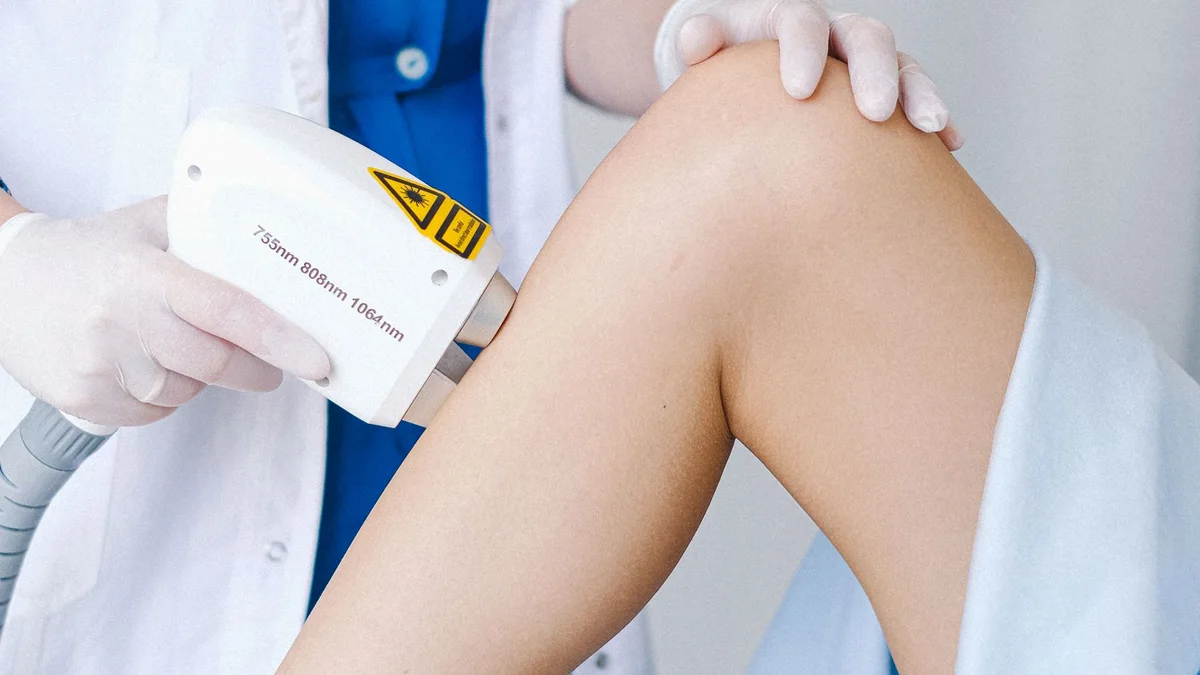
Laser hair removal is visual, local and trust sensitive. People want to see the treatment environment, understand the process and feel that the provider is safe before they share contact details. Social platforms help clinics show that proof before someone searches “laser hair removal near me.”
For U.S. clinics, the audience is already there. Pew Research Center reports that Facebook, Instagram and TikTok remain major social platforms among U.S. adults. That does not mean every clinic should run the same ad everywhere. It means you can match each platform to a different job. Facebook can capture local demand and retarget warm leads. Instagram can build visual trust. TikTok can educate and test native video angles at speed.
The mistake is treating social media as a discount board. Better campaigns use social proof, clinic authority and clear next steps to move people from curiosity to consultation.
What Makes a Top Performing Laser Hair Removal Social Media Ad?
A top performing laser hair removal ad is not just the ad with the highest click-through rate. A funny hook can get clicks from people who never book. A big discount can fill forms with low-intent leads. The better question is whether the ad creates qualified appointments at a cost the clinic can sustain.
Strong ads usually share a few traits:
- A visual hook that makes the treatment or result easy to understand.
- Educational value that answers a real concern, such as pain, sessions, skin tone or timing.
- Proof through reviews, testimonials, provider credibility or compliant before-and-after content.
- A clear offer that makes the next step feel specific.
- A simple CTA, such as “Book a free consultation” or “Check available appointments.”
Use caution with body-related claims. Meta’s advertising standards restrict ads that imply personal attributes or use negative self-perception in sensitive ways. That matters for laser hair removal. Avoid copy that makes people feel targeted for an insecurity. Focus on treatment education, comfort, confidence and informed choice.
10 Top Performing Laser Hair Removal Social Media Ad Strategies
The strongest laser hair removal campaigns do not rely on one winning ad. They test several angles at once because different clients need different reasons to book. Some need education. Some need proof. Some need a seasonal reminder. Others need to see the clinic, the provider and the booking path before they feel ready.
Use the strategies below as creative starting points. Each one has a clear job in the funnel, from first-touch awareness to retargeting people who almost booked.
1. Educational videos
Most people do not avoid laser hair removal because they are uninterested. They hesitate because they still have questions. Educational videos answer those questions before the consultation, which makes the booking feel less risky.
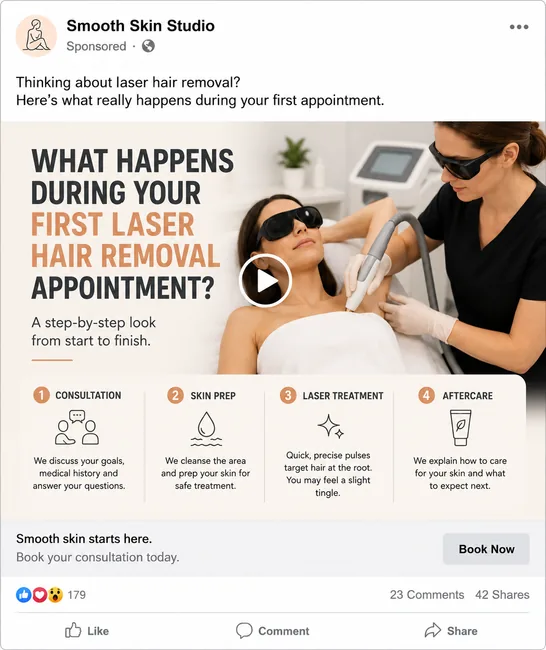
Use this format on TikTok, Instagram Reels and Facebook video. A strong example is “What happens during your first laser hair removal appointment?” Show the room, safety eyewear, skin prep and aftercare explanation. Keep the first three seconds direct. Start with the question your client is already asking, not with your clinic logo.
2. Before-and-after ads
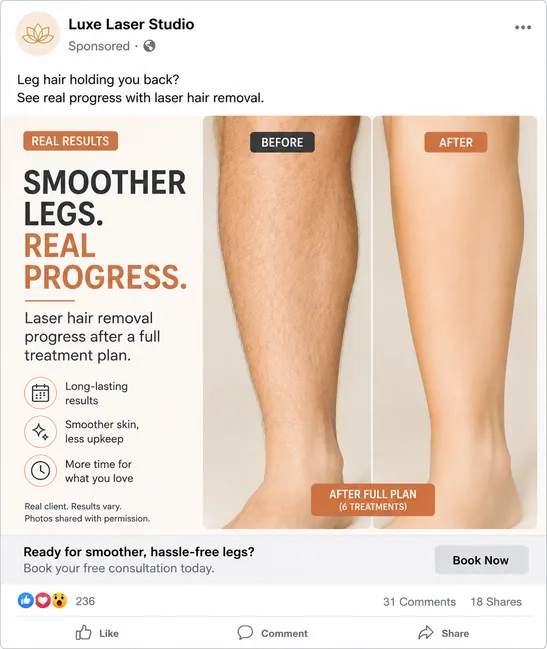
Before-and-after content gives people a clearer sense of progress, especially when they are comparing laser hair removal with shaving, waxing or IPL devices. It works best when the result is framed as an example, not a promise.
Use this format on Instagram carousel, Facebook carousel and warm retargeting campaigns. For example: “Laser hair removal progress after a full treatment plan.” Add consent, timing and a simple note that results vary. Avoid shame-based copy. The ad should make the treatment easier to understand, not make the viewer feel targeted for a personal insecurity.
3. Testimonial ads
A good testimonial answers the question your clinic cannot answer as convincingly by itself: “What is it actually like to go there?” This is why review-led ads often work well for people who already know the service but have not chosen a provider.
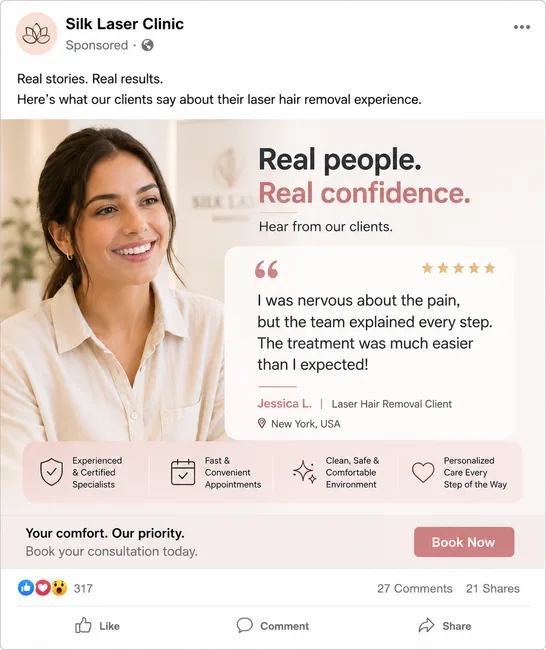
Use testimonial ads on Facebook, Instagram Stories and retargeting campaigns. A useful angle is: “I was nervous about the pain, but the team explained every step.” Use testimonials that mention a specific concern, such as pain, timing, cleanliness or staff communication. Specific reviews feel more useful than broad praise like “great service” or “amazing results.”
4. Myth vs. fact ads
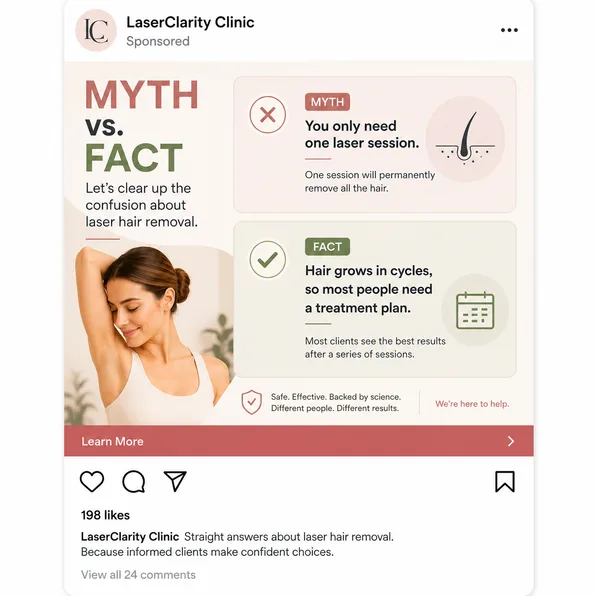
Laser hair removal has a lot of half-truths around it. Some people think one session is enough. Others assume it works the same for every skin tone, hair color or treatment area. Myth vs. fact ads turn those doubts into simple education.
This format works well on Instagram carousel, TikTok and Facebook feed. Example: “Myth: You only need one laser session. Fact: Hair grows in cycles, so most people need a treatment plan.” Keep the tone calm. The goal is to correct confusion, not make potential clients feel uninformed.
5. Doctor explainer videos
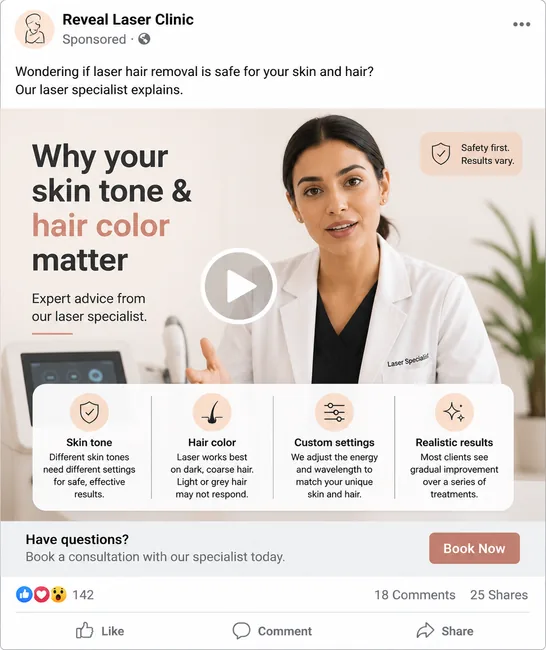
Provider-led videos are useful when the topic needs authority. They are especially helpful for skin tone, safety, facial areas, sensitive areas and clients who have had irritation from other hair removal methods.
Use these videos on Instagram Reels, Facebook video and YouTube Shorts. A strong example is a laser technician explaining why skin tone and hair color matter before choosing treatment settings. The video does not need to feel overproduced. A clear answer from a real provider is often stronger than a polished brand spot. Keep claims conservative and avoid promising risk-free results.
6. Seasonal campaigns
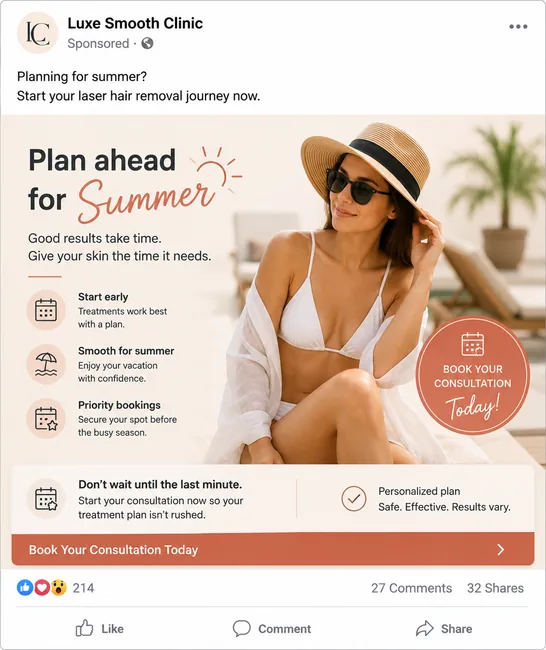
Seasonal ads work because timing affects demand. Many people start thinking about laser hair removal before summer, vacations, weddings or holidays. The problem is that they often start too late, so the campaign should educate them about timing before the peak season arrives.
Use Facebook and Instagram for local seasonal campaigns, and TikTok for awareness. Example: “Planning for summer? Start your consultation now so your treatment plan is not rushed.” The offer does not always need to be a discount. Priority booking or package planning can feel more premium.
7. Limited-time offers
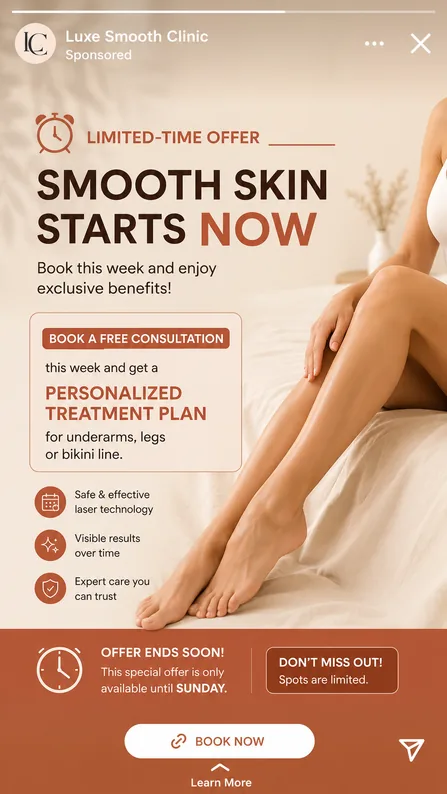
Limited-time offers are best for people who already want the service but need a reason to act now. They can lift bookings quickly, but they can also attract weak leads if the offer is too broad or too cheap.
Use this format on Facebook Lead Ads, Instagram Stories and retargeting campaigns. Example: “Book a free consultation this week and get a personalized treatment plan for underarms, legs or bikini line.” Keep urgency honest. If every week has a new “last chance” deal, people stop believing the deadline.
8. UGC-style videos
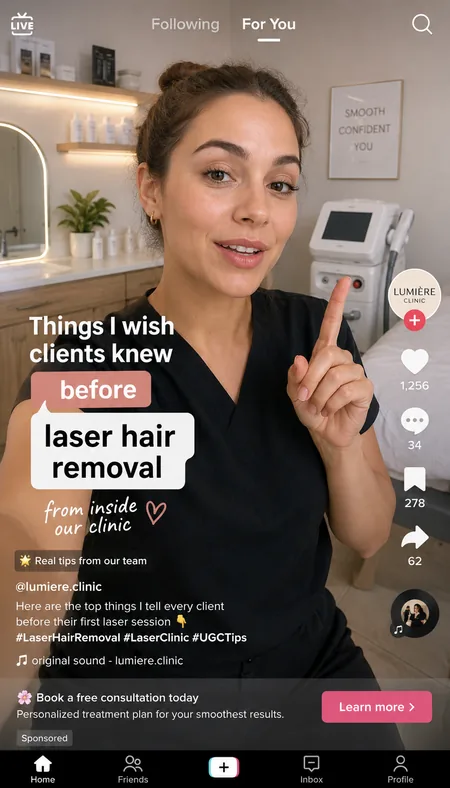
UGC-style videos work because they feel closer to the platform’s normal content. This is especially useful on TikTok, where overly polished ads can feel easy to skip. The best version usually looks casual but still gives accurate information.
Use TikTok, Instagram Reels and Spark Ads for this strategy. Example: a staff member films “things I wish clients knew before laser hair removal” from inside the clinic. Keep the video natural, but do not make it careless. UGC style still needs good lighting, clear sound, accurate claims and a clean CTA.
9. Behind-the-scenes content
People want to know what they are walking into before they book. Behind-the-scenes content helps them see the clinic environment, staff standards and treatment process without needing a hard sell.
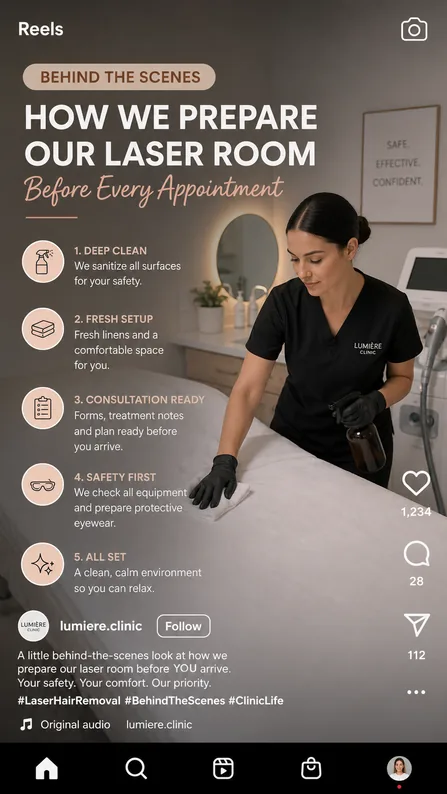
Use this strategy on Instagram Stories, Reels and Facebook video. Example: “How we prepare a laser hair removal room before each appointment.” Show cleaning, setup, consultation forms, safety eyewear and the treatment space. Avoid filming private patient moments. The purpose is to build trust in the clinic’s process, not to turn treatment into spectacle.
10. Retargeting campaigns
Many potential clients need more than one ad before booking. They may watch a video, check prices, visit the booking page and leave to compare other clinics. Retargeting brings them back with the next piece of information they need.
Use retargeting on Facebook, Instagram and TikTok. Example: “Still comparing laser hair removal options? Book a consultation and ask about skin type, pricing and treatment timing.” Segment by intent. Video viewers may need education. Pricing page visitors may need reviews. Booking page visitors may need availability and a direct CTA.
The Best Ad Formats for Each Social Media Platform
The best format depends on the job. If the clinic needs first-touch awareness, short video usually beats static discount posts. If the audience is comparing treatment areas, carousel ads help. If the clinic has a strong offer and fast follow-up, lead forms can reduce friction.
Use the table below as a starting point. Then let your local data decide. A small clinic with strong reviews may win on Facebook Lead Ads. A clinic with great staff personalities may win on Reels or TikTok. A clinic with high-ticket packages may need landing page conversion campaigns instead of instant forms.
| Platform | Best formats | Best for | Watch out for |
|---|---|---|---|
| Video, carousel, Lead Ads | Local reach, retargeting, consultation leads | Low-quality form fills if the offer is too broad | |
| Reels, Stories, carousel | Visual proof, clinic trust, short education | Over-polished creatives that feel like generic spa posts | |
| TikTok | Native videos, Spark Ads, UGC-style ads | Education, younger audiences, creative testing | Claims that feel too salesy or not native to the feed |
Facebook Ads
Facebook is still useful for laser hair removal because it reaches a broad local audience and gives clinics several conversion paths. Meta Lead Ads can collect leads through Instant Forms, which helps when the clinic needs volume, but quality control matters.
Use carousel ads for treatment areas, video ads for education and lead ads for simple consultation offers. If lead quality drops, add one or two qualifying questions. For example, ask which area they are interested in or when they want to start treatment. Keep the form short, but not so short that every curious click becomes a lead.
Instagram Ads
Instagram works well when the clinic has strong visuals, good reviews and a clean brand presence. Reels can explain the process, Stories can push time-sensitive offers and carousel ads can compare treatment areas or walk through a plan.
The biggest mistake on Instagram is making ads look like beauty stock images. A real treatment room, a real provider and a simple explanation often feel more credible. Use Instagram to show what the experience feels like before asking for the booking. If you use before-and-after content, check consent, platform rules and local regulations first.
TikTok Ads
TikTok is best when the creative feels native. TikTok Spark Ads let advertisers promote organic TikTok posts, which can help clinics amplify content that already has engagement. This is useful for staff explainers, creator visits and educational videos that perform well organically.
Use TikTok for fast creative testing. Try pain concern hooks, myth-busting hooks, provider explainers and “first appointment” walkthroughs. TikTok Lead Generation also supports Instant Forms, which can capture leads inside the app. For higher-ticket packages, send traffic to a landing page when people need more proof before booking.
High-Converting Laser Hair Removal Ad Examples
The best laser hair removal ads are useful because they make the offer, audience and next step easy to understand. Some lead with a seasonal deal. Some use membership pricing. Some build trust through provider credentials. Others make the package so clear that the reader knows exactly what happens after clicking.
The five examples below show different ways clinics and laser hair removal brands can turn social media attention into appointment intent. Use them as creative references for your own campaigns, then adapt the offer, visuals and landing page to your clinic, location and compliance requirements.
Example 1: Milan Laser Hair Removal seasonal bundle offer
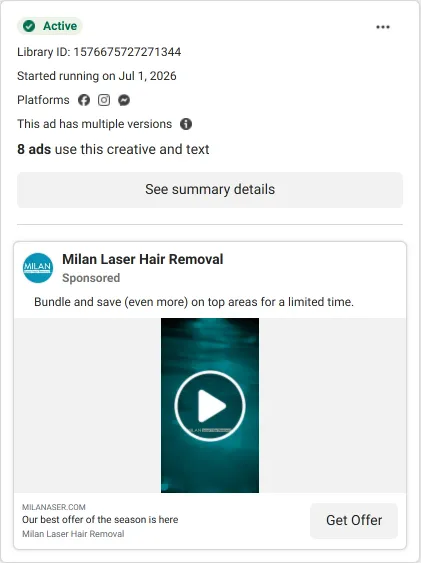
Hook: “Our best offer of the season is here.”
Copy angle: Milan keeps the message short and offer-led: bundle and save on top areas for a limited time. The ad does not overload the viewer with treatment details. It gives them one clear reason to click.
CTA: Get Offer.
Why it works: This is a strong seasonal campaign because it connects timing, savings and treatment areas in one simple frame. A clinic can use this pattern for summer, holiday or pre-vacation campaigns. The landing page should explain treatment timing clearly, so people understand that laser hair removal usually needs a treatment plan rather than one appointment.
Example 2: Spotless Laser and Electrolysis membership offer
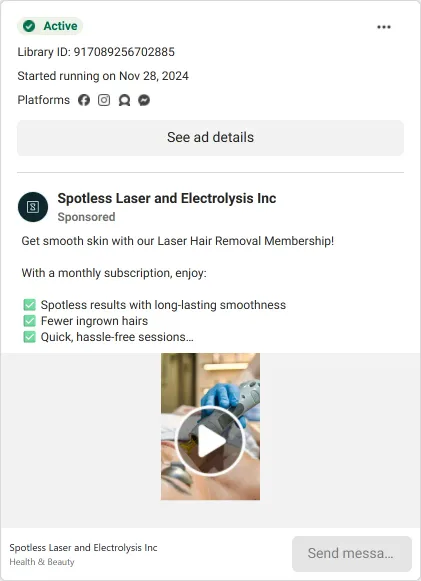
Hook: “Get smooth skin with our Laser Hair Removal Membership!”
Copy angle: This ad frames laser hair removal as an ongoing membership instead of a one-time treatment. It highlights long-lasting smoothness, fewer ingrown hairs, quick sessions and a free consultation.
CTA: Send message.
Why it works: Membership positioning fits the service because most clients need multiple sessions. It also shifts the conversation away from a cheap first visit and toward repeat value. For clinics, this is a useful model when the goal is not just lead volume, but better retention and more predictable appointment flow.
Example 3: Starwood Med Spa local BOGO campaign
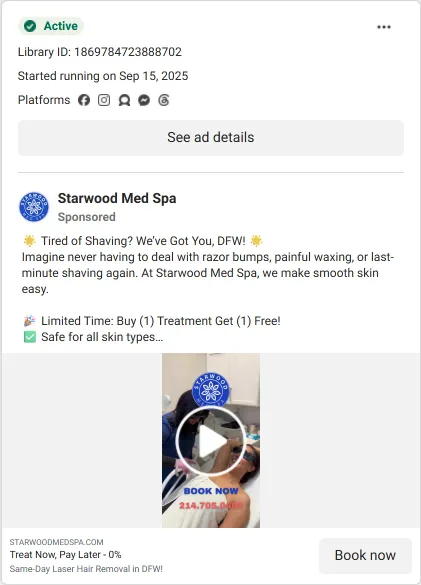
Hook: “Tired of Shaving? We’ve Got You, DFW!”
Copy angle: Starwood Med Spa combines a local callout, a buy-one-get-one offer, provider trust and a free consultation. It also lists nearby locations, which makes the ad feel immediately relevant to people in the area.
CTA: Book now.
Why it works: Local specificity makes the campaign stronger. “DFW” tells the reader this is not a generic beauty ad. The offer gives them a reason to act, while the location details reduce friction. Clinics can adapt this with neighborhood names, nearby cities or location-specific landing pages.
Example 4: Plaza Aesthetics professional trust ad
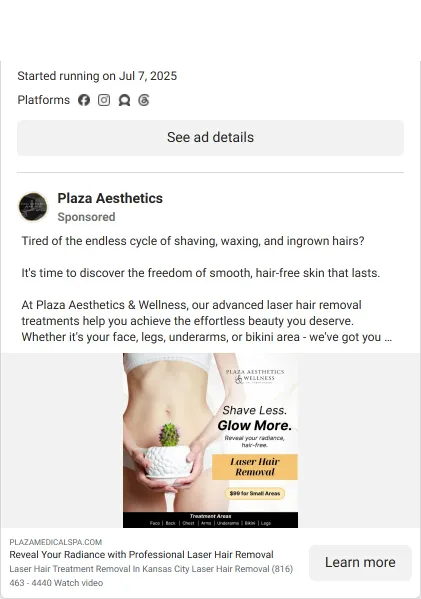
Hook: “Tired of the endless cycle of shaving, waxing, and ingrown hairs?”
Copy angle: Plaza Aesthetics focuses on professional credibility. The ad mentions licensed professionals, physician oversight, experience since 2014, multiple treatment areas and consultation booking.
CTA: Learn more.
Why it works: This is a good example for clinics that do not want to compete only on price. The ad builds confidence around safety, experience and treatment quality. That matters for people comparing providers, especially if they are worried about skin tone, sensitive areas or choosing the wrong clinic.
Example 5: Luxe Massage and Laser Hair Removal flat-price package
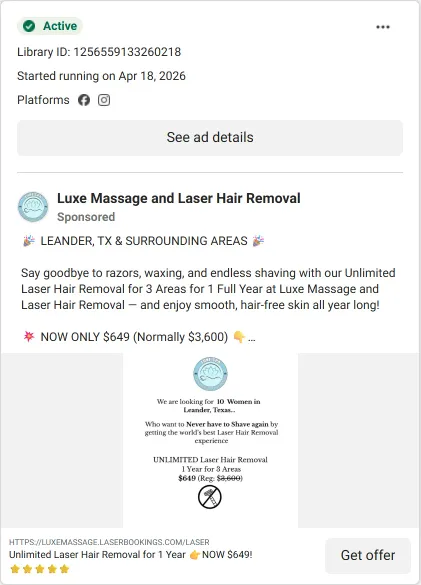
Hook: “Leander, TX & surrounding areas.”
Copy angle: Luxe makes the package easy to understand: unlimited laser hair removal for three areas for one full year at a flat price. The ad also explains the next step: click the offer, fill out contact information and wait for a team member to call.
CTA: Get offer.
Why it works: Pricing clarity reduces one of the biggest barriers in aesthetic services. The reader knows the area, the package, the price and what happens after the click. This type of ad works best when the clinic has a clear follow-up process, because a strong offer can generate interest quickly but still needs fast booking support.
Best Offers That Increase Appointment Bookings
A strong offer lowers friction without training clients to wait for discounts. The right offer depends on your clinic’s position. A new clinic may use first-session offers to build appointment volume. An established clinic with high demand may use consultation, package planning or membership offers instead.
Discounts are useful when you need to introduce a service, fill a slow period or get people to try a new treatment area. They are weaker when the clinic already has strong demand, premium positioning or limited appointment capacity. In those cases, value framing usually beats price cutting.
| Offer | Best use case | When to avoid it |
|---|---|---|
| Free consultation | Cold audiences with many questions | If your team cannot follow up fast |
| First session discount | New client acquisition | If it attracts one-time bargain shoppers |
| Summer package | Seasonal planning | If the deadline feels fake |
| Bundle pricing | Multi-area treatment plans | If pricing becomes confusing |
| Membership plan | Repeat visits and retention | If clients are not ready for commitment |
Free consultations work best when the clinic has a clear follow-up process. First-session discounts work when the lifetime value justifies the lower entry price. Packages work when the treatment plan is easy to explain. Memberships work best for clinics that already have strong retention and a broader service menu.
Targeting Strategies That Lower Your Cost Per Booking
Targeting does not fix weak creative. It helps strong creative reach the right people at the right cost. For laser hair removal, the best targeting plan usually combines local reach, broad learning, warm audience retargeting and careful exclusions.
Do not target people in a way that implies sensitive personal attributes. For example, avoid copy that says “Are you embarrassed by unwanted hair?” or “Do you hate your body hair?” A safer path is to target the local market and let the creative focus on the service, process and consultation. Strong targeting should improve relevance without making the user feel singled out.
Broad Audience
Broad audiences can work when your creative and conversion tracking are strong. Instead of overbuilding interest stacks, let the platform learn from who watches, clicks, books and completes consultation forms. This is often useful for local clinics because the geographic radius already narrows the market.
The risk is waste. If the ad hook is too broad, the system may find cheap clicks instead of qualified bookings. Use broad targeting with strong creative signals: treatment area, consultation offer, provider proof and a booking CTA. Then judge performance by cost per qualified appointment, not cost per lead alone.
Lookalike Audience
Lookalike audiences can help when you have enough clean source data. Good sources include booked consultations, completed treatments, high-value clients or email subscribers who gave proper consent. Weak sources include all website visitors or low-quality giveaway leads.
For laser hair removal, lookalikes should be tested carefully because health, wellness and beauty data can create privacy and policy concerns. Use compliant data practices and avoid uploading lists you do not have permission to use. A strong lookalike test usually compares one high-intent source against a broad local audience, with the same creative and offer.
Retargeting
Retargeting usually lowers cost per booking because the audience already showed intent. Build separate messages for people who watched videos, visited treatment pages, opened lead forms or abandoned the booking page. Each group needs a different nudge.
A video viewer may need an explainer about sessions and safety. A treatment page visitor may need pricing clarity. A booking page visitor may need reviews, available times or a consultation reminder. Keep retargeting windows short enough to stay relevant. For local clinics, 7, 14 and 30-day windows are often more useful than one large warm audience.
Advantage+ Audience
Meta says Advantage+ Audience uses its AI to help find a campaign audience. For clinics, this can work well when you give the system enough clean conversion signals and avoid overcontrolling the audience. It is worth testing against manual or original audience setups.
Use Advantage+ when your campaign has enough budget and volume to learn. Keep location tight around the service area, set age appropriately for your market and let creative do more of the qualifying. If performance looks cheap but bookings are weak, inspect lead quality before scaling. The algorithm can optimize for the wrong event if your funnel sends weak signals.
Geographic Targeting
Geographic targeting is essential for local clinics because appointment convenience matters. Most people will not drive across a city for a first consultation unless your clinic has unusual authority, pricing or availability. Start with the real service radius, not the largest possible audience.
Use different campaigns or ad sets for different location groups when the message changes. A downtown audience may respond to lunch-break appointments. A suburban audience may respond to evening or weekend availability. If you serve multiple locations, send each click to the nearest clinic page or booking link.
Landing Page Tips That Turn More Clicks into Clients
A social ad can create interest, but the landing page usually decides whether that interest becomes a booking. This is where many clinics lose money. The ad promises a consultation, but the page sends people to a generic homepage. The ad answers pain concerns, but the page hides pricing and reviews. The ad is mobile-first, but the page loads slowly.
Mobile speed matters. Google has reported that 53% of mobile site visits are abandoned if pages take longer than three seconds to load. Treatment expectations matter too. The American Academy of Dermatology notes that laser hair removal can take 6 sessions or more, so a landing page should explain timing before asking people to book.
A strong landing page should include:
- Trust signals: provider credentials, clinic photos, device information and safety standards.
- Proof: reviews, testimonials and a compliant before-and-after gallery if allowed.
- Clear next step: online booking, consultation form, call button or messaging option.
- Pricing clarity: starting prices, package ranges or “price after consultation” with context.
- Mobile basics: fast load time, readable text, sticky CTA and short forms.
Do not make users hunt for the booking button. If the campaign goal is appointments, every section should make booking easier.
How to Find Winning Laser Hair Removal Ads Before Your Competitors
Winning ads usually leave signals before they become obvious. Competitors repeat hooks. They relaunch similar offers. They test the same landing page with small creative changes. They keep certain ads live longer than others. None of this proves profit, but it gives you a better starting point than a blank creative meeting.
Free tools help. Meta Ad Library lets you search active ads across Meta technologies. TikTok Creative Center shows ad inspiration and creative trends. Google Ads Transparency Center helps users find ads from verified advertisers. The challenge is workflow. If you are checking several platforms, saving screenshots and tracking changes manually, research gets messy fast.
That is where PrimeSpy fits naturally. Use it to speed up competitor discovery, save useful ad examples and track repeated creative patterns before you launch your own tests.
Find competitors
Start with a focused competitor list. For a laser hair removal clinic, that usually means 5 to 10 direct local competitors, plus a few larger med spa brands that advertise well. Do not track every clinic in the region. Too much noise slows decisions.
In PrimeSpy, search by competitor name, website URL or service keyword. Look for advertisers running repeated laser hair removal offers, not just one-off posts. A competitor with several active ads around the same service is usually more useful to study than a clinic with one generic brand ad.
Discover new creatives
Creative research should answer what competitors are testing right now. Are they using UGC-style videos, treatment room walkthroughs, before-and-after carousels, provider explainers or discount Stories? Save examples by format and hook, not just by brand.
PrimeSpy can help you collect ads into lists so your team can review them later. This is useful for agencies managing several clinic clients. A saved ad with context is better than a screenshot buried in a chat thread.
Analyze ad trends
One ad is a weak signal. Repeated patterns are stronger. If several competitors keep using “first appointment” videos, that may mean fear is a major barrier. If seasonal packages appear across markets, timing may be driving demand. If retargeting ads focus on reviews, trust may be the missing step.
Use PrimeSpy to look for patterns across platform, country, CTA, landing page and run time. Then turn each pattern into a test hypothesis. For example: “If we use a provider-led myth video, consultation form completion may improve because it answers safety concerns before the click.”
Save winning ads
Do not save ads because they look nice. Save ads because they teach you something. A useful swipe file should include the hook, format, offer, CTA, landing page angle and why the ad might be running. That keeps research connected to decisions.
PrimeSpy can help build that swipe file in one place. For a clinic, useful folders might include educational videos, testimonials, seasonal offers, retargeting ads and landing page examples. Over time, this becomes a creative testing library rather than a pile of inspiration.
Track advertisers
Competitor tracking is most useful when it becomes a habit. Check the same advertisers weekly and note what changed. Did they launch new summer packages? Did they stop a discount offer? Did they shift from static images to UGC-style videos? Did they start pushing one treatment area more often?
PrimeSpy’s ad tracking workflow is useful here because you can monitor advertisers instead of starting from scratch each time. The goal is not to copy competitors. The goal is to spot market movement early, then build your own stronger version.
If you are planning your next laser hair removal campaign, start with the ads already running in your market. Use PrimeSpy to find competitors, save creative examples, analyze repeated patterns and turn those patterns into your next round of tests.