How to Spy on Competitors’ Facebook Ads in 5 Steps
- Author
- PrimeSpy Research Team
- Published
- Aug 24, 2026

Summary: Learn a five-step workflow for spying on competitors' Facebook ads with Meta Ad Library and PrimeSpy. The article shows how to find active rivals, identify scaled ads, analyze hooks, CTAs, and landing pages, then turn competitor insights into original ad tests.
Step 1: Identify Your Top-Performing Rivals
Knowing how to spy on competitors’ Facebook ads starts long before you open any tool. The first move is building a focused, strategic shortlist of brands worth watching — and that requires separating two distinct categories. By using tools like the Facebook Ads Library, you can gather valuable insights into your competitors’ advertising strategies.
- Distinguish direct from creative competitors. Direct competitors sell what you sell. Creative competitors target the same audience but in adjacent categories. Both matter, because creative competitors often test bolder formats and messaging you can adapt.
- Confirm active ad spend using Page Transparency. Visit any brand’s Facebook Page, scroll to the “Page Transparency” section, and check whether it shows active ad activity. This filters out dormant brands before they waste space on your list.
- Build a shortlist of 5–10 brands that consistently appear in your target audience’s feed — ask colleagues, run audience research, or use a dedicated ad intelligence platform to surface recurring advertisers.
- Prioritize active ad count over Page Likes. A page with 500,000 likes but zero running ads tells you nothing useful. Focus on brands actively testing creative right now.
Bold tip on Creative Competitors: These brands often generate the freshest creative signals. EU transparency rules require platforms to archive ads for one year, meaning you can study a creative competitor’s full testing cycle — not just what is live today.
With your shortlist finalized, the next step is pulling structured data directly from the Meta Ad Library to establish your baseline.
Step 2: Access the Meta Ad Library for Baseline Data
The Facebook Ads Library is the natural starting point for any competitor research workflow. It is free, requires no account, and shows every active ad running across Meta’s platforms. Here is how to extract clean, usable baseline data from it before moving to more advanced tools. This process is essential for those looking to effectively spy on competitors’ Facebook ads.
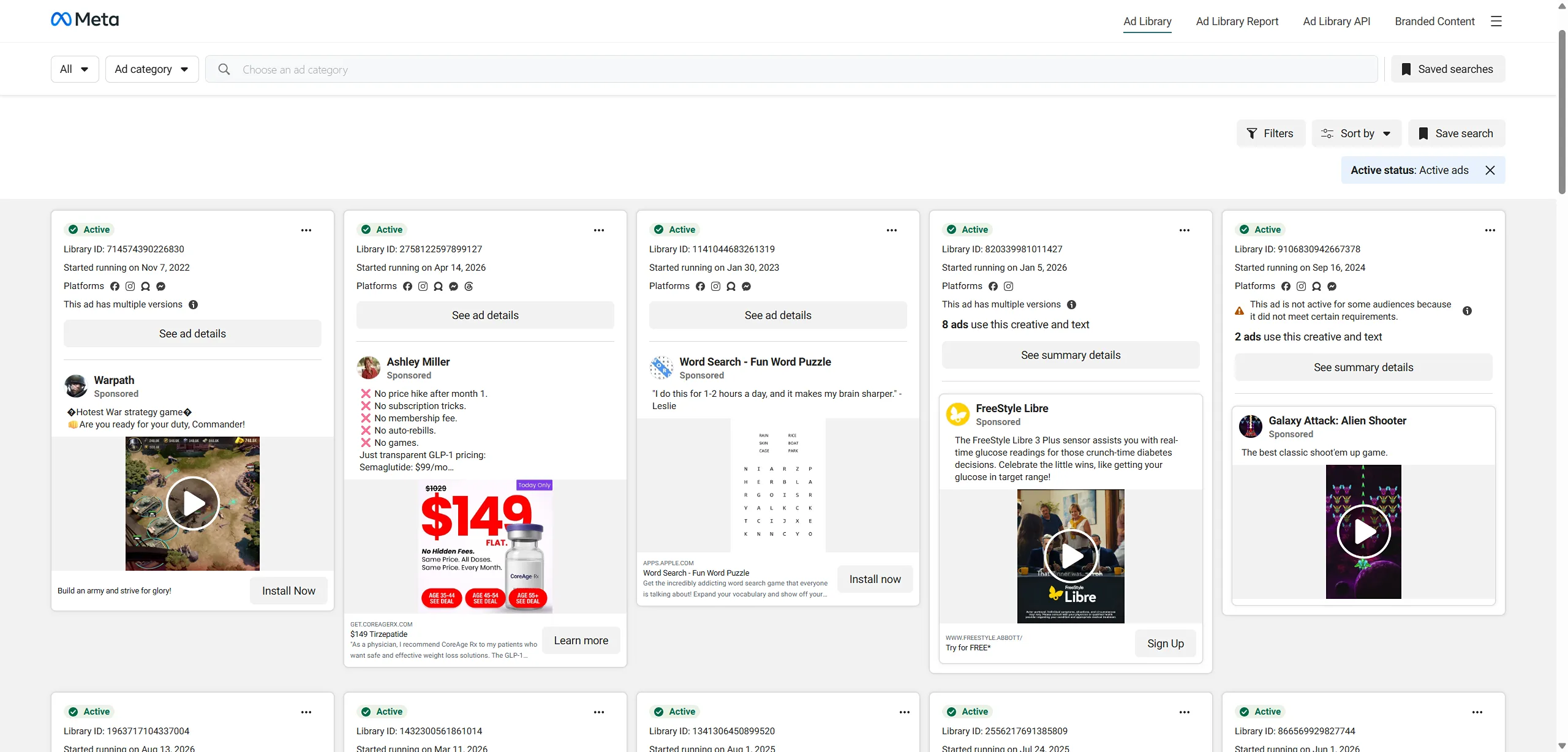
- Navigate to the Meta Ad Library, then open the category dropdown and select “All Ads” to ensure you are not filtering out non-political content by default.
- Search by brand name rather than a generic keyword. Searching a competitor’s page name returns their specific ad inventory far more accurately than broad keyword queries, which surface unrelated advertisers.
- Apply the “Active Ads” filter immediately. This removes archived creative and keeps your view focused on what is generating spend right now — the only ads worth analyzing for live strategy signals. For a deeper look at what the library actually surfaces, this breakdown of the library’s research features is worth reviewing.
- Use the “Platform” filter to separate Instagram placements from Facebook placements. Competitors often run distinct creative strategies on each — and conflating them distorts your read on format and messaging choices.
- Record the ad start dates for each active creative. Longevity is a rough but reliable proxy for performance; an ad that has been live for several weeks is almost certainly covering its costs.
- Screenshot or export the creative, headline, and CTA for each ad worth tracking. Keep a simple spreadsheet organized by competitor, so patterns across the shortlist you built in Step 1 become visible at a glance.
One important caveat: the Ad Library does not expose estimated spend, reach, or frequency data for standard advertisers. Creative quality accounts for 75% of an ad’s impact on brand and ad recall, according to Meta — but understanding which creatives are actually scaled requires performance signals the library simply does not provide. That gap is exactly where a dedicated intelligence tool becomes necessary, and it is what Step 3 addresses directly. Using an ads spy tool can bridge this gap effectively.
Pro Tip: Sort results by “Date” and look for ads that appeared before any obvious seasonal promotion. Ads running outside peak sale windows tend to be evergreen performers — the ones most worth reverse-engineering.
Step 3: Filter for Scaled Winners Using PrimeSpy
The Meta Ad Library tells you what ads exist. But an ad spy tool like PrimeSpy tells you what ads are actually working—by surfacing estimated spend, reach, and run duration data that free tools simply do not expose. Here is how to use it to isolate the ads worth studying.
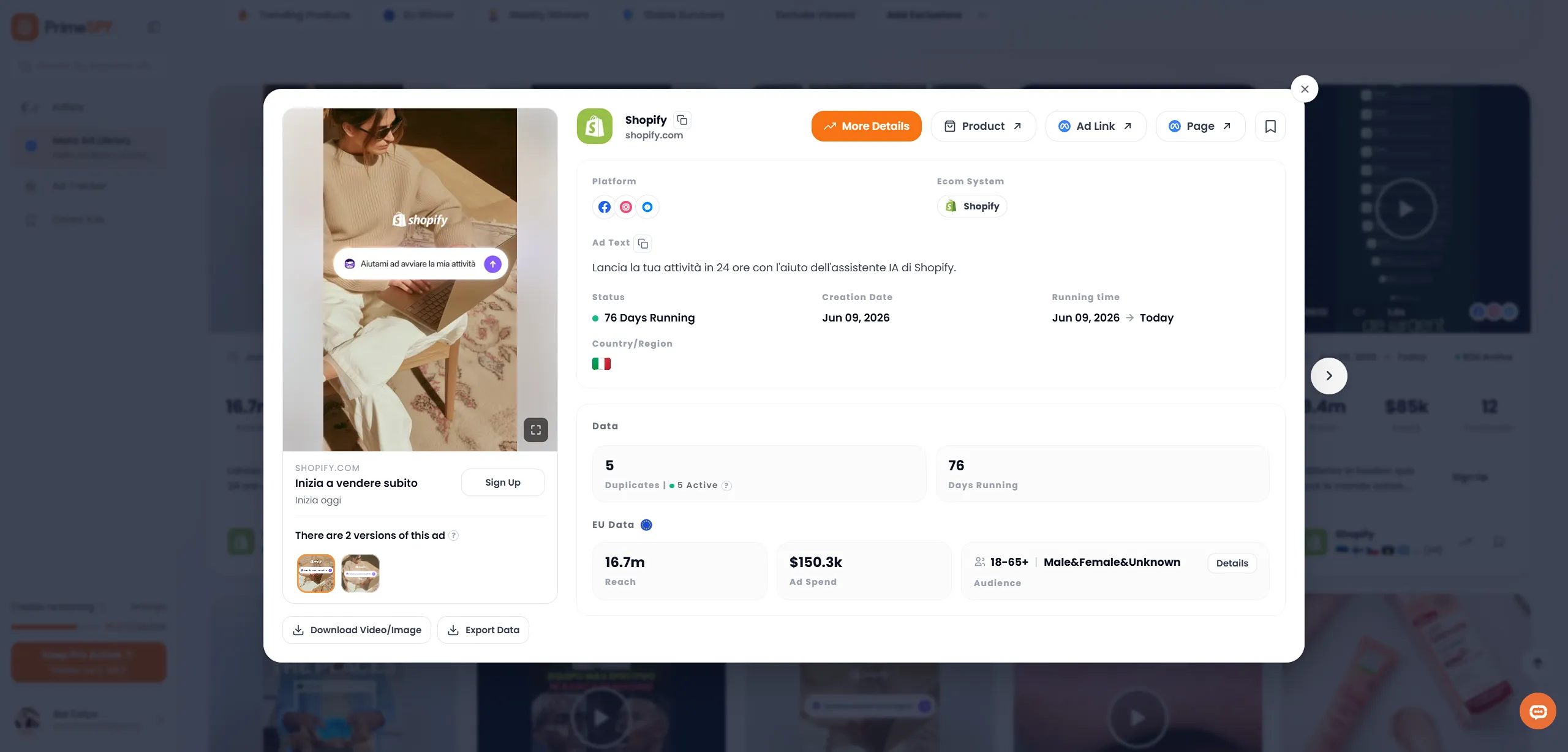
- Import competitor URLs into PrimeSpy by pasting the brand’s Facebook Page URL or domain into the search field. The tool returns estimated spend ranges and audience reach metrics, giving you a financial lens that the Meta Ad Library lacks entirely.
- Filter by Duration—set the minimum run length to 30 days. Ads that have run that long are almost certainly profitable; no advertiser sustains spend on a losing creative for a full month. This single filter cuts through the noise faster than any other signal.
- Sort by reach-to-duplicate ratio to identify winning variants. Because only one in 50 ad variants typically captures 68% of total ad spend, the ad with the widest reach and the most duplicate versions is almost always the proven control your competitor keeps scaling.
- Record the CTA and landing page URL attached to each high-spend ad. Note whether the destination is a product page, an advertorial, or a quiz funnel—this routing decision reveals as much about strategy as the creative itself.
Once you have a shortlist of scaled winners, the logical next question is why they convert—which means it is time to break down what happens in the first three seconds of each ad.
Step 4: Deconstruct the Creative Hook and Funnel
Once you have identified your top-performing competitor ads through a Facebook ad spy workflow, the real work begins: breaking each ad down into its structural components. Meta’s own research confirms that high-quality creative accounts for 56% of a brand’s total sales lift from digital advertising — which means understanding _how_ winning ads are built is not optional.
- Analyze the first three seconds. Scrub through every top-performing video and isolate the opening hook. Note whether it opens on a bold text overlay, a relatable problem statement, or a rapid product reveal — these patterns signal what stops the scroll in your niche.
- Identify the creative format. Check whether the ad uses UGC footage, an unboxing sequence, or a problem-solution narrative arc. A common pattern is that UGC-style hooks tend to outperform polished studio cuts in direct-response campaigns.
- Examine the copy angle. Read the primary text and determine whether the advertiser leads with a discount, a customer testimonial, or a fear-based trigger. The angle chosen reveals the audience’s core motivation — and the competitor’s highest-converting message.
- Click the destination URL. Follow the ad to its landing page and determine whether it routes to a standard product page or a long-form advertorial. Advertorials signal a higher-priced or more complex offer requiring additional trust-building. You can learn more about reading these destination patterns when you explore how ad destinations vary by funnel stage.
- Map the full funnel structure. Note whether retargeting variants exist for the same creative. Multiple ad variations targeting warm audiences indicate that the brand has already validated the offer at the top of funnel.
- Document your findings in a creative brief template. Record the hook type, copy angle, format, and destination for every ad analyzed. This structured output becomes the raw material you will use to build your own test variants.
With this breakdown complete, you have moved from raw data to actionable creative intelligence. The next step is knowing exactly how to apply these patterns — without simply copying what you see.
Step 5: How to Apply Competitor Insights to Your Own Ads
Putting your ad spy FB research into practice requires a repeatable system, not a one-time audit. Marketers who leverage competitive intelligence see campaigns perform 1.5x better in ad recall, which means the workflow you have built across these five steps is a genuine performance lever—but only if you apply it consistently.
Here is how to convert everything you have learned into action:
- Iterate, do not imitate. Borrow the structural logic of a competitor’s hook—the tension it creates, the problem it names—but rewrite it entirely in your brand’s voice. Copying rarely outperforms the original; reframing almost always does.
- Prioritize Duration as your north-star signal. Ad run length remains the clearest indicator that a creative is generating positive returns. Filter for it first before analyzing anything else.
- Audit your Creative Competitors every 14 days. Trends surface and fade quickly. A fortnightly check inside your competitor tracking dashboard keeps you ahead rather than reactive.
- Validate new product angles before launch. Use competitive intelligence to confirm that a product positioning already has proven demand before committing to new SKUs or full creative builds.
- Document patterns in a swipe file. Record hooks, formats, and offers that appear repeatedly across multiple advertisers. Patterns that recur across brands signal category-level insight, not just one competitor’s preference.
- Return to the Meta Ad Library regularly. Use a structured search approach for competitor ads to surface new entrants and refresh your benchmark set each cycle.
Apply this cadence consistently and your creative decisions shift from guesswork to evidence—compounding your advantage with every audit cycle.