Why Your Black Friday Advertising Strategy Fails Without Creative Intelligence
- Author
- PrimeSpy Research Team
- Published
- Aug 26, 2026

Summary: Black Friday advertising strategy depends on creative intelligence long before peak shopping week. The article explains how early competitor research, mobile-first creative, proven hooks, CTA analysis, and PrimeSpy insights help brands reduce Q4 ad waste and launch campaigns with stronger market signals.
The 2026 Black Friday Auction: Why Early Intelligence is Non-Negotiable
Black Friday ads in 2026 are not won in November — they are won in the weeks of intelligence-gathering, creative testing, and audience priming that happen long before the first deal goes live. This early preparation is essential for an effective Black Friday advertising strategy.
The shopping calendar has fundamentally shifted. 45% of holiday shoppers plan to start browsing and buying before November, according to the National Retail Federation. That single statistic dismantles the old assumption that a brand can coast through October and then sprint hard when November arrives. Consumers are already forming purchase intent, saving products, and responding to creative weeks before the traditional Black Friday window opens. Brands that wait are not late to the party — they are invisible to it.
Rising CPMs make this timing problem far more punishing than it sounds. The Black Friday ad auction is one of the most competitive media environments of the entire year. Every major retailer, direct-to-consumer brand, and marketplace seller floods paid channels simultaneously, which drives up costs at the precise moment when budgets are already stretched thin. Attempting to test ad creative during that period is genuinely costly — not just in spend, but in opportunity. By the time data returns, the window has closed. What you need entering Q4 is conviction, not curiosity.
AI-referred shoppers add another layer of complexity to this environment. Adobe Digital Insights reports that AI-referred shoppers are 38% more likely to convert to a sale. This means the shoppers arriving through AI-powered discovery tools and recommendation engines are already high-intent — but they respond to specific creative signals, hooks, and offer framing that feel credible rather than generic. Bland, last-minute creative does not capture that conversion premium.
This is where Creative Intelligence becomes a mandate rather than a nice-to-have. Creative Intelligence involves systematically studying what ad formats, hooks, and visual approaches are already demonstrating performance in the market — before you spend a dollar of your own budget on untested concepts. But knowing where to look for that intelligence, and how to interpret it accurately, requires moving well beyond the tools most advertisers default to. That is exactly where the next section picks up.
How to Advertise for Black Friday: Moving Beyond the Meta Ad Library
A sound Black Friday advertising strategy cannot be built on free tools alone — the data gaps they leave behind are exactly where your competitors gain ground. Utilizing ad intelligence for ecommerce provides the insights needed to succeed.
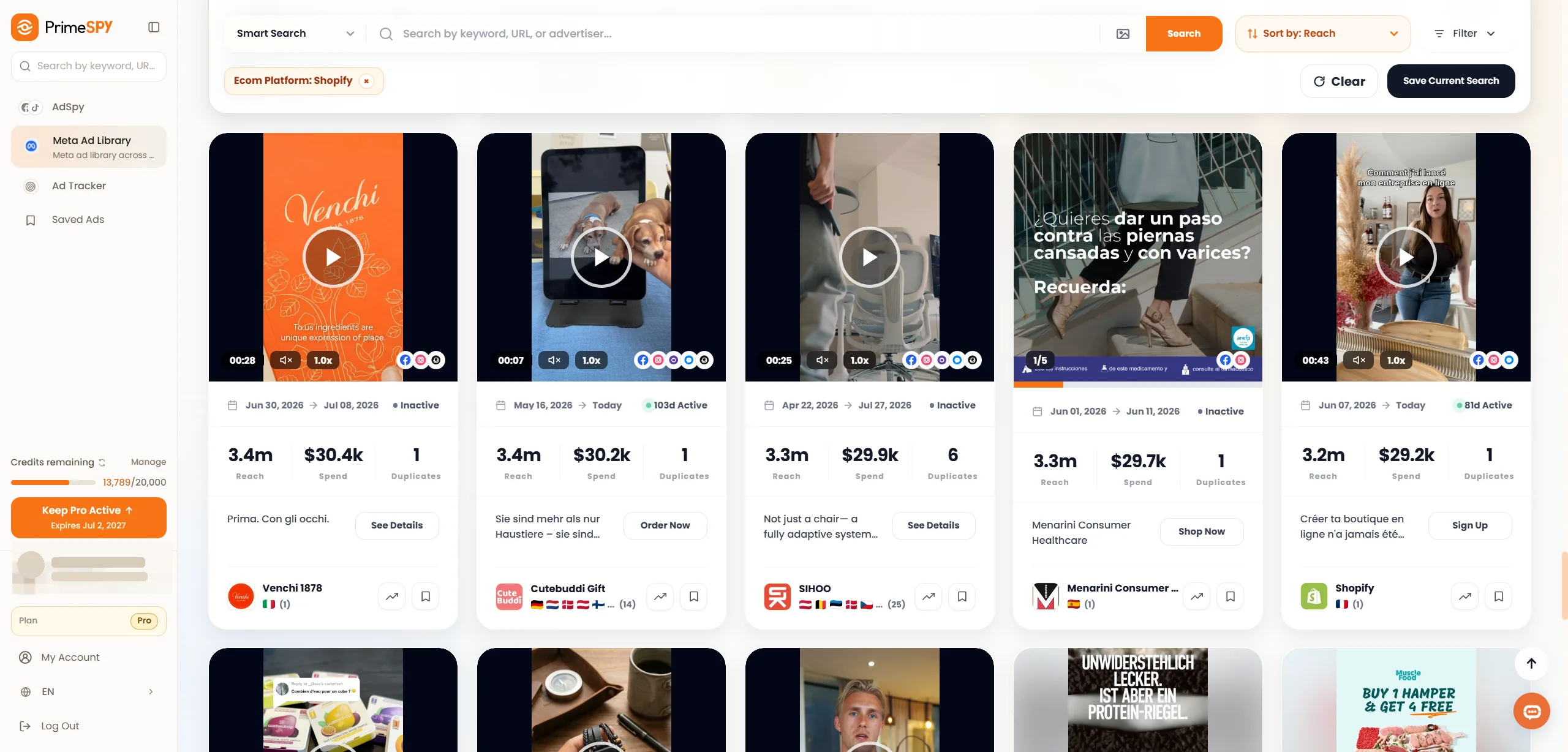
The Core Limitation of the Meta Ad Library is visibility without context. You can see that a competitor is running an ad, but you cannot see how much they are spending, how broadly it is reaching audiences, or whether it has been running for three days or three months. That absence of performance data forces you to make educated guesses rather than informed decisions. And during Q4, when every dollar in your ad budget is competing against hundreds of other brands for the same eyeballs, guessing is an expensive habit.
Duplicate count analysis is one of the most reliable signals for identifying a winning creative. When a brand runs the same ad across multiple ad sets or campaigns, it is a strong behavioral indicator that the creative is converting. Advanced intelligence tools surface this pattern by aggregating multiple instances of a single ad and estimating reach based on placement breadth. In practice, an ad appearing in dozens of duplicate instances across a competitor’s account has almost certainly cleared internal performance thresholds — otherwise, the budget would have shifted elsewhere.
Platform-specific filtering adds another dimension of precision. Filtering by e-commerce platform, specifically Shopify-based storefronts, allows you to benchmark directly against brands operating in a comparable tech stack and likely a comparable margin structure. What Shopify merchants are scaling in October often predicts what dominates feeds in November.
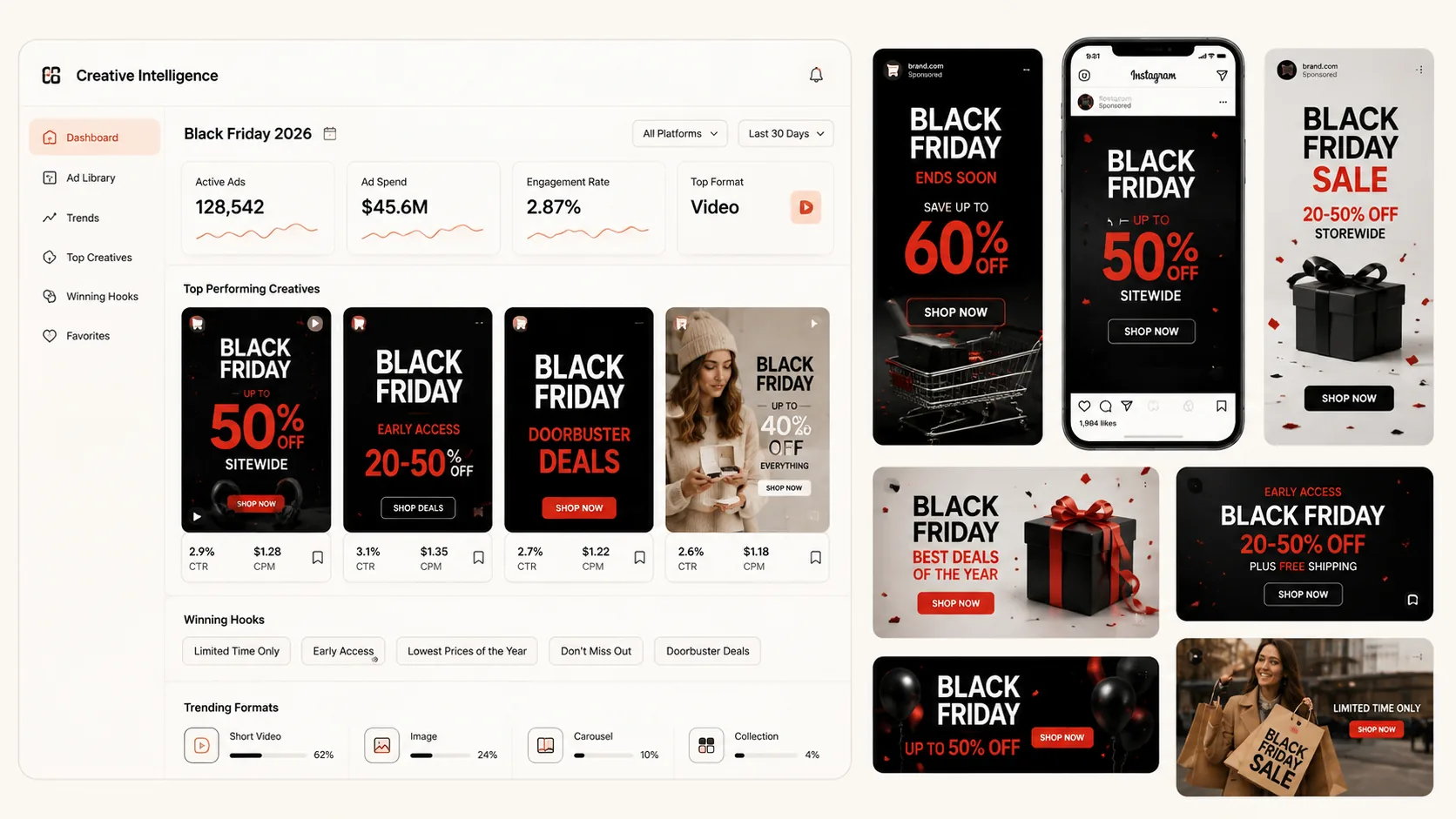
Proven Hooks are the creative angles, headlines, or visual formats that have survived multiple Q4 cycles. These are not accidents. Urgency-driven countdowns, social proof callouts, and sharp discount framing tend to resurface each year because they have proven resilience across different audience fatigue cycles. Identifying these patterns in advance means your creative team is building on validated foundations, not experimenting blind.
Knowing which hooks and formats perform is only half the equation. The other half is ensuring those creatives are built for the environment where the majority of clicks actually convert — and that is where mobile-first execution becomes the deciding factor.
Mobile-First Creative: The Dominant Conversion Driver for 2026
Mobile devices are no longer a secondary touchpoint for Black Friday shoppers — they are the primary battlefield where purchase decisions are made and lost in seconds.
As the previous section established, free tools leave critical data gaps that compound under Q4 pressure. Nowhere is that pressure more visible than on mobile. According to Adobe Digital Insights, mobile devices drove 55.2% of Black Friday online sales in 2026 — a threshold that reframes every creative decision a brand makes heading into BFCM. If your ads are not built for a five-inch screen first, you are engineering failure from the brief stage.
Mobile Hooks: Capturing Attention in Two Seconds
The mobile scroll is unforgiving. In practice, a creative that does not establish its core value proposition within the first two seconds tends to lose the viewer permanently. For Black Friday, that means front-loading the discount figure, the product, or the urgency signal — not building toward it. Text overlays need to be large, high-contrast, and readable without sound. And motion in the first frame is not a stylistic choice; it is a functional requirement for stopping a thumb mid-scroll.
Platform Nuance: TikTok vs. Instagram Reels for BFCM
These two platforms share a format but attract meaningfully different creative expectations. TikTok tends to reward raw, fast-cut, user-adjacent energy — polished studio content often underperforms against lo-fi demonstrations or reaction-style hooks. Instagram Reels, by contrast, tends to work better with slightly more produced visuals, especially for fashion, beauty, and home categories where aesthetic signals build purchase confidence. Effective ad intelligence for ecommerce treats these platforms as distinct channels with distinct creative briefs, not one asset repurposed across both.
Speed and Friction: The Ad-to-Cart Bottleneck
A high-performing mobile creative that routes to a slow or cluttered landing page is a wasted impression. Frictionless mobile checkout — pre-filled payment options, single-page flows, and shop-native checkout tools — directly affects the return on every dollar spent on creative production. The ad earns the click; the checkout experience determines whether that click converts.
Tracking creative trends across platforms also ensures visual consistency, so the brand identity a shopper sees on TikTok matches what they encounter at checkout — a continuity that builds trust under high-competition conditions. Getting these inputs right is where structured competitive research becomes essential, and the next section breaks down exactly how to build that workflow before committing your Q4 budget.
De-Risking Your Spend: The Competitive Research Workflow
Reducing wasted Q4 budget comes down to one discipline: building a repeatable competitive research workflow before a single dollar is committed to paid media.
The sections above established why mobile-first creative and ad intelligence tools are non-negotiable foundations. But intelligence is only valuable when it is organized into a clear sequence of decisions. Creative trend tracking without a structured workflow tends to produce scattered observations rather than actionable strategy. The four steps below convert raw competitive data into a defensible spend plan.
- Historical analysis of 2024 and 2026 winning creatives in your niche. Start by pulling the highest-engagement ads from the previous two Black Friday cycles within your category. Look for recurring visual patterns — countdown timers, percentage-off overlays, product-in-use imagery — and note which formats appeared most frequently among advertisers who ran campaigns continuously (a reliable proxy for profitability). Ads that ran for three or more weeks are rarely accidents; they are proof of positive return.
- Identifying spend outliers using ad intelligence tools. Once the creative landscape is mapped, isolate the outliers — advertisers whose estimated impression volume or run duration significantly exceeds category norms. These are the accounts worth reverse-engineering. Expert practitioners recommend examining not just what those ads say, but which placements and formats they favor, since heavy spend in a specific placement often signals discovered efficiency.
- Mapping competitor CTA strategies. A granular but frequently overlooked step is cataloguing the exact call-to-action language competitors deploy. The difference between “Shop Now,” “Get the Deal,” and “Claim Your Offer” is not cosmetic — each signals a distinct funnel stage and urgency level. Mapping these patterns across your niche reveals whether the category skews toward transactional or curiosity-driven copy, and gives you a clear choice: match the convention or deliberately break it.
- Validating product angles before committing high Q4 budgets. Use the intelligence gathered in steps one through three to pressure-test your own proposed angles. If no competitor has successfully run a “free shipping” lead message in your niche despite obvious incentive to do so, that absence is data. It may signal audience indifference — or it may signal an untapped gap. Either way, you are making an informed bet rather than an expensive assumption.
And this is precisely where timing compounds everything. Knowing which creative angles and CTAs are already winning tells you what to bring to market — but knowing when to bring them is an equally consequential decision, which is what the next section addresses directly.
Timing the Market: When to Launch Your Black Friday Adverts
The single most expensive mistake in Q4 media buying tactics is treating Black Friday as a single-day event rather than a multi-week conversion arc.
Experienced media buyers divide the season into two distinct phases. The Teaser Phase runs from early-to-mid October through the first week of November. This is where you build brand familiarity, seed wish lists, and capture the researchers — not the buyers. The Conversion Phase follows, shifting creative messaging from awareness to urgency as Thanksgiving week approaches. Each phase demands different creative formats, different bidding strategies, and different success metrics. Conflating them wastes budget at precisely the moment competitors are sharpening their edge.
The case for launching in October is straightforward. Research shows that roughly 45% of shoppers begin browsing for Black Friday deals well before November, which means brands that wait until mid-November are essentially invisible to nearly half their potential audience. And these early browsers are not passive window shoppers — they are actively shortlisting products and building purchase intent. Reaching them during the Teaser Phase at lower CPMs, before auction pressure intensifies, tends to produce a measurably lower blended cost-per-acquisition across the full Q4 window.
Budget pacing is where many otherwise well-planned campaigns collapse. As Thanksgiving Day approaches, auction competition spikes dramatically across every major ad platform. Brands that have spent aggressively in early November often find themselves with depleted budgets precisely when conversion rates peak. One practical approach is to hold 30–40% of your Q4 flight budget in reserve for the final 72-hour window, allowing you to stay competitive in auctions when rivals are burning through their remaining spend at inflated CPMs.
Real-time trend tracking adds a critical layer of flexibility during Conversion Phase week. Consumer sentiment shifts fast — a competitor drops an unexpected deal, a shipping deadline changes, or a product category surges in search volume. Monitoring platform-level trend signals mid-week allows you to pivot creative angles, adjust offer framing, or reallocate budget toward categories gaining traction. Static campaign plans built in September cannot account for conditions on the ground in late November.
Taken together, these timing decisions — when to enter the market, how to phase your messaging, and how to protect budget for peak moments — form the operational backbone that everything else in your strategy depends on. The next step is distilling these moving parts into a clear, repeatable framework for Black Friday dominance.
The Bottom Line: 4 Keys to Black Friday Ad Dominance
Knowing how to advertise for Black Friday effectively comes down to four compounding advantages — and missing even one of them hands budget directly to competitors who have figured them out.
The sections above have mapped the research workflow and the timing logic. What follows distills that thinking into the four principles that separate Q4 winners from brands that overspend and underperform. Each one is actionable before your next campaign goes live.
- Start early and capture pre-season intent. Roughly 45% of holiday shoppers begin browsing well before November, which means a launch strategy anchored to Black Friday week is already late. The brands that dominate Q4 run awareness creative in early October, retarget warm audiences through November, and reserve conversion-focused spend for the final push. Starting early is not about burning budget — it is about being present when purchase intent first forms, so your brand is the default choice by the time deals go live.
- Design every creative as a mobile-first experience. More than 55% of Black Friday traffic arrives on mobile devices, and ad creative built for desktop rarely translates cleanly to a smaller screen. Tight aspect ratios, front-loaded text, and thumb-stopping visual hierarchy are not optional refinements — they are baseline requirements. A creative that renders poorly on mobile is effectively invisible to the majority of your audience.
- Replace intuition with ad intelligence data. Successful Black Friday campaigns rely on evidence, not guesswork. Studying competitor hooks, offer structures, and creative formats before briefing your own team removes the guesswork that drains Q4 budgets. Proven patterns in the market are signals, not shortcuts — and ignoring them means paying a premium to discover what others already know.
- Target AI-referred shoppers deliberately. Shoppers arriving via AI-powered discovery channels convert at rates roughly 38% higher than average — a signal that this audience segment carries significantly stronger purchase intent. Structuring campaigns to intercept these users, through precise targeting and messaging that matches their research-ready mindset, is quickly becoming one of the highest-leverage moves in Q4 media buying.
And this is precisely where creative intelligence stops being a tactical advantage and becomes a structural one. The difference between a brand that applies these four principles and one that does not is not just performance — it is the entire margin of Q4 profitability.
Winning the Q4 Creative War with PrimeSpy
Creative intelligence is the unfair advantage that separates media buyers who scale profitable campaigns from those who burn budget chasing instincts during the most competitive retail window of the year.
The previous sections have mapped the full terrain: CPMs spike weeks before Black Friday, creative fatigue kills momentum faster than poor targeting, and the brands that win are the ones who arrive prepared. But preparation without intelligence is still guesswork. Browsing the Meta Ad Library manually surfaces what is running — it does not tell you what is working, how long an ad has been active, or which formats are driving enough engagement to justify a competitor’s continued spend. That gap between visibility and insight is exactly where most Q4 strategies quietly fall apart.
PrimeSpy directly bridges that gap. Rather than forcing you to interpret raw ad data and draw your own conclusions, it surfaces the signal underneath the noise — revealing which creatives have staying power, which offers are resonating across your vertical, and when competitors began scaling specific angles. In practice, that intelligence compresses weeks of creative testing into days. You stop launching Q4 campaigns with untested concepts and start launching with validated frameworks that already have market proof behind them.
The shift from guessing to spying is not a minor tactical upgrade; it is a structural change in how you approach Black Friday advertising strategy. Media buyers who monitor the competitive creative landscape before and during the campaign window consistently enter bids with higher confidence, tighter creative briefs, and faster iteration cycles. According to expert campaign analysis, brands that invest in pre-season research and creative preparation significantly outperform those that react in real-time. Reaction is expensive in Q4. Preparation compounds.
You now have the framework. The next move is to stop theorizing and start seeing exactly what your competitors are running — before they outspend you into irrelevance. Start your free PrimeSpy trial today and walk into Black Friday with the intelligence advantage your Q4 budget deserves.