See Every Market Like a Local: The Proxy Network Behind Modern Ad Intelligence
- Author
- PrimeSpy Research Team
- Published
- Oct 7, 2026

Summary: This article explains how different proxy types help researchers observe local markets, then explores how PrimeSpy’s ad intelligence and Dexodata’s geo-targeted network work together.
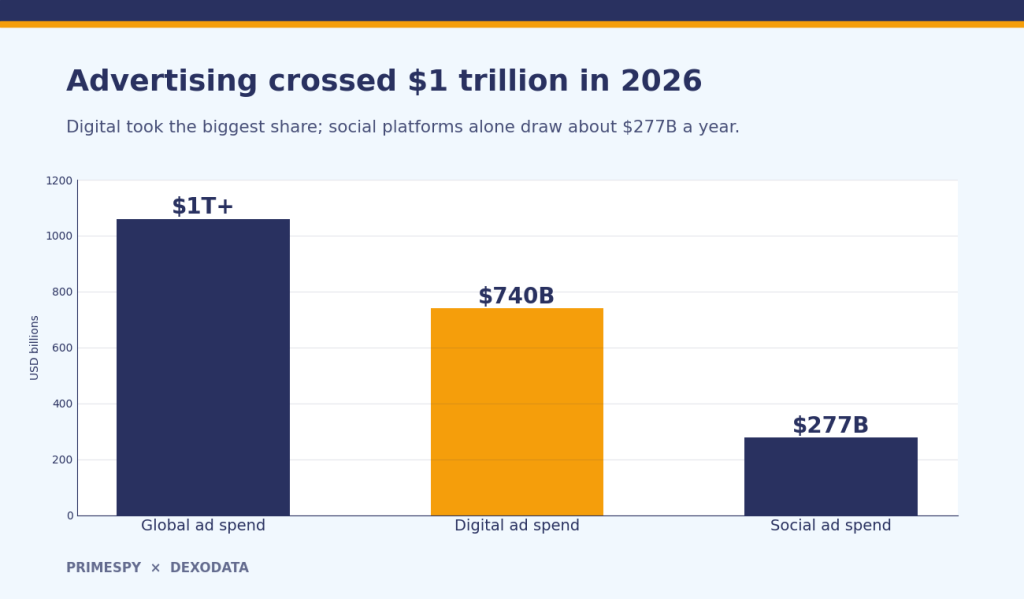
In 2026, global advertising spend crossed $1 trillion for the first time, and digital took the lion’s share – roughly $740 billion, with social platforms alone drawing about $277 billion a year. Behind those numbers sits a quieter shift: algorithms now decide what each person sees, so the same brand can run different creatives, offers, and prices in every country and on every device. For media buyers and marketers, that turns competitive ad research from a nice-to-have into a survival skill, and the intelligence you gather is only as good as the vantage point you gather it from, which is your IP address.
Test the network before you scale
Before committing budget, you can put the network to the test.
One-time promo code PRIMESPY – 10% off your port purchase (until September 28, 2027).
New Dexodata users get a free $1 starting balance and a 25% bonus on the first deposit, and because pricing is Pay-As-You-Go on a tokenized balance, there is no fixed monthly plan to sign up for – spend simply follows real usage. It is a low-risk way to check the exact markets and account setups you need before scaling.
Ad research has gone global – and personal
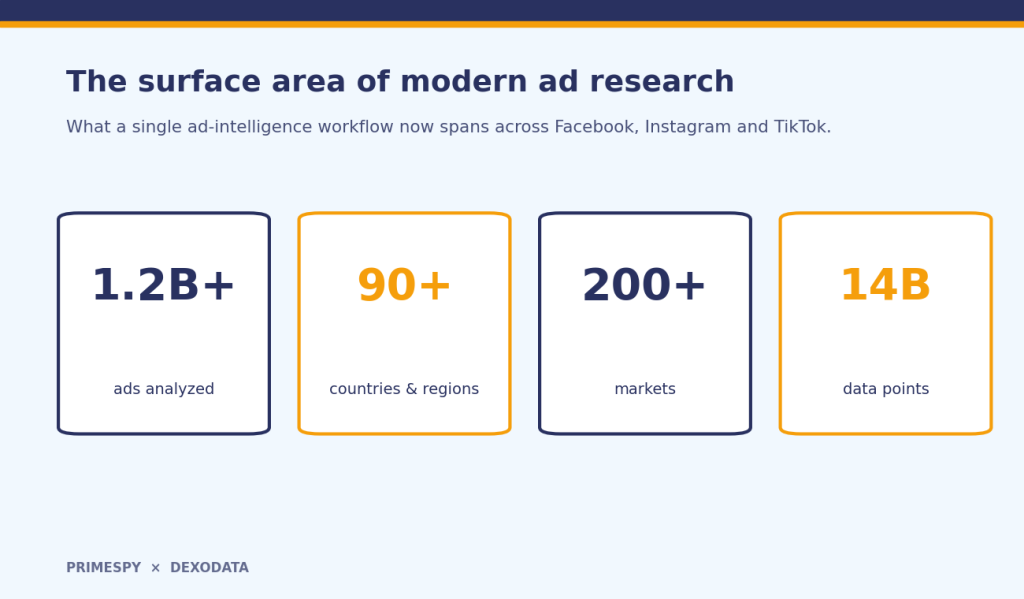
Modern ad-intelligence tools exist because the surface area is enormous. A platform like PrimeSpy analyzes more than 120 million ads across 90+ countries and 200+ markets, turning 14 billion data points into a single research workflow that surfaces winning creatives, competitor angles, and rising products across Facebook, Instagram, and TikTok. The scale is real: Instagram and Facebook each host more than 200 million business accounts, and worldwide social ad spend now grows by over $5 billion every week.
The problem is that this ocean of advertising is personalized. Ad libraries, feeds, and landing pages are served by geography, language, device, and even network. The offer a competitor shows in the United States is often not the one they show in Brazil or Germany, and some of it is gated or throttled by region entirely. So what a researcher actually sees depends on where their connection appears to originate.
Why your IP is your vantage point
Research from a single country’s datacenter IP and you see one distorted slice: the wrong market, a limited view, or a decoy served to traffic that looks automated. To see what competitors run in a given market, you have to appear as a genuine local user there.
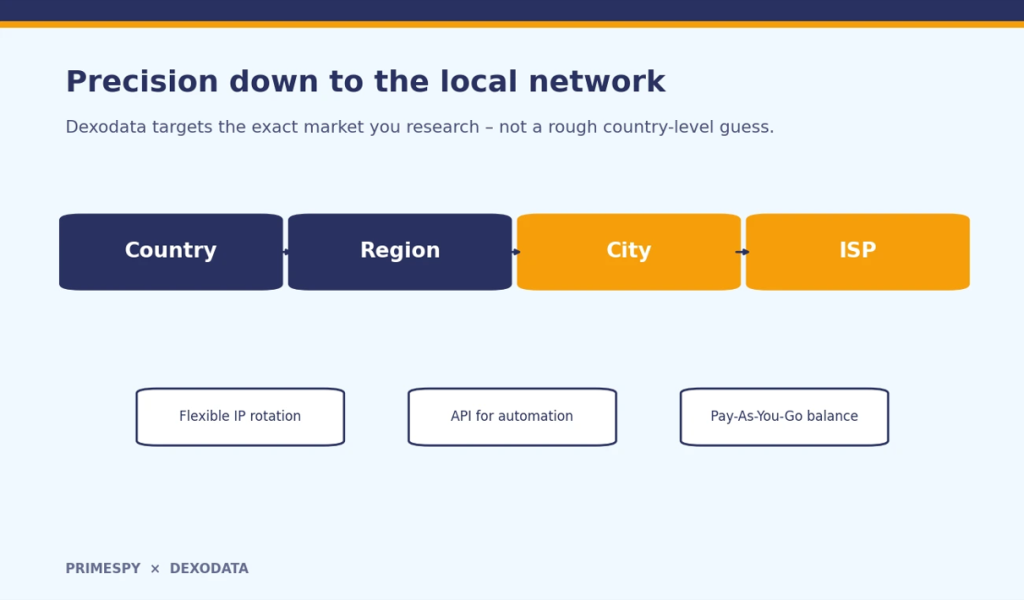
This is where the network layer comes in. Dexodata is a global proxy ecosystem built on a consent-based network, with extensive IP coverage worldwide. It is an advanced proxy ecosystem that combines modern routing technologies, precise geotargeting, and full control over network traffic: geotargeting reaches down to country, region, city, and provider (ISP), so a connection matches the exact market you are researching instead of a rough country-level guess. Explore the network at Dexodata.
One network, every proxy type
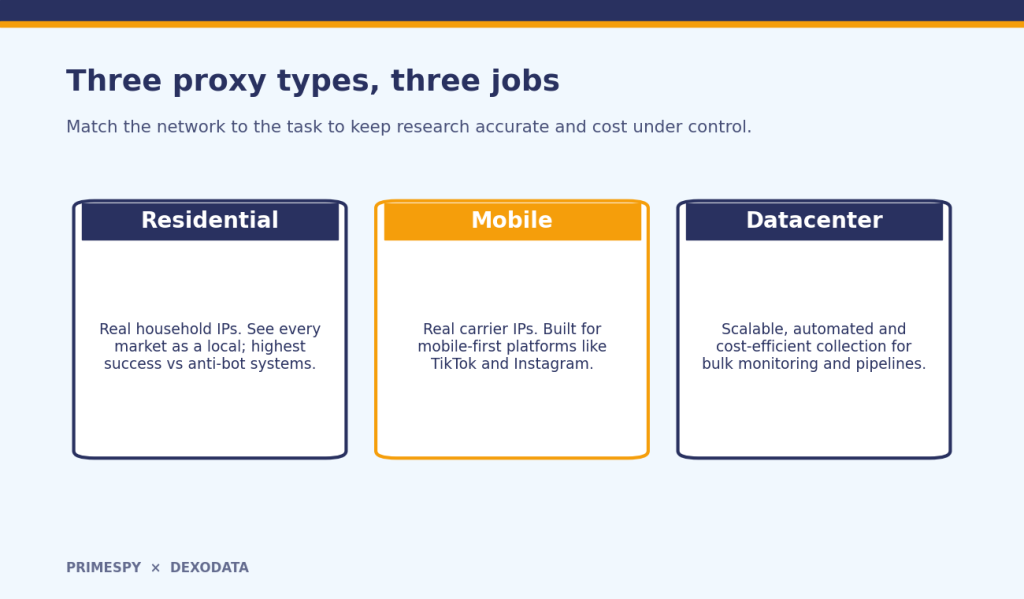
Not every task needs the same connection, and matching the type to the job keeps research accurate and cost under control:
- Residential IPs route through real household connections, so you see ads, libraries, and landing pages exactly as a local user does. They also carry the highest success rates against anti-bot systems, which makes them the default for serious competitive research.
- Mobile IPs reflect real carrier connections, essential on mobile-first platforms like TikTok and Instagram, where most ad experiences and most of the personalization happen on a phone.
- Datacenter IPs are the choice for scalable, automated, and cost-efficient collection: bulk monitoring, large data pulls, and pipeline work where volume and price matter most.
Around this, Dexodata adds flexible IP rotation, an API for automation, VPN compatibility (WireGuard) and Xray support, and a built-in firewall with customizable domain allowlists and blocklists – enough for a small team to run many parallel research sessions and control exactly where proxy traffic can go.
The internet you research isn’t neutral
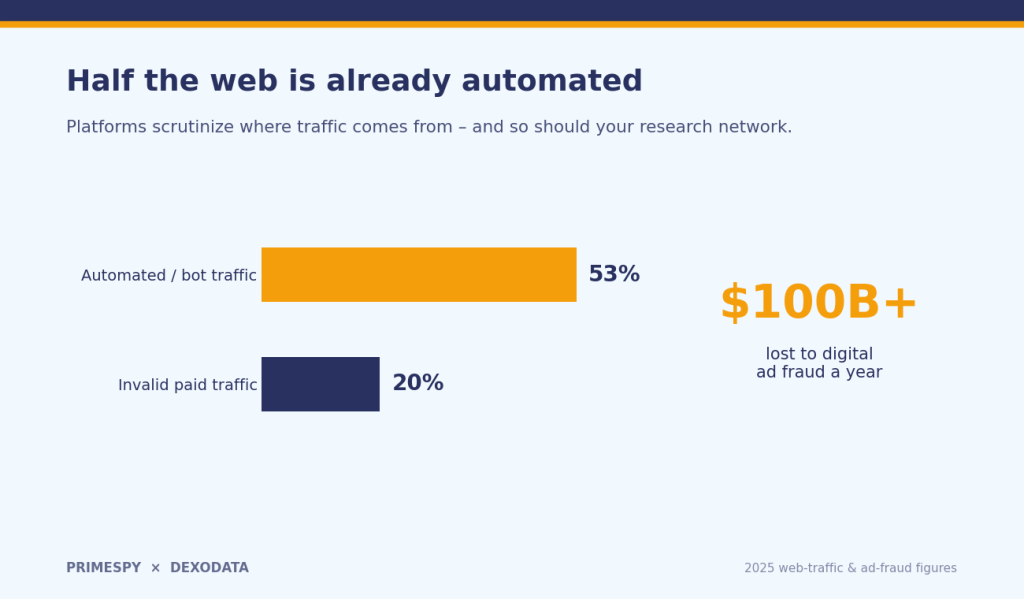
There is a reason platforms scrutinize where traffic comes from. Automated traffic now makes up more than half of everything moving across the web – over 53% in 2025 – and digital ad fraud is on track to drain more than $100 billion a year, with roughly a fifth of all paid traffic invalid. Anti-bot and anti-fraud systems respond by weighing IP reputation, geo consistency, and network origin on every request. That cuts both ways: in research, a suspicious or mismatched IP gets you blocked or fed a decoy; at launch, the same signal gets your campaign flagged. A geo-accurate, accountable network is what keeps both sides legitimate and lets you stand behind where your traffic comes from, which matters as platforms and payment partners tighten their own due diligence.
From insight to launch
Research is only half the loop. Tools like PrimeSpy earn their place by doing what the native Meta Ad Library cannot: tracking competitors after you find the ads worth watching, comparing advertisers and placements in one view, and filtering by CTA, landing page, reach, spend, and twenty-plus other dimensions to spot rising products before they peak. But acting on those findings means running your own campaigns and accounts, often many of them, across markets.
That is where the network decides how far you scale. Each account needs its own trusted, local IP so accounts don’t read as linked, and delivery has to match the GEO you actually bought. Residential and mobile IPs give every account a stable local presence, and the API folds rotation and management into your existing stack, so scaling many campaigns does not become a manual chore.
PrimeSpy and Dexodata: the full loop
Put simply, PrimeSpy answers what is working, and Dexodata answers how to see it accurately and act on it at scale. One reveals the winning ads, angles, and products across markets; the other gives you the network to observe every one of those markets like a local, then to launch against them without the network becoming the weak link. For e-commerce and DTC teams, dropshippers, app and game marketers, and arbitrage buyers alike, that combination turns scattered competitive signals into campaigns that actually ship.
Conclusion
In a trillion-dollar, algorithm-driven ad economy where automated traffic already outnumbers humans, two things quietly decide outcomes: the vantage point you research from, and the network you launch from. Pairing PrimeSpy’s ad intelligence with Dexodata’s geo-accurate network is how research becomes advantage – every market seen like a local, every campaign scaled on a network built to pass as real. New users can start with a free $1 balance and a 25% bonus on the first deposit, and partners earn from 5% to 12% on every referred payment through the RevShare program. Get started at Dexodata.
Frequently Asked Questions
Why do you need proxies for competitive ad research? Ads, ad libraries, and landing pages are personalized by geography, device, and network, so what you see depends on where your connection appears. Proxies let you view each market as a genuine local user instead of one distorted slice from a single location.
Which proxy type is best for viewing competitor ads – residential, mobile, or datacenter? Residential IPs are the default for accurate research because they see pages as a local user does and hold the highest success rates against anti-bot systems. Mobile IPs suit mobile-first platforms like TikTok and Instagram, while datacenter IPs fit scalable, automated, cost-efficient data collection.
How does geotargeting down to the provider (ISP) help ad research? Provider-level targeting lets a connection match the exact market you are researching, from country and region to city and ISP, rather than a rough country-level guess, so the ads and offers you see reflect what real local users are served.
Can I use Dexodata to run campaigns after finding winning ads with PrimeSpy? Yes. Once PrimeSpy surfaces the winning ads and angles, Dexodata’s residential and mobile IPs give each ad account its own trusted local presence and geo-matched delivery, with an API to automate rotation and management across many campaigns.
Is there a way to test Dexodata before committing budget? Yes. New users can try the network on a starter balance, and Pay-As-You-Go pricing on a tokenized balance means spend follows real usage rather than a fixed monthly plan, so you can validate the markets you need at low risk.
What extra control does Dexodata give over proxy traffic? Beyond geotargeting and flexible rotation, Dexodata offers an API for automation, VPN compatibility (WireGuard) and Xray support, and a built-in firewall with customizable domain allowlists and blocklists, so you decide exactly where proxy traffic can and cannot go.