10 Facebook Ads A/B Testing Strategies That Actually Work: A Beginner’s Scale-Up Guide
- Author
- PrimeSpy Research Team
- Published
- Sep 15, 2026

Summary: Facebook Ads A/B testing works best when each experiment isolates one meaningful variable and runs long enough to produce reliable signals. The article covers creative, copy, CTA, bidding, placement, audience, hook, and landing page tests, helping beginners run cleaner Meta ad experiments, avoid noisy data, and scale stronger campaigns.
The Foundations of Effective Facebook Ads A/B Testing
Running Facebook Ads without A/B testing is like navigating without a map — you’re spending real budget on assumptions instead of evidence.
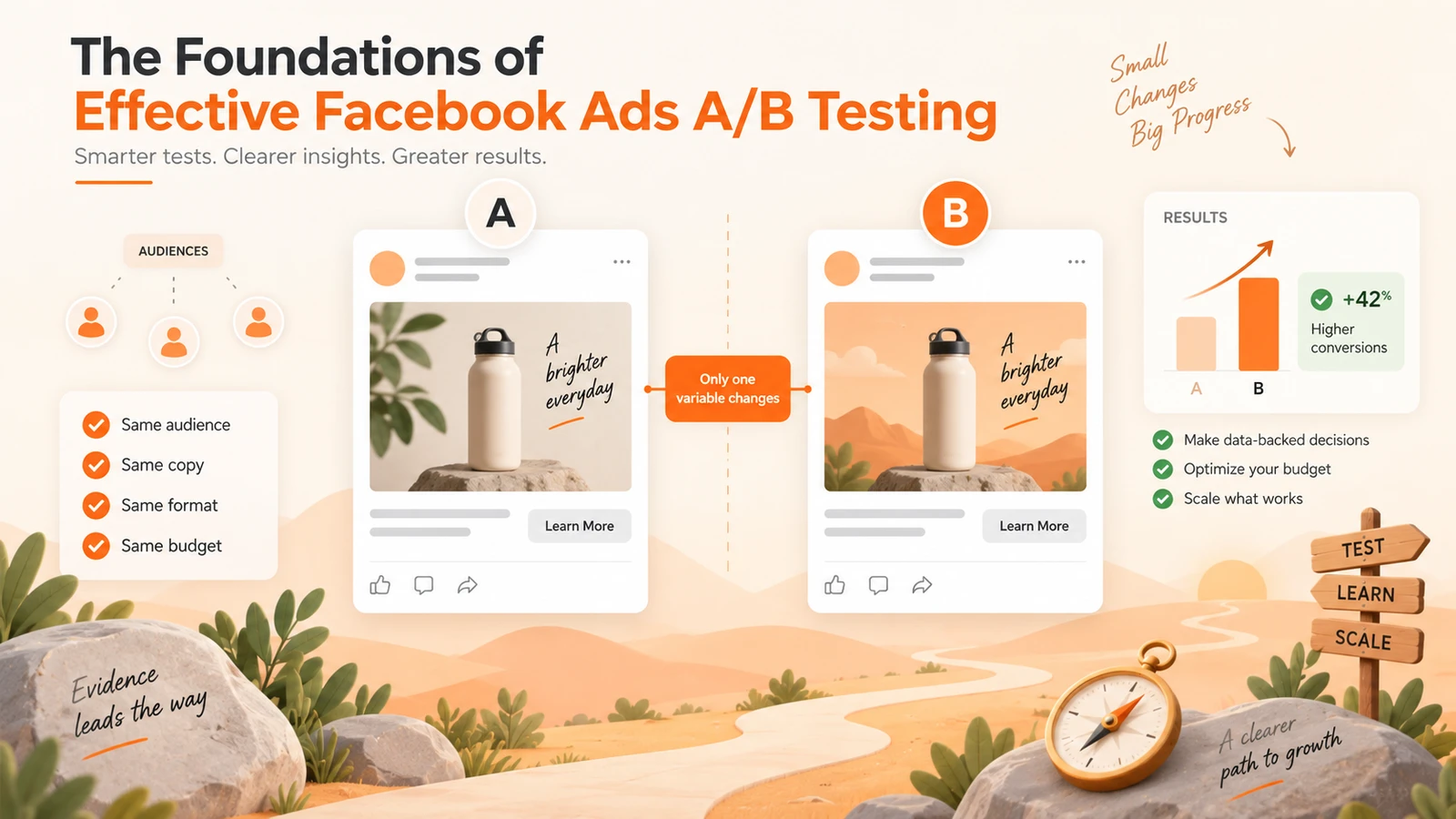
Meta ads A/B testing, often called split testing, works on a simple principle: compare two versions of an ad with exactly one variable changed. Same audience, same budget, same timing — just one element different. That controlled isolation is what makes results meaningful rather than coincidental.
So, is it worth it? Absolutely. Knowing how to test Facebook Ads properly protects your budget from slow, invisible leaks. Instead of running a campaign for weeks only to wonder why performance dropped, you’re building a feedback loop that tells you _what’s working and why_. For beginners especially, that clarity is invaluable.
When getting started, you have two main paths. Meta’s native A/B testing tool automates audience splitting and reduces overlap, making it the safer choice for most beginners. Manual ad set testing offers more flexibility but requires closer oversight. And browsing the Facebook Ads Library can give you useful creative benchmarks before you even launch a test.
The single most important rule — call it the Golden Rule — is this: test only one element at a time. Change two things simultaneously and you’ll never know which variable drove the result.
That discipline sets the stage for everything you’ll learn next, starting with which variables actually move the needle.
Core Variables: What to Test First for Maximum Impact
The variables you choose to test first inside Facebook Ads Manager determine whether you extract real insight or just burn budget — so start with the elements that move the needle most.
Creative format is typically the highest-leverage starting point. A video thumbnail versus a static image can produce dramatically different click-through rates for the same audience, simply because one format stops the scroll more effectively. This matters especially in placements like Facebook Ads Instagram Stories, where full-screen visuals compete hard for attention.
Copy length is the next logical variable. Short-form “hook” text — a punchy single line — often outperforms in cold audiences who don’t yet know your brand. Long-form storytelling tends to convert better further down the funnel, where trust is already forming. Testing both against the same creative reveals which approach your specific audience actually responds to, not which one feels right.
CTA buttons are surprisingly underestimated. “Shop Now” signals purchasing intent and works best at the bottom of the funnel; “Learn More” reduces friction for users still in discovery mode. Swapping one for the other on an otherwise identical ad can shift your conversion rate without touching a single pixel of creative.
Headlines follow a similar logic. Benefit-driven headlines (“Save 30% on Your First Order”) perform reliably for warm audiences who understand the offer. Curiosity-based hooks (“Most Brands Won’t Tell You This”) can outperform with cold traffic by creating an information gap. The right choice depends on where someone sits in your funnel — and only a structured test will tell you which applies to your audience. Once you’ve identified your winning creative and copy variables, the next question becomes how much to spend, and how to bid — which is exactly where the real scaling decisions begin.
Technical Parameters: Bidding and Budgeting Strategies
Understanding Facebook Ads cost before you launch a test is what separates advertisers who scale efficiently from those who exhaust their budget on inconclusive data.
Bid strategy is one of the most underleveraged test variables for beginners. The choice between Highest Volume (formerly lowest cost) and Cost Cap shapes your entire delivery pattern. Highest Volume maximizes results within your budget but lets costs fluctuate. Cost Cap enforces a ceiling, stabilizing acquisition costs — at the expense of reach when supply tightens. Testing both against the same creative gives you a clear read on which model fits your margin requirements.
Budget minimums matter more than most guides admit. A $10/day budget sounds accessible, but it rarely generates the statistical significance needed to trust your results. In practice, plan for at least $50–$100 per variant, per test, before drawing conclusions. That figure shifts depending on your conversion rate and average order value — but underfunding a test is one of the fastest ways to act on noise instead of signal.
Placement testing rounds out your technical setup. Reviewing samples of Facebook Ads across formats reveals that performance varies dramatically by placement. Advantage+ Placements lets Facebook’s algorithm distribute spend across surfaces automatically, often lowering costs through broader inventory access. Manual selections — Instagram Stories only, for example — can outperform when your creative is purpose-built for that format. Testing both reveals whether algorithmic flexibility or format precision better serves your campaign goals, a question that sets up naturally into deeper creative strategy work ahead.
Advanced Audience and Creative Testing Strategies
Testing audience temperature — cold, warm, and hot traffic — is one of the highest-impact strategies you can apply before touching anything else in your Facebook Ads account.
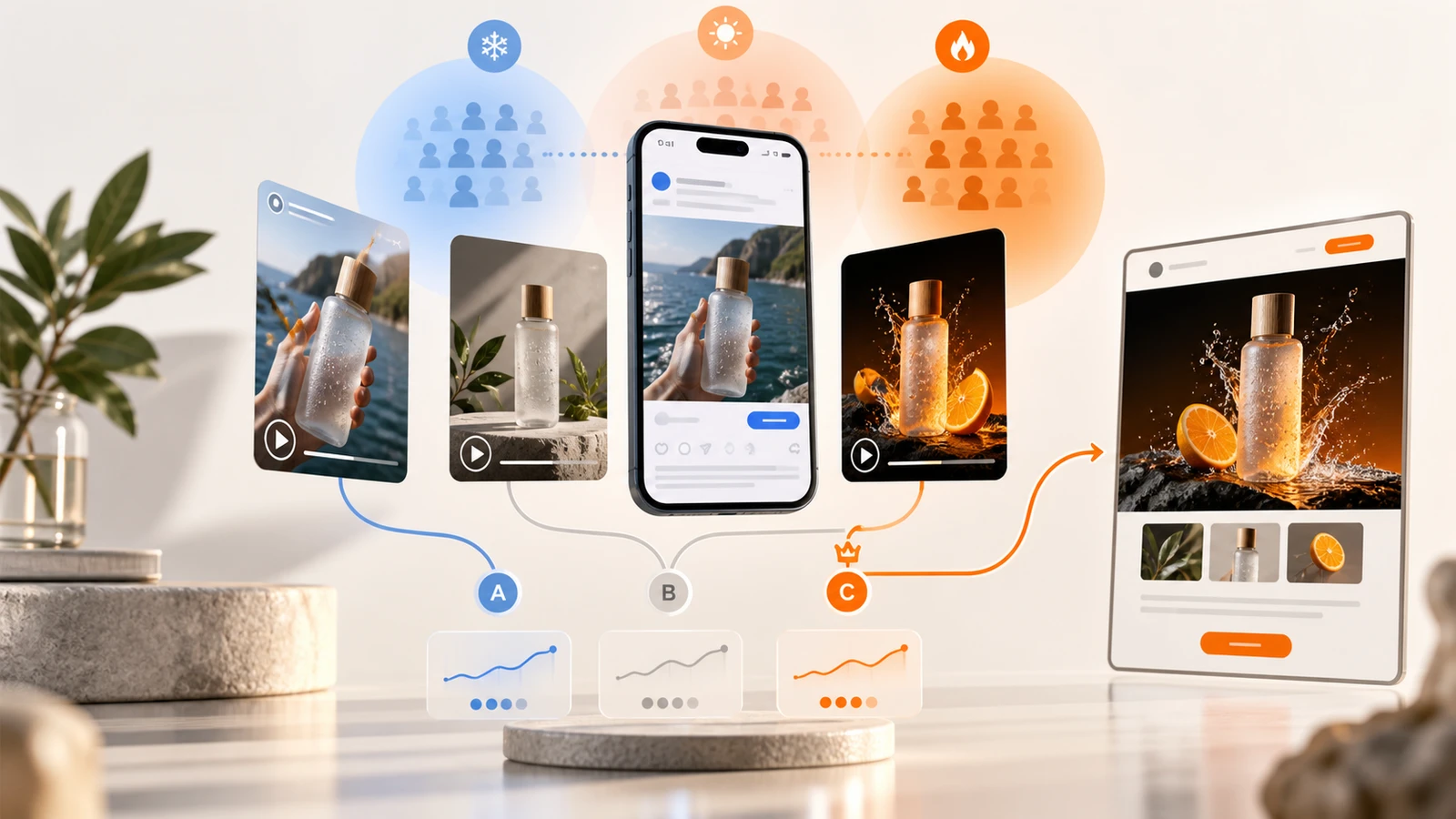
Cold audiences have never heard of your brand. Warm audiences have interacted with your content. Hot audiences are past buyers or recent website visitors. Each group carries a different intent level, which means the same ad creative can perform brilliantly for one segment and fall completely flat for another. Structuring your tests around audience temperature gives you a framework that actually explains _why_ something worked, not just _that_ it worked.
The Facebook Ads Library is an underused resource for creative research. Browsing Facebook Ads examples from competitors in your niche reveals patterns in headlines, offers, and visual formats that are already resonating with similar audiences. Pay attention to ads that have been running for weeks or months — longevity signals that a creative is profitable, not just pretty. This is especially useful when you’re building out a Facebook Ads interest list and need to understand which messaging angles align with specific audience segments.
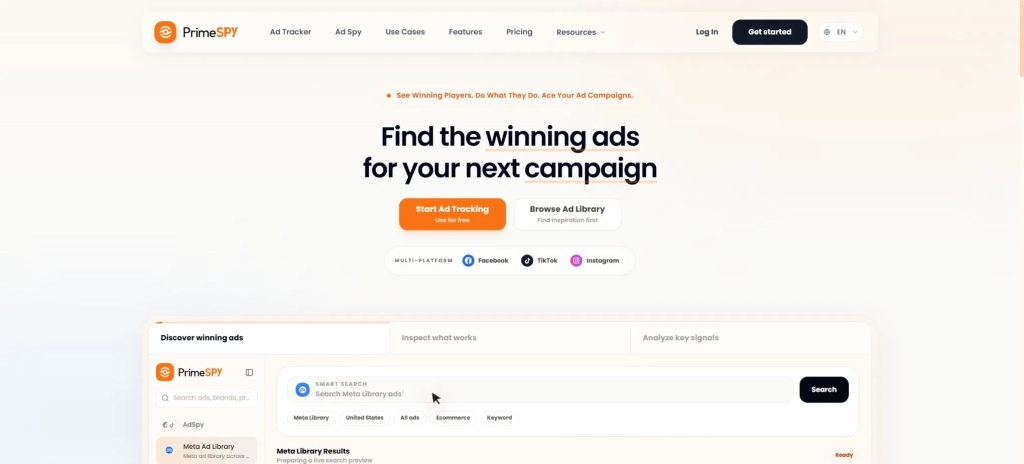
PrimeSpy is another useful resource for Facebook ad research. It helps advertisers discover competitor ads, analyze creative patterns, and find promising products and markets before spending on their own campaigns. Using these insights alongside A/B testing can make creative decisions more informed and efficient.
Once you’ve identified promising creative angles, test your landing pages alongside your ads. The post-click experience has to match the promise the ad makes — a disconnect here silently kills conversions regardless of how strong your creative is.
And finally, prioritize ruthlessly. Testing for the sake of testing wastes budget and muddies data. Focus on variables with the highest potential impact — offer framing, audience temperature, and landing page alignment — before moving into nuanced details. That discipline sets you up perfectly for the next layer of optimization: how you segment audiences and structure your funnel to capture buyers at every intent level.
Audience and Funnel Segmentation
Audience segmentation is where Facebook ads A/B testing moves from tactical to truly strategic — and where small structural decisions compound into major efficiency gains.
Broad vs. interest-based targeting is the first fork in the road. Broad targeting lets Facebook’s algorithm find buyers within a wide pool, which often works well once a campaign has sufficient conversion data. Interest-based targeting — built from your Facebook Ads list of interests — gives the algorithm guardrails, which helps early on when the pixel is still learning. Testing both in parallel reveals which approach your specific offer responds to.
Lookalike audience percentages deserve their own dedicated test. A 1% Lookalike closely mirrors your best existing customers, while a 5% Lookalike sacrifices some relevance for dramatically broader reach. The sweet spot varies by niche and budget, so running both simultaneously with equal spend is the only reliable way to find it.
Retargeting windows close the loop. A 7-day website visitor audience captures high-intent users still actively considering a purchase. A 30-day window casts a wider net but includes users whose interest has cooled. Testing these windows separately — using Facebook Ads transparency tools to audit what each audience actually sees — often reveals that 7-day audiences convert at a lower cost per acquisition, though 30-day pools can still produce profitable results for higher-consideration purchases. Once you’ve locked in your strongest audience structure, the next performance lever shifts to what those audiences actually see — which means it’s time to examine creative from the very first frame.
Creative Iteration and Hooks
Creative variables — not audience settings or interest targeting Facebook ads — are often the fastest lever you can pull to move performance metrics in your favor.
The 3-second hook test is one of the most underutilized tactics in the creative playbook. Swap only the opening frames of a video while keeping everything else identical. A static product shot versus a person speaking directly to camera can produce dramatically different retention rates — and retention drives everything downstream, from watch time to conversions.
UGC vs. professional studio assets is another high-impact variable worth isolating. Polished creative signals brand credibility; raw, authentic UGC often signals relatability. Which wins depends entirely on your demographic. Younger audiences frequently respond better to UGC, while higher-ticket or B2B-adjacent products may convert more reliably with structured, studio-quality visuals.
Color and contrast deserves its own test entirely. Bold, high-contrast visuals interrupt the scroll; muted, lifestyle-feeling images blend into the feed and can feel more native. When you’re running Facebook automated ads through Meta’s creative optimization tools, the system will favor whichever asset drives engagement — but only if you’ve given it genuinely different creative signals to learn from. Feed it variety, not variations of the same concept.
Once you’ve identified your strongest creative directions, you’re ready to think about how to structure the test itself — the methodology that keeps your results clean and actionable.
Methodology: How to Execute a Clean Split Test
Split testing Facebook campaigns cleanly is less about button-clicking and more about disciplined decision-making before the test even launches.
Getting the mechanics right matters enormously. When you’re doing AB testing in Facebook, small setup errors — like splitting budget unevenly or running tests across different time windows — can corrupt your results entirely. Here’s how to structure a clean test from the start.
Setting up in Meta Ads Manager follows a logical sequence: navigate to the Experiments tool, select “A/B Test,” choose your variable (audience, creative, or placement), then duplicate your ad set so each variant runs under identical budget and schedule conditions. Meta isolates audiences automatically to prevent overlap at this stage.
Test duration is one of the most overlooked variables. The standard window is 7–14 days, specifically because it captures at least one full weekly conversion cycle — purchase behavior on Mondays looks nothing like Saturdays, and a 3-day test misses that entirely.
Choosing your primary KPI depends on funnel position. CTR works well for top-of-funnel creative tests; Cost Per Result suits middle-funnel comparisons; ROAS is the right signal for bottom-funnel, purchase-optimized campaigns.
Statistical confidence is where many beginners act too early. A result isn’t actionable until it reaches roughly 95% confidence — meaning there’s only a 5% chance the outcome is random noise. Meta’s Experiments tool surfaces this figure directly. Until you hit that threshold, what you’re seeing may be coincidence rather than causation.
Even a perfectly executed test can still go wrong — and the next section breaks down the most common failure modes that quietly undermine results.
Common Failure Modes and How to Fix Them
Even a well-structured Facebook ads optimization effort fails when the underlying test is contaminated by avoidable mistakes that distort your data before you’ve had a chance to act on it.
Overlapping audiences are one of the most expensive traps. When two ad sets target the same pool of users — whether through broad demographics or shared facebook ads targeting interests — Meta’s auction system forces them to compete against each other. Your costs inflate, your results blur, and you walk away with data that reflects internal bidding friction rather than true creative or audience performance. The fix is straightforward: use audience exclusions religiously, and lean on Meta’s built-in A/B test tool, which creates mutually exclusive splits by default.
Premature optimization is the second killer. Pulling the plug on a test after 48 hours because one variant looks weaker is a beginner mistake with real budget consequences. Impressions need to accumulate — most practitioners recommend waiting until each variant has reached statistical significance before drawing any conclusions. Patience isn’t passive; it’s a discipline.
Testing low-impact variables wastes runway. Swapping a single word inside a body paragraph almost never produces a measurable lift, especially early in your testing program. Prioritize variables with genuine visual or structural weight — the hero image, the headline, the call-to-action button — before you fine-tune copy at the sentence level.
Finally, don’t overlook Meta’s Learning Phase. Every new ad set enters a period where the algorithm is actively exploring delivery — results during this window are inherently unstable and shouldn’t be treated as final verdicts. Editing an ad set mid-learning resets the clock entirely, compounding the distortion. Understanding this cycle is foundational to reliable A/B testing on the platform.
These failure modes are fixable — but they’re also a reminder that clean testing has real structural limits worth understanding before you scale.
Limitations, Considerations, and Trade-offs
Facebook ads split testing is a powerful tool, but it carries real costs and constraints that every advertiser should factor in before committing budget to structured experiments.
Budget thresholds matter. If you’re spending less than roughly $50–$100 per day, traditional facebook ad experiments may not generate enough data to reach statistical significance before your runway runs out. Small audience sizes compound this problem — a segment of fewer than 50,000 users often can’t support two meaningful variations simultaneously without cannibalizing delivery. In those situations, running a single optimized ad and iterating over time is a more practical path forward.
The cost of learning is real. Every split test means allocating a portion of your budget to gathering data rather than driving conversions. Think of it as paying tuition — necessary, but it needs to be planned for. Rushing a test to cut costs is what leads to the inconclusive results discussed in the previous section.
Platform-level constraints have also shifted the landscape. Apple’s iOS 14+ privacy changes reduced the accuracy of pixel-based tracking and shortened reliable attribution windows, which means some conversion signals that structured tests depend on are noisier than they used to be. This doesn’t make testing obsolete, but it does mean you should treat results directionally rather than as absolute truth.
Dynamic Creative is worth considering as an alternative when audience size or budget won’t support a clean split. Rather than running discrete variations, Dynamic Creative lets Facebook automatically serve combinations of headlines, images, and copy — surfacing top performers without requiring formal test structure. It’s less precise, but it’s more forgiving under constrained conditions.
With these trade-offs in mind, the patterns that actually move the needle start to become clearer — and that’s exactly what the takeaways ahead will consolidate.
Key Takeaways: Summary for Scaling Success
Disciplined Facebook ads A/B testing comes down to four principles that compound over time: test one variable, prioritize high-impact creative and audience experiments, respect your data window, and scale what wins.
After covering failure modes and trade-offs in earlier sections, the pattern is clear. Messy tests produce confusing data. Clean tests produce leverage.
Here’s what to carry forward:
- One variable at a time. It’s the only way to know what actually moved the needle.
- Lead with creative and audience temperature tests. These consistently deliver the biggest ROI shifts in Facebook ads A/B testing.
- Run tests for at least 7 days. Daily budget fluctuations and algorithmic learning phases will skew shorter windows.
- Scale deliberately. Use winning data to expand horizontally into new ad sets, or vertically by increasing budget — but not both simultaneously.
Questions like _how much do Facebook ads cost_ often overshadow the more important question: how efficiently can you spend what you have? Rigorous testing answers that. As you build this practice, knowing where to find authoritative benchmarks and updated platform documentation becomes just as valuable as the strategies themselves.
Where to Look Next
The fastest way to sharpen your Facebook ads A/B testing skills is to go straight to the source — then layer in the statistical context that most beginner guides skip.
Start with the Meta Business Help Center for the latest technical updates on how to split test Facebook ads inside Ads Manager, since the platform’s tools evolve frequently. For Facebook ads creative testing benchmarks, cross-reference industry-standard reports specific to your e-commerce or app category — generic averages rarely reflect your actual audience. And if data confidence still feels murky, a foundational statistics textbook will clarify concepts like sample size and significance far better than any blog post can.