How to Start an Ecommerce Business: A Data-Driven Performance Strategy
- Author
- PrimeSpy Research Team
- Published
- Aug 26, 2026

Summary: Learn how to start an ecommerce business with a data-driven launch strategy. The article covers niche validation, business setup, unit economics, storefront optimization, creative testing, and low-budget ad tests to help founders validate demand before scaling.
Key Takeaways
- What validation actually buys you
- Select your selling platform based on audience behavior, not brand familiarity.
- Optimize each product page around the creative hooks your competitors are already proving.
- Build a minimum of three ad creatives per offer before launch.
- Launch smoke tests at $10–$20 per day per ad set to validate the offer before scaling.
Step 1: Validate Your Niche with Competitive Ad Intelligence
Most people approach learning how to start an ecommerce business by chasing personal passion — building around what they love rather than what the market is already buying. That instinct is understandable, but it is also one of the most common reasons new stores stall before gaining traction. Data-driven niche validation flips that script entirely, grounding your entry point in observable demand rather than guesswork.
The core principle: competitive ad intelligence reveals which products are already generating spend, which creative hooks are resonating, and whether a viable audience exists before you commit a single dollar to inventory or ads. And with the global B2B ecommerce market projected to grow at a 14.5% CAGR through 2026, understanding whether your niche skews toward business buyers or consumers is no longer optional — it shapes every structural decision that follows.
Work through the steps below in order. Each one builds directly on the last.
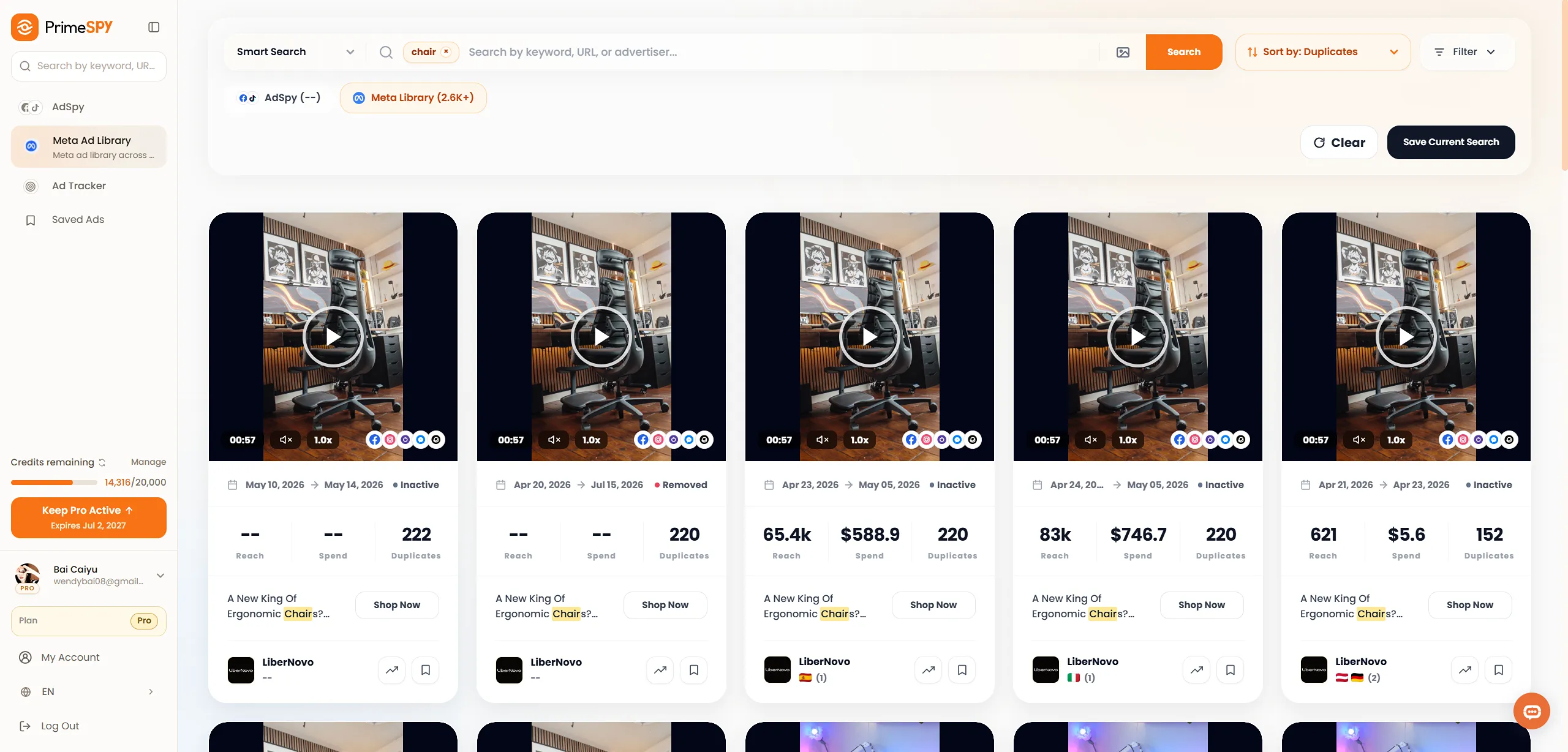
- Open an ad intelligence platform and search your target product category. Filter results to display active ads only, sorted by reach or impressions. You want signals of current spend, not historical noise.
- Sort by “duplicate count” — the number of times an ad creative has been copied or re-run across accounts. A high duplicate count is a reliable signal that the creative hook is converting. Advertisers do not scale losing ads.
- Identify the top three to five creative patterns in your niche. Note the headline formats, offer structures, and visual styles that appear repeatedly. These patterns reveal what the market responds to, not what you think it should respond to.
- Estimate competitor spend and reach by reviewing ad run-length alongside impression volume. Longer-running ads with broad reach confirm sustained demand — a niche with one viral moment is very different from one with consistent advertiser investment.
- Map the buyer type behind the demand. Consumer-focused niches typically feature emotional hooks and impulse price points, while business-oriented niches emphasize ROI, volume discounts, and operational outcomes. Recognizing this distinction now will inform decisions about business model and legal structure.
- Score each niche candidate against three criteria: advertiser density (competition exists, but it is not monopolized), creative diversity (multiple hooks are working, not just one), and buyer-type clarity (you can describe your customer precisely). Only proceed with niches that pass all three.
What validation actually buys you is the confidence to invest — in branding, in product sourcing, in paid traffic — with market evidence behind every decision. Once your niche is validated and you understand whether it leans B2B or B2C, the next critical move is formalizing how your business operates and protects itself legally.
Step 2: Define Your Business Model and Legal Framework
Once you have validated demand using competitive ad intelligence, the next step is converting that market insight into a concrete structure for your ecommerce business. That means choosing how you will sell, how you will fulfill orders, and how you will protect yourself legally. Getting this foundation right before you spend a dollar on inventory saves you from costly reorganization later.
Work through the following steps in order to establish a legally sound, operationally ready business model.
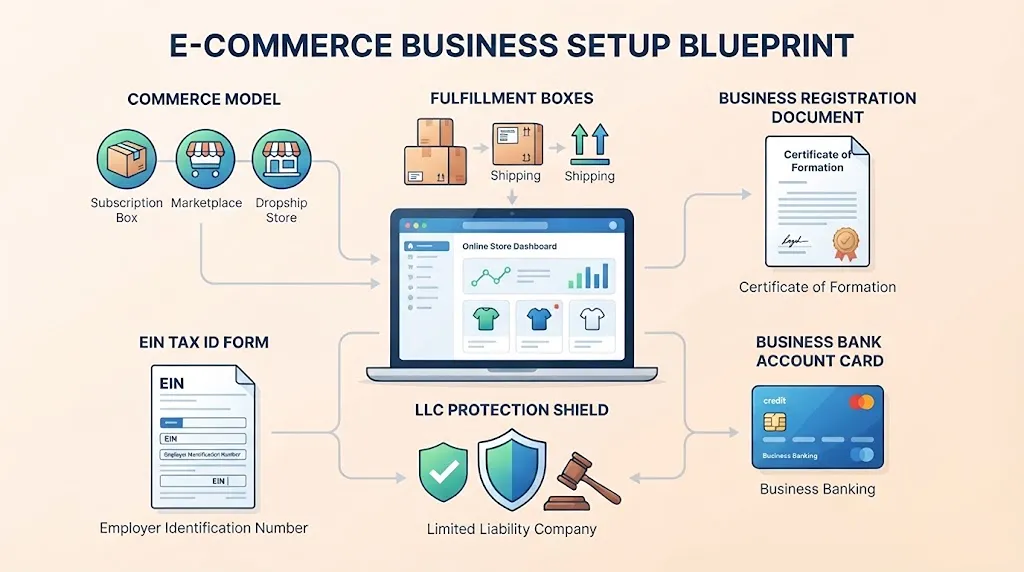
- Select your commerce model. Most online sellers operate under one of four frameworks: B2C (business to consumer), B2B (business to business), C2C (consumer to consumer, such as a marketplace reseller), or C2B (consumer to business, such as licensing creative assets). For first-time sellers, B2C tends to offer the fastest path to revenue and the most platform support.
- Choose your fulfillment method. Dropshipping, private label, and wholesale each carry a different risk-to-margin profile. Dropshipping keeps upfront costs near zero but compresses margins significantly. Private label builds brand equity but requires minimum order quantities. Wholesale sits in the middle — you buy existing branded inventory in bulk and resell it at a markup. Match the method to the capital you have available, not to the margin you wish you had.
- Register your business name. File a DBA (“doing business as”) or a formal entity name with your state’s secretary of state office. This step is required before you can open a dedicated business bank account, which is non-negotiable for clean bookkeeping and tax filing.
- Obtain an Employer Identification Number (EIN). Apply for a free EIN through the IRS, even if you have zero employees. Suppliers, payment processors, and wholesale accounts routinely ask for one. It also keeps your Social Security Number off vendor paperwork, which reduces your personal fraud exposure — worth noting that online shopping fraud is the second most commonly reported fraud category to the FTC.
- Form an LLC for liability protection. An LLC separates your personal assets from business debts and legal claims. Sole proprietors who skip this step expose personal savings, vehicles, and property to business litigation. In most states, formation costs between $50 and $500 — a small price relative to the protection it provides.
- Open a dedicated business bank account and apply for a business credit card. Commingling personal and business funds is one of the most common accounting mistakes new sellers make. Separate accounts make quarterly estimated taxes, COGS tracking, and audit preparation significantly easier.
Fraud prevention callout: Register your business name and trademark your brand early. Counterfeit storefronts and brand impersonation are growing threats in ecommerce — securing your legal identity now makes takedown requests far more effective down the road.
With your model defined and your legal entity in place, the next critical question becomes financial: how much capital do you actually need, and what does your unit economics math look like before you commit to inventory or ad spend?
Step 3: Calculate Your Startup Capital and Unit Economics
With your business model and legal structure in place, understanding how to start an ecommerce company on a realistic budget is what separates sustainable launches from premature failures. This section walks you through allocating capital strategically, calculating your break-even point, and setting honest expectations for early-stage growth.
Work through these steps in order to build a launch budget grounded in real unit economics rather than optimism.
- Map your fixed platform costs first. If you are selling direct-to-consumer, Shopify’s Basic plan runs $39/month, while Amazon’s Professional seller account costs $39.99/month plus referral fees ranging from 8% to 15% depending on category. These are non-negotiable monthly obligations — account for them before projecting any profit. Factor in domain registration, email software, and any inventory management tools you require.
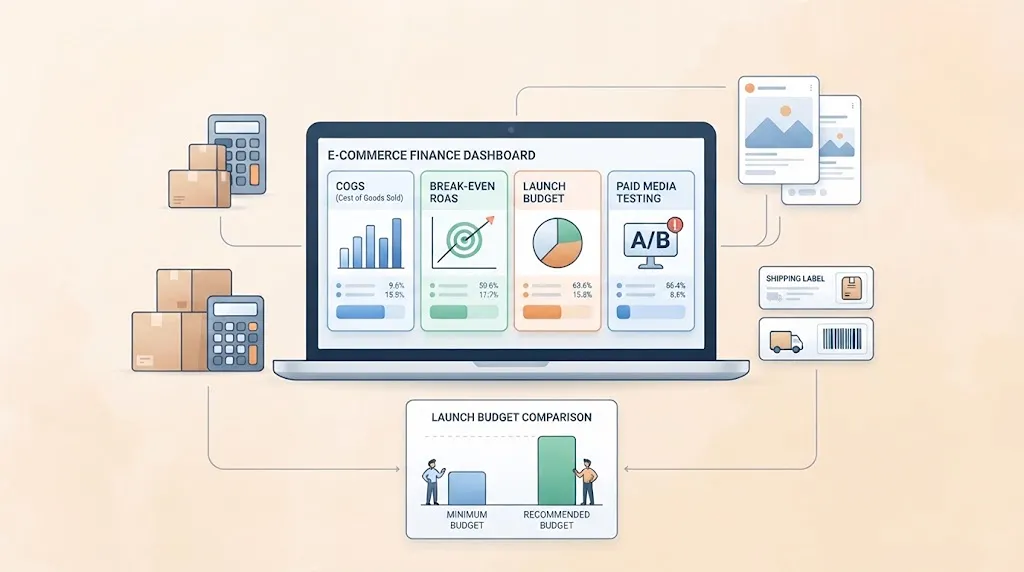
- Calculate your Cost of Goods Sold (COGS) per unit. Add your product cost, inbound freight, packaging, and fulfillment (pick, pack, and ship) to arrive at a true landed cost. For example, if a product costs $8 to manufacture, $2 to ship inbound, and $6 to fulfill outbound, your COGS is $16. This number anchors every financial decision that follows.
- Determine your Break-Even ROAS before spending a dollar on ads. Break-Even ROAS equals your selling price divided by gross profit per unit. If you sell a product at $40 with a COGS of $16 and a $4 payment processing fee, your gross profit is $20 — making your break-even ROAS 2.0. Any return on ad spend above that threshold means your ads are profitable. Any figure below it and you are subsidizing customer acquisition out of pocket.
- Allocate at least 50% of your initial capital to creative testing and paid media. A common pattern in early-stage ecommerce is over-investing in inventory and under-investing in traffic. In practice, inventory you cannot sell is a liability. Paid ad tests — even at $20 to $50 per day — generate the conversion data you need to make smarter inventory decisions. Budget accordingly from day one.
- Build a Minimum vs. Recommended launch budget comparison. Use the table below as a baseline reference:
| Budget Category | Minimum Launch ($) | Recommended Launch ($) |
|---|---|---|
| Platform fees (3 months) | $120 | $120 |
| Initial inventory | $500 | $2,000 |
| Creative production | $100 | $500 |
| Paid ad testing budget | $500 | $2,000 |
| Legal and registration | $200 | $500 |
| Total | $1,420 | $5,120 |
6. Prepare for a slow, deliberate ramp to full-time income. Ecommerce is expected to account for 22.6% of all retail sales worldwide by 2027, which reflects genuine market opportunity — but that growth is captured by operators who scale data before they scale spend. Most sustainable ecommerce businesses operate at break-even or slight loss during the first 60 to 90 days of testing. Plan to maintain another income source during this period rather than pressure a new store to perform before the underlying data supports it.
Once your unit economics are mapped and your capital is allocated, the logical next step is building the storefront and creative infrastructure that will convert paid traffic into actual customers — which is exactly what Step 4 addresses.
Step 4: Build Your Storefront and Launch Creative Tests
With your unit economics mapped and your legal structure in place, the next practical question for anyone figuring out how to start an ecommerce business operations is where and how to build a storefront that converts. This step covers platform selection, page optimization, pixel setup, and low-budget ad validation — the four moves that turn a registered business into a live, data-generating machine.
- Select your selling platform based on audience behavior, not brand familiarity. If you are selling direct-to-consumer with full control over brand experience and customer data, a hosted storefront tends to work better for long-term margin. If you want immediate access to existing buyer intent and reduced traffic costs, a marketplace model lowers the barrier to your first sale. According to Shopify’s ecommerce blueprint, the right platform choice depends heavily on your product category, order volume projections, and how much customization your funnel requires. Choose the environment that matches where your target customer already shops.
- Optimize each product page around the creative hooks your competitors are already proving. Pull the angle, headline structure, and benefit framing from the highest-engagement ads you identified during validation. Mirror that language in your above-the-fold copy, bullet benefits, and primary image. A common pattern is leading with the outcome the customer wants, not the product feature you are proud of. Social proof — even early-stage reviews or press mentions — should appear before the fold wherever possible.
- Bold Callout — Pixel Setup Is Non-Negotiable: Install your Meta Pixel and TikTok Pixel before a single dollar of ad spend goes live. Both pixels need to fire on the product page, add-to-cart event, checkout initiation, and purchase confirmation. Without clean event data from day one, your ad algorithms have nothing to optimize against, and every early dollar you spend is effectively wasted. Verify pixel health using each platform’s native diagnostics tool before launching any campaign.
- Build a minimum of three ad creatives per offer before launch. Vary the hook format — one direct benefit statement, one problem-agitate-solve angle, one social proof lead. Keep creative assets simple at this stage; production quality matters far less than message clarity during initial testing.
- Launch smoke tests at $10–$20 per day per ad set to validate the offer before scaling. A smoke test is a deliberately low-budget campaign designed to measure click-through rate, cost-per-click, and add-to-cart rate — not to generate profit. If your ecommerce launch produces a cost-per-click that exceeds your projected customer acquisition cost ceiling within the first 72 hours, the offer or the creative angle needs adjustment before you increase spend.
- Interpret the data before making changes. Wait until each ad set accumulates at least 1,000 impressions before drawing conclusions. Pause underperformers, isolate the winning hook, and reallocate budget incrementally. In practice, one strong creative angle often accounts for a disproportionate share of early conversions — finding it quickly is the entire purpose of this phase.
Once your storefront is live and your first performance data is flowing, the decisions you make in the next 30 days will determine whether you scale efficiently or burn through your initial capital. That is where launch strategy — from inventory discipline to retention mechanics — becomes the defining factor.
How to Ensure a Successful Ecommerce Launch
Bringing together everything covered in this guide — from unit economics and legal structure to storefront design and creative testing — the final step is execution with discipline. Every decision in business and ecommerce comes down to one principle: validate before you scale. The checklist below synthesizes the core actions that separate brands that gain traction from those that stall after launch.
- Prioritize creative intelligence over aesthetic perfection. A visually polished ad that misses the emotional trigger of your target buyer will consistently underperform a scrappier creative that speaks directly to a real pain point. As PrimeSpy puts it, “Find the winning ads for your next campaign.” Studying what is already resonating in your category — before you spend a dollar on production — tends to produce stronger first-round results than building creative in isolation.
- Maintain a lean inventory until product-market fit is proven. Overcommitting to stock before demand is validated is one of the most common reasons early-stage ecommerce businesses run out of runway. Order conservatively, fulfill reliably, and expand SKU depth only after repeat purchase data confirms what your customers actually want.
- Monitor competitor ad spend to identify shifting market trends. Paid media signals reveal category momentum faster than almost any other data source. When competing brands increase spend on a specific angle or product type, that is a signal worth investigating — not copying, but understanding. Spotting these shifts early gives you time to respond strategically rather than reactively.
- Focus on customer retention from day one to offset rising CAC. Acquiring a new customer consistently costs more than retaining an existing one. Building post-purchase sequences, loyalty incentives, and re-engagement flows into your launch plan — not as a later-stage add-on — is what compresses your payback period and builds a sustainable margin structure over time.
- Review your unit economics at every growth threshold. The numbers that worked at 50 orders per month will look different at 500. Revisit your contribution margin, CAC, and LTV ratio each time you meaningfully increase ad spend or expand to a new channel. According to Coursera’s ecommerce business guide, understanding these financial fundamentals is essential before scaling any online store.
- Document every test and decision. Institutional memory compounds. Keeping a simple record of what you tested, what you changed, and what resulted means you are building a competitive advantage — not just running campaigns. Over time, this log becomes the most valuable asset your brand owns.
The path from concept to profitable ecommerce brand is rarely linear, but it is repeatable when built on clear data, controlled costs, and a relentless focus on what customers actually respond to. Start lean, test fast, and let performance — not assumption — guide every next move.