Social Media Advertising: How to Improve Creative and Budget Decisions
- Author
- PrimeSpy Research Team
- Published
- Sep 21, 2026

Summary: Social media advertising decisions should be based on CAC, creative fit, platform behavior, and competitor spend signals, not clicks alone. The article explains how teams can separate testing and scaling budgets, adapt creatives by placement, and use PrimeSpy to spot formats, hooks, and offers worth testing.
The Real Reason Social Media Advertising Works in 2026
More clicks don’t always mean more customers. More reach doesn’t settle where to spend next. Performance teams need purchases, leads, and revenue from advertising on social media. They also need to know when to keep testing and when to scale. Results must be measurable at each stage of the funnel.
Building brand recall and waiting for sales is no longer enough. AI has raised the standard for paid social. AI-driven ads on Meta delivered 22% higher returns in 2024. Manual bidding and static audience targeting cannot match that precision. The algorithms work with much more behavioral data. This higher baseline is here to stay.
Creative remains the main variable advertisers control. Creative intelligence helps them decide what to make. It means studying formats, visual hooks, and messages already performing in the market. Teams can use that research to develop campaigns faster. With a consistent process, they can build lasting growth from campaign results.

Platform Dynamics: Where Performance Dollars Are Moving
An ad that worked three weeks ago can stop producing results today. This is a familiar problem on Meta. Facebook users see a high volume of ads. They quickly learn to recognize branded patterns. Creative fatigue develops faster than on most other platforms.
Successful teams keep rotating assets. They treat each one as a short-lived test. That work is part of the cost of advertising on Meta. Its audience depth, targeting infrastructure, and purchase data remain unmatched at scale. It is still the default for ecommerce and app growth. The budget needs to account for frequent creative updates.
Snapchat offers a different opportunity for brands selling directly to consumers. Snapchatters are 34% more likely to buy products advertised on the app than on other platforms. That purchase intent matters when allocating the next portion of spend. Audience size is only part of the decision.
Viewing habits matter too. On Snapchat, 64% of ads are watched with the sound on. A voiceover can explain the offer. Music can set the pace. An audio cue can help people recognize the brand. The image does not have to carry the whole message.
This shift extends beyond Snapchat. Immersive, sound-on environments invite fuller attention. Platforms that support them reward creative made for listening as well as looking.
For the actual asset, Snapchat’s format guide gives a useful starting point. Its single image or video ads use a 9:16 frame and can appear in Stories and Spotlight. Collection Ads offer another option for ecommerce. They let people browse products and follow links to the shop or website. Choose the format around what you want someone to do after seeing the ad.
An equal budget split misses these differences. In 2026, the gap between spending allocations and actual performance is wider than most advertisers realize. Consider audience intent, viewing habits, and the demand for fresh creative when dividing the budget.
The Creative Intelligence Gap: Beyond the Ad Library
A brand might have fifty creatives in its ad library. You can see the copy, the offers, and the visuals. You cannot tell which ad is driving results.
Public libraries provide useful transparency. But a list of live ads leaves out essential history. Which creative has stayed in rotation for six weeks? Which one earns enough return to justify continued spending? Competitive intelligence needs that context.
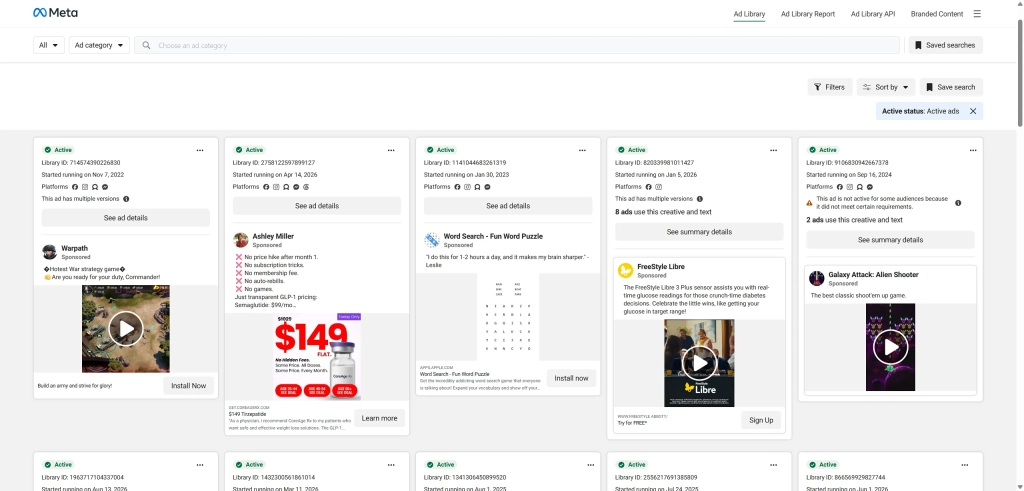
Tracking sustained investment is the only reliable way to separate a test from a proven winner. Advertisers withdraw losing ads and scale successful ones. Look at how long a creative stays active. Check its reach growth, frequency patterns, and spread across placements.
These signals are indirect evidence of performance. They suggest the ad has met the advertiser’s internal threshold. Several weeks of support across multiple placements strengthen that signal.
The research can reduce the cost of finding an angle. Testing normally means paying to learn what resonates. Competitor data shows which hooks, formats, and offers already hold attention at scale. That gives your team a starting point. More of the budget can then go toward amplification.
Optimizing for Format: Lessons from YouTube and Meta
Viewers can skip a pre-roll ad. Those who stay have chosen to keep watching. Their behavior signals stronger interest than a forced view. This helps explain why 29% of YouTube advertisers name skippable pre-roll their most effective format.
The placement also catches people at an engaged moment. They have just chosen a video to watch. A strong hook in the first three seconds can hold their attention and lead to a conversion. A weak opening wastes that opportunity.
The platform rule gives that opening a deadline. Google Ads Help says viewers can skip skippable in-stream ads after five seconds. These ads can run before, during, or after a video. For a pre-roll execution, the practical check is simple: does the opening give the viewer a reason to stay before the skip option appears?
Short-form vertical video needs a different approach. Reels, Stories, and TikTok-style placements reward speed and a native feel. Traditional feed placements allow slightly longer copy and more deliberate pacing. These formats serve different stages of consideration.
When you advertise with Instagram, make separate versions for Reels and the feed. The way people use each placement should shape the creative. Identical ads across both consistently underperform versions adapted to each format.
Choose the format before the first test. Even strong creative produces weaker signals in the wrong environment. The algorithm uses those signals to decide where to deliver it. Poor fit can reduce delivery quality before much spend has accumulated. That disadvantage grows over time. Getting the fit right early gives the campaign a lasting advantage.
Budgeting for Scale: CPC vs. CPM Realities
Consider a campaign paying $0.40 per click. Its conversion rate is 0.5%. At that rate, one customer takes 200 clicks. The acquisition cost is $80.
Now consider a campaign paying $1.20 per click. It converts 3% of visitors. The acquisition cost works out to $40. Each click costs three times as much, but each customer costs half as much.
CPC alone would point you toward the more expensive acquisition. Customer Acquisition Cost (CAC) captures the outcome that matters. It connects spend to the full path from impression to purchase. Teams using CAC spend more efficiently than competitors focused on click prices. Many find their largest margin gains here.
A testing budget has a different job. It pays for information. Which creative variables, audiences, and formats can produce a defensible CAC? A test needs enough data to answer that question. Immediate positive ROAS is the wrong benchmark.
Reserve a fixed percentage of monthly spend for testing. Judge that spending by how quickly it produces useful learning. Keep it separate from the scaling budget. Scaling should follow once the evidence exists.
Mixing the two budgets leads to poor decisions. Teams may stop a concept before it has enough data. They may also scale another concept on incomplete results. Separate allocations help teams judge each budget against its purpose.
To make the test useful, define the comparison before making both ads. Snapchat’s measurement guide describes comparing versions with one change and recommends Split Test for a more accurate comparison. It also explains how Snap Pixel measures website actions after an ad and tracks ROAS. That gives the team a way to connect creative choices with what happens after the click.
Creative quality also affects the cost of delivery. Platforms value ads that hold attention. They reward strong engagement with a lower effective cost per thousand impressions. Two advertisers can bid the same amount and receive very different effective CPMs. The creative accounts for that difference.
Better engagement improves distribution. That can lower effective CPM further over time. Creative choices affect both the first result and the efficiency of later spending. They belong in every social media advertising budget decision.
The buying method matters as well. For skippable in-stream ads, Google’s billing explanation distinguishes CPV from impression-based buying. With CPV bidding, a charge occurs after 30 seconds of viewing, completion of a shorter ad, or an interaction, whichever comes first. With Target CPM, Target CPA, or Maximize conversions bidding, charges are based on impressions. Check that setting before comparing the cost of a view across campaigns.
The Bottom Line: Scaling Social Ads in 2026
Check competitor reach and spend before committing a substantial budget. Look for several competitors maintaining investment behind the same format or offer. That persistence provides evidence of performance. Validate it through reach data before deciding to scale. Doing so reduces the risk of backing an untested assumption.
External creative intelligence makes it faster and cheaper to find a promising angle. Native tools remain useful for execution. A list of live ads, however, leaves the competitive research incomplete.
On Meta, broad, AI-assisted delivery tends to outperform tightly constrained setups. This applies to most performance objectives, especially with strong creative. The system can find conversion paths across placements. Improving on those decisions through manual overrides is increasingly difficult. Let machine learning distribute the spend. Keep the team’s attention on creative and offer strategy.
Platform fit still needs a separate decision. Snapchat has a younger, purchase-ready audience. Its direct, product-focused environment can suit specific product categories. It deserves consideration even when Meta or TikTok dominates the plan.
Match the audience to the product and the format to the placement. Keep testing funds separate from scaling funds. Teams that make these decisions well before increasing spend will outperform those relying on budget size alone.
Winning the Ad Intelligence War with PrimeSpy
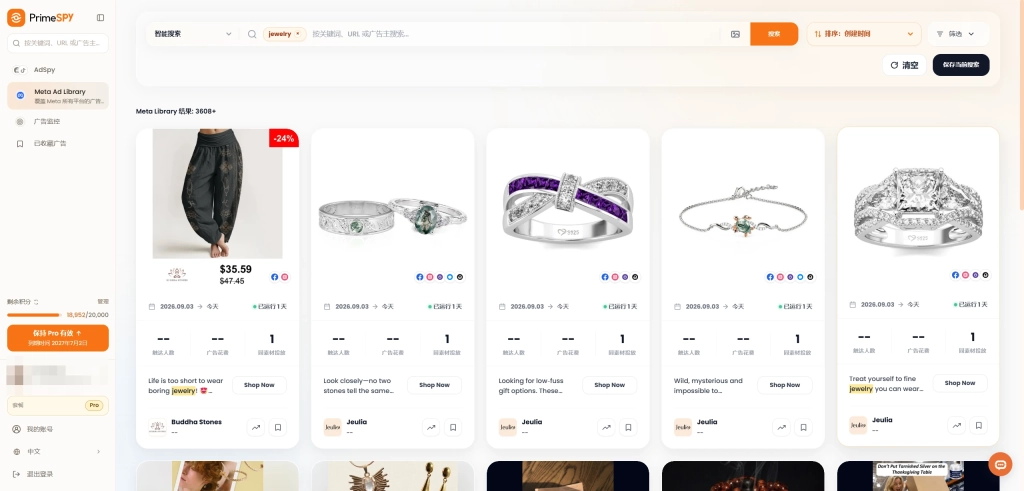
Creative ideas cannot make up for missing data. Teams need to see the activity behind an ad before making spending decisions. PrimeSpy adds reach and spend signals to the creative. This helps distinguish an early test from an ad receiving sustained support.
The same creative running across Meta, TikTok, and Instagram signals commitment to an approach. Compare the activity on each platform. Brands often concentrate spending where they have found results. They keep a lighter presence elsewhere.
PrimeSpy’s multi-platform visibility reveals those differences. It shows where rivals commit budget at scale and which audiences they prioritize. A single-platform view can give a misleading picture of their strategy.
For ecommerce research, filter by category, engagement trend, or platform format. Those filters narrow the search to relevant ads. They are more useful than browsing a broad library without a clear focus. They can also reveal a direction before a trend becomes saturated. That leaves time to act while reach costs remain favorable.
Explore the PrimeSpy dashboard with your next campaign in mind. Use the creative, reach, and spend data to guide the work. Choose a hook to test, a format to develop, or an offer to investigate. Base that choice on a clearer view of what competitors are doing.