How to Start AI Dropshipping in 5 Steps (Without Manual Research or Product Guesswork)
- Author
- PrimeSpy Research Team
- Published
- Aug 6, 2026

Summary: AI dropshipping becomes more reliable when product decisions are based on proven ad signals instead of manual guessing. The article breaks down a five-step workflow for finding winning products with ad intelligence, building a Shopify store faster with AI, creating multiple ad variations, launching campaigns on Meta and TikTok, and scaling only the creatives that meet ROAS targets. It is especially useful for sellers who want a faster, data-backed way to validate products, reduce wasted ad spend, and improve creative testing efficiency.
Most people start dropshipping backwards.
They spend hours scrolling TikTok, browsing AliExpress, and trying to guess which product might go viral. The result is usually the same: a store full of random products and ad campaigns that never become profitable.
AI changes that workflow completely.
Today, you can use ad intelligence tools, AI copywriting, image editing, and creative-generation platforms to validate products, build a store, and launch ads in a fraction of the time it used to take. The goal is not to let AI run your business—it is to eliminate the repetitive work so you can focus on the decisions that actually drive revenue.
In this guide, you’ll learn how to start AI dropshipping in five practical steps, from finding products that are already selling to launching campaigns and scaling them with real-time performance data. No manual product research. No guesswork. Just a faster, data-backed workflow that performance marketers are already using.
Step 1: Find Winning Products With AI Ad Intelligence
If you’re serious about learning how to start AI dropshipping, the first thing to stop doing is guessing which products will sell.
The most successful dropshippers don’t rely on trend lists or personal preferences. McKinsey estimates that generative AI could create $400 billion to $660 billion in annual value for retail and consumer packaged goods companies, making data-driven product selection increasingly important for ecommerce operators.
They use ad intelligence data to identify products that are already generating profitable sales before spending a dollar on inventory or advertising.
Follow this workflow:
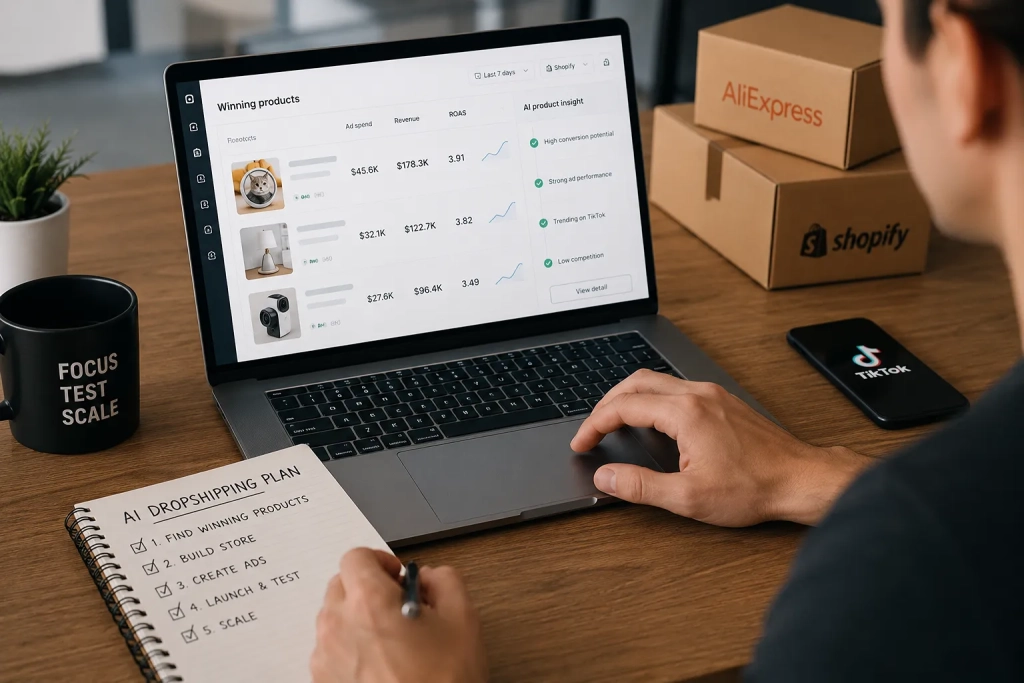
- Open an ad intelligence platform such as PrimeSpy and filter Meta and TikTok ads that have been running for at least 30 days. Long-running ads are one of the strongest indicators that a product is consistently converting.
- Sort by rising reach over the last 7 days. Look for products with rapidly growing audience exposure but relatively low ad saturation. These are often the best opportunities for new sellers.
- Study the top-performing competitor creatives. Focus on the first three seconds of each video. Notice whether the hook leads with a problem, a transformation, or a bold claim. Repeated hook patterns usually indicate what is working right now.
- Compare spend-to-reach ratios. A strong product typically achieves significant reach without requiring unusually high ad spend.
- Validate the niche with broader market trends. Categories such as home efficiency, wellness technology, and organizational products continue to benefit from long-term consumer demand.
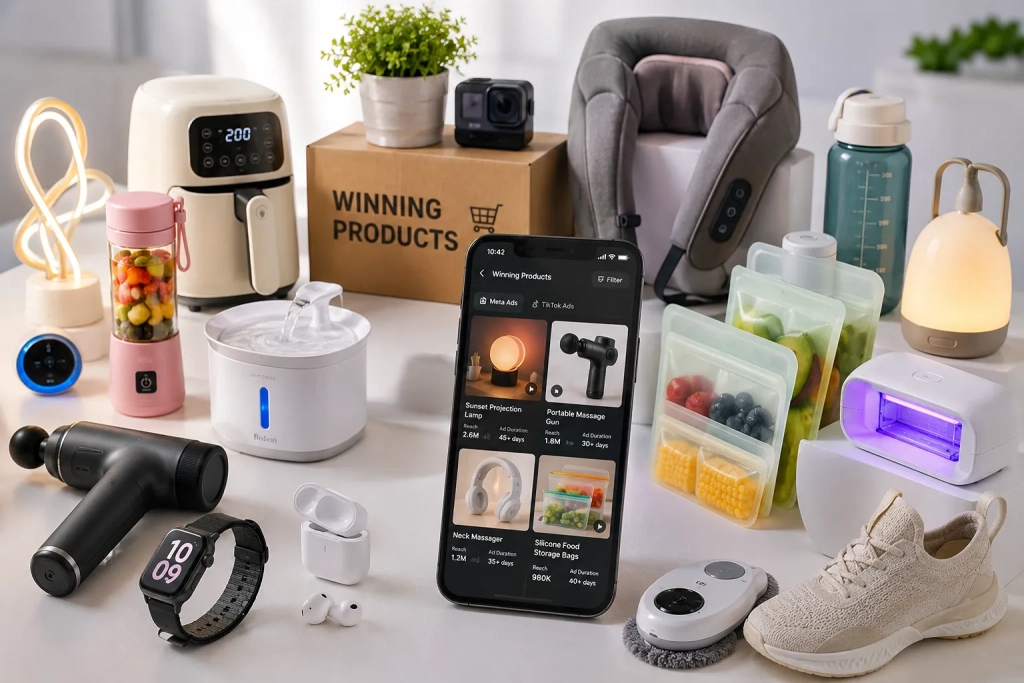
- Build a shortlist of three to five products. Avoid testing ten products at once. A smaller shortlist allows faster execution and clearer performance analysis.
Once you have a validated shortlist, the next step is to build your store quickly and let AI handle most of the setup work.
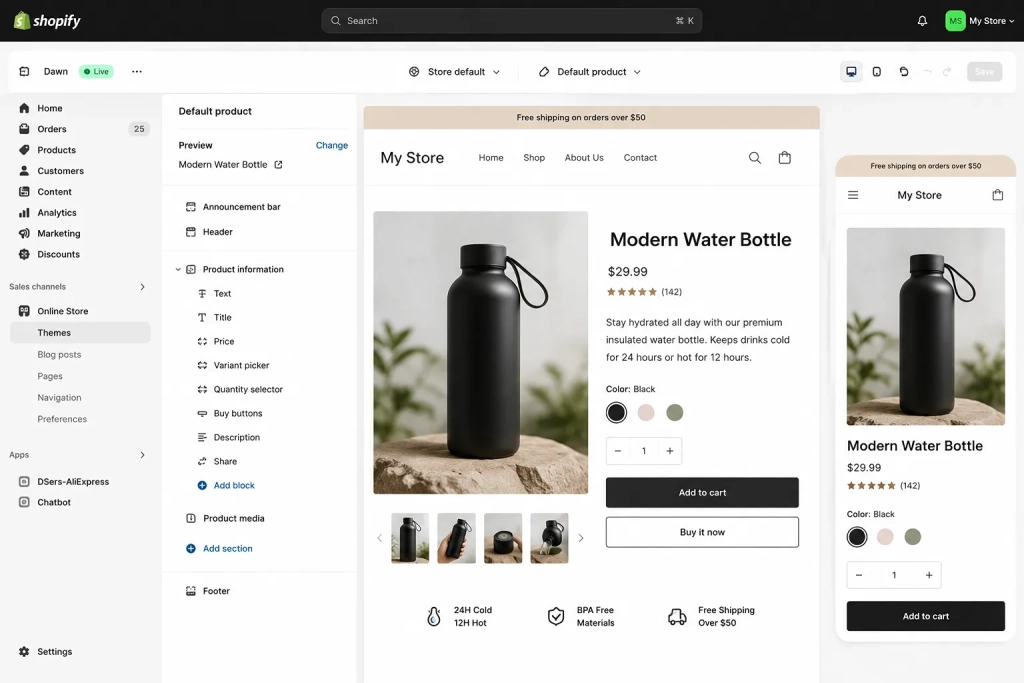
Step 2: Build Your Store in Minutes With AI
With your winning products selected, the goal is simple: get a conversion-ready store online as quickly as possible.
This is where AI saves the most time.
- Generate product descriptions with ChatGPT. Feed it the pain points and emotional triggers you discovered during competitor research. A prompt like _“Write a 150-word product description for [product] that solves [pain point] and ends with a strong call to action”_ is usually enough to create multiple usable versions.
- Improve supplier images with AI editing tools. Remove backgrounds, standardize lighting, and enhance image quality so your product pages look consistent and professional.
- Connect your products to Shopify. Use a dropshipping fulfillment app to import products and automate pricing rules, inventory syncing, and order processing.
- Add an AI chatbot before launching. Configure answers for common questions such as shipping times, returns, sizing, and product compatibility.
- Launch your store and record baseline metrics. A live store collecting real data is far more valuable than a perfectly designed store that hasn’t received any traffic.
The goal isn’t perfection—it’s speed. Once the store is live, the next bottleneck becomes creative production.
Step 3: Create AI Ads That Actually Convert
On Meta and TikTok, creative often matters more than audience targeting.
The strongest-performing brands aren’t winning because they found a secret audience. They’re winning because their ads are compelling enough that the algorithm can find the right audience automatically.
Here’s a practical workflow:
- Reuse the winning hooks from Step 1. Start with the opening lines that generated the highest engagement across competitor ads.
- Generate videos with AI tools such as Runway or Pika. Combine your hook with supplier footage and product visuals.
- Use ChatGPT to create multiple script and caption variations. One product brief can easily become five different ad angles in under a minute.
- Produce five to ten creative variations for each hook. Change the opening visual, text overlay, voiceover, or call-to-action while keeping the core offer consistent.
- Enhance every asset before exporting. AI upscaling and image enhancement tools can noticeably improve feed performance and thumb-stop rates.
- Organize creatives by hook type. Naming assets systematically (for example, Hook-A-Video-1 or Hook-B-Video-3) makes performance analysis much easier later.
What used to require several days of editing can now be done in a single afternoon. More importantly, you’re testing multiple emotional angles instead of relying on a single creative idea.
With your creative library ready, it’s time to launch campaigns and let real data guide your decisions.
Step 4: Launch and Scale With Real-Time Performance Data
This is where your AI dropshipping setup becomes a real business.
The objective is to test quickly, spend conservatively, and scale only what the market proves is working.
- Launch low-budget campaigns on both Meta and TikTok. Start with $20–$30 per day per platform, split across two or three ad sets.
- Monitor competitor activity in PrimeSpy while your ads are running. If multiple advertisers begin increasing spend on the same product, that is often a strong sign that demand is still growing.
- Review your first 24 hours of performance data. High CPC combined with weak engagement usually means the creative—not necessarily the product—is the problem.
- Scale only the creatives that meet your ROAS target. Ignore vanity metrics such as clicks or views. Profitability is the metric that matters.
- Increase budgets gradually. A 20% increase every 48 hours is usually safer than doubling budgets overnight, which can disrupt Meta and TikTok learning phases.
- Refresh the creative angle before abandoning the product. If results begin to flatten, test a new hook, format, or offer before deciding that the product has failed.
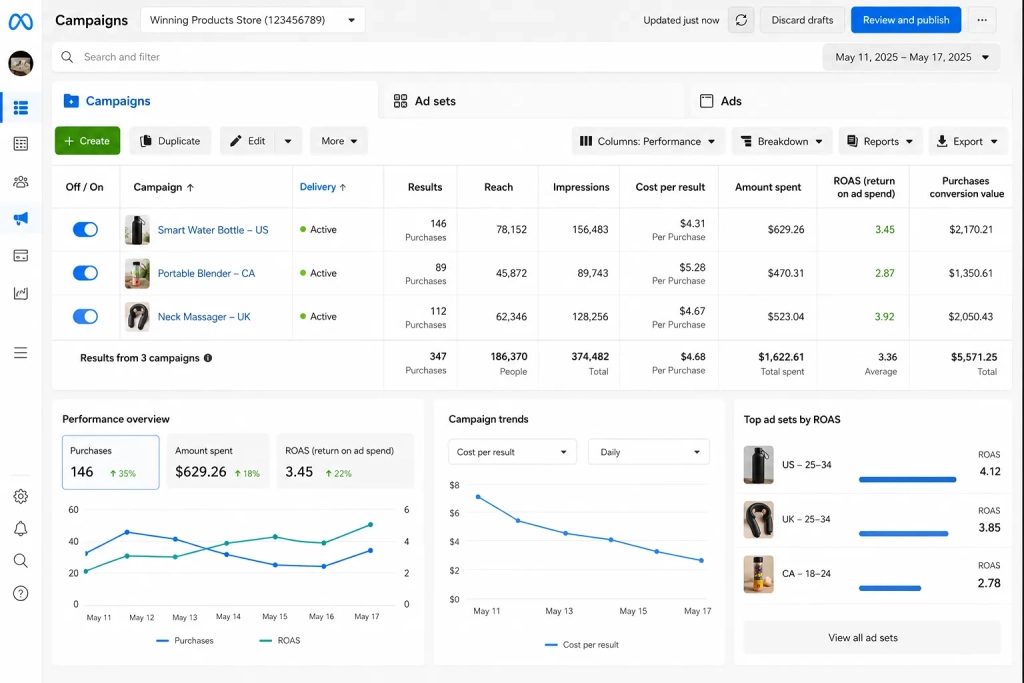
Key scaling signals to watch:
- ROAS remains above target for 48+ hours
- Competitor ad spend is increasing
- Video thumb-stop rate exceeds 25%
- Add-to-cart rate stays above 8%
- CPC trends downward over time
This is the step that separates profitable operators from people who remain stuck in endless testing cycles.
Step 5: Validate Results and Double Down on Winners
A lot of new dropshippers lose money because they scale too soon.
Clicks are not proof. A product can get attention, burn through ad spend, and still fail once people reach the checkout page. AI helps here because it speeds up the part that matters most: figuring out what deserves another test and what needs to be cut.
Use this process before increasing your budget:
- Review the first 3 to 7 days of data. Do not stop at clicks and impressions. Look at conversion rate, cost per purchase, average order value, and ROAS. Those numbers tell you whether the product is actually making money.
- Compare creatives for the same product. One video can carry the whole test while another barely moves, even with the same targeting. Keep the strongest creative and pause the weak ones.
- Figure out what caused the result. Was the product weak? Was the offer unclear? Was the creative not strong enough? Use AI to create new hooks, headlines, pricing angles, and ad scripts based on what the data is telling you.
- Run another round before you scale. Make three to five new creative variations based on the best performer. This helps you see whether the result can repeat, or whether you just caught one lucky day.
- Scale only when the product stays profitable. Wait until the product has multiple purchases and stable ROAS across several days. That gives you a real reason to push the budget harder.
Used well, AI gives you a tighter feedback loop. You can review what happened, create better tests, and move faster than sellers who are still guessing. The point is not to launch hundreds of products. It is to find a small number that actually work, improve them, and build from there.
How to Maximize Your AI Dropshipping ROI?
Launching a store is only the beginning. Long-term profitability comes from creative velocity, data discipline, and continuous iteration.
Prioritize Creative Velocity
The fastest-growing stores are usually the ones producing the most creative variations. AI allows you to refresh hooks, scripts, and visuals in hours instead of weeks.
Use Ad Intelligence Before Spending Money
Before launching any campaign, check whether competitors are already succeeding with the product. Tools such as PrimeSpy help you validate demand, identify proven ad formats, and avoid entering saturated niches blindly.
Scale Only Proven Winners
Never increase budgets based on hope. Wait until a creative has demonstrated a consistent cost-per-purchase and ROAS that meets your target.
Treat Iteration as a Weekly Habit
Creative fatigue is inevitable. Refresh your top-performing ads regularly by testing new openings, new visuals, and new messaging angles generated with AI.
Frequently Asked Questions
Is AI dropshipping still profitable in 2026?
Yes. The biggest advantage is speed. Sellers who can validate products, generate creatives, and launch campaigns quickly often outperform competitors relying on manual research.
What is the best AI tool for dropshipping beginners?
For product research, an ad intelligence platform such as PrimeSpy is one of the most valuable starting points because it shows which products are already being scaled successfully on Meta and TikTok.
How much money do I need to start AI dropshipping?
Many beginners start with $300–$1,000, including a Shopify subscription, a domain, and an initial advertising budget.
Can I start AI dropshipping without Shopify?
Yes. WooCommerce, Shoplazza, and other ecommerce platforms can also be combined with AI tools for product descriptions, image editing, and ad creation.
Final Thoughts
The biggest advantage of AI dropshipping is not that it automates everything—it’s that it helps you make better decisions faster.
Instead of spending weeks searching for products, writing copy, and creating ads manually, you can validate demand, launch quickly, and scale only what the data confirms is working.
If you want to start with real product signals instead of guesswork, try PrimeSpy for free. You can monitor Meta and TikTok ads, identify long-running winners, and build a shortlist of products before you spend your first advertising dollar.