Why TikTok Shop Ads Are Outperforming Traditional E-commerce Funnels
- Author
- PrimeSpy Research Team
- Published
- Aug 24, 2026

Summary: TikTok Shop Ads are reshaping ecommerce by turning product discovery, creator content, and checkout into one in-feed experience. The article explains why short-form video, affiliate creative, Video Shopping Ads, and competitive intelligence help brands reduce funnel friction and scale TikTok Shop campaigns more effectively.
The Shift from Social Discovery to In-Feed Commerce
TikTok Shop ads represent a fundamental rethink of how e-commerce works — eliminating the gap between content and checkout that has quietly been killing conversion rates across traditional social funnels.
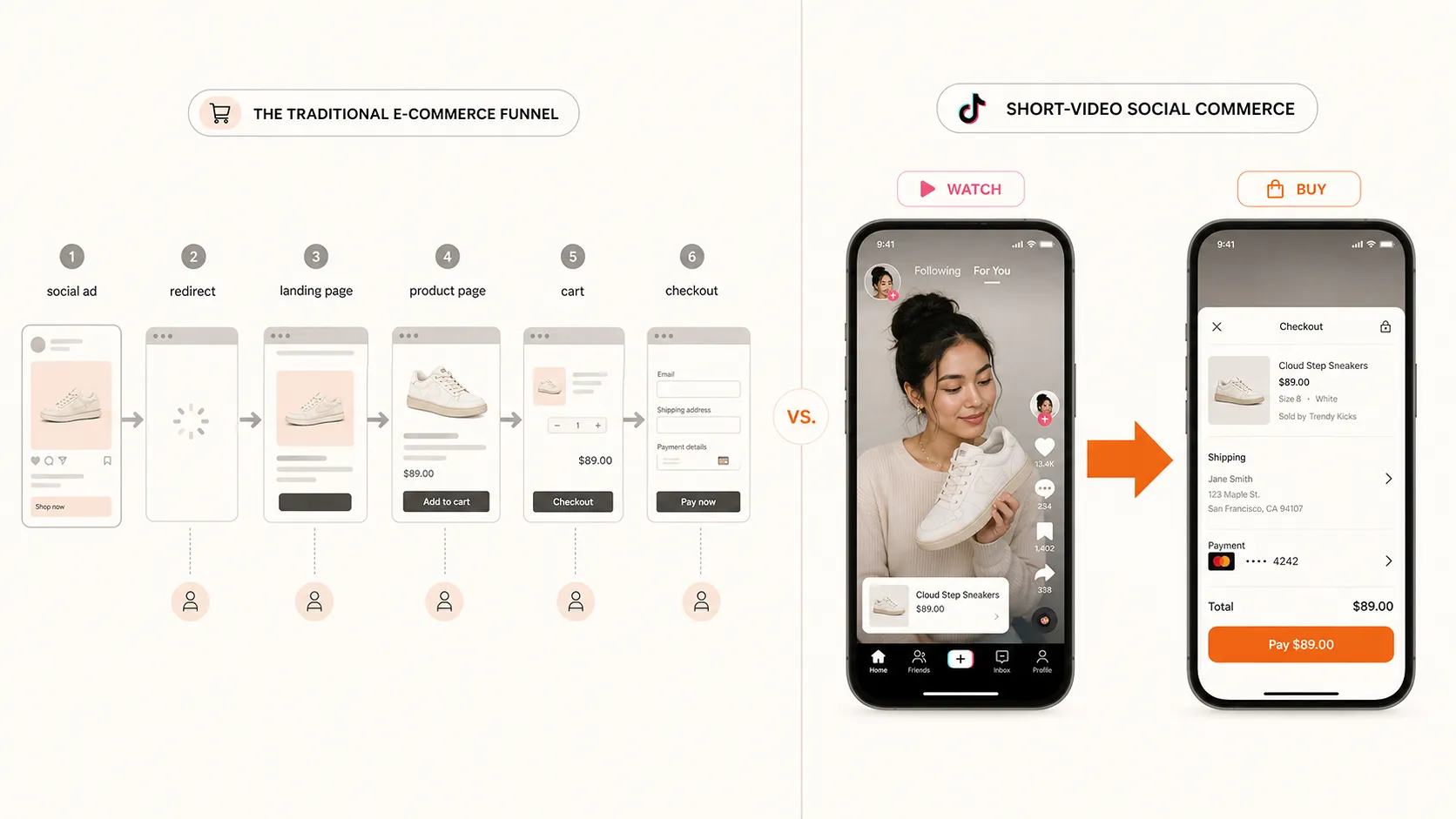
For years, the standard playbook looked the same: run an ad, drive a click, land the user on an external page, and hope the momentum survived the journey. It rarely did. Every redirect, every load time, every unfamiliar storefront introduced friction — and friction kills intent. What TikTok has engineered is something structurally different. The purchase happens inside the platform itself, meaning the distance between “I want this” and “I bought this” has collapsed to almost nothing.
The algorithm as a discovery engine. Traditional paid search works because users already know what they want. They type a query; they get results. The For You Page operates on an entirely different principle. It surfaces products through content that users did not know they were looking for, matching video to viewer based on behavioral signals rather than declared intent. This is not a minor distinction — it rewires the entire top-of-funnel dynamic. A product can go from zero awareness to sold out in 48 hours without a single person searching for it.
Video Shopping Ads (VSAs) are the primary engine powering this shift. VSAs allow brands to embed shoppable product links directly into in-feed video content, so a viewer watching an engaging clip can tap to purchase without ever leaving the app. The format is native by design — it does not look like an interruption, it looks like content. And that distinction matters enormously for conversion. TikTok Shop ads drive conversion rates between 8% and 12%, compared to the 2% to 4% average seen on other social shopping platforms — a gap that points directly to the power of frictionless, native commerce.
This is the context that makes TikTok’s shopping ecosystem so difficult to replicate elsewhere. And understanding why video — specifically short-form video — sits at the center of that ecosystem is where the real strategic picture begins to come into focus.
Why Short-Form Video Dominates the Shop Ecosystem
Short-form video is not just one channel within TikTok Shop — it is the engine that drives the entire commerce ecosystem, accounting for 58% of total Gross Merchandise Value (GMV) in the U.S. in 2023.
TikTok Shop operates across three primary surfaces: in-feed short-form video, the Shop tab (a dedicated browsing destination), and livestream commerce. Each plays a distinct role. The Shop tab functions more like a traditional storefront — users arrive with purchase intent already formed. Livestreams build community and trust over time, often converting viewers who have seen a product multiple times. But short-form video does something neither of the other formats can replicate at scale: it creates purchase intent from zero, reaching users who had no idea they needed a product thirty seconds ago.
Impulse behavior is baked into the TikTok experience in a way that no other platform has fully reproduced. The algorithm surfaces content based on engagement signals, not follower counts, which means a product video can reach millions of cold-audience users in days. And critically, the path from “I want this” to “I bought this” is now measured in taps rather than tabs. That frictionless environment accelerates impulse decisions that traditional funnels — with their landing pages, retargeting sequences, and abandoned cart emails — were designed to recover, not prevent.
Reach versus conversion is where many advertisers still misallocate budget. A common misconception, sometimes framed as a rough “dollar per thousand views” benchmark, treats TikTok as a reach play first and a commerce channel second. In practice, raw view counts are a poor proxy for revenue. What moves GMV is whether the video creates enough belief in the product — through demonstration, social proof, or authentic storytelling — to generate a tap-through and a completed purchase. Campaigns managed through TikTok Ads Manager that optimize for product sales rather than impressions consistently outperform those chasing volume metrics alone.
That distinction — optimizing for conversion quality rather than content volume — connects directly to one of the most powerful levers available to TikTok Shop advertisers: using affiliate-created content as paid media.
The Strategic Advantage of Boosting Affiliate Creative
Boosting affiliate-created content as video shopping ads is one of the highest-leverage moves available to TikTok Shop advertisers — combining authentic social proof with paid reach at a fraction of the cost of brand-produced creative.
The mechanism that makes this possible is TikTok’s Spark Ads format. Rather than uploading a brand-produced video to Ads Manager, Spark Ads allow you to amplify an existing organic post — including content published by third-party affiliates — directly within the paid system. The affiliate retains credit for the post, their handle and comments remain visible, and the content appears in-feed exactly as it would organically. For users scrolling through content, the distinction between a paid boost and a genuine recommendation is nearly invisible. That perception gap is where the real commercial advantage lives.
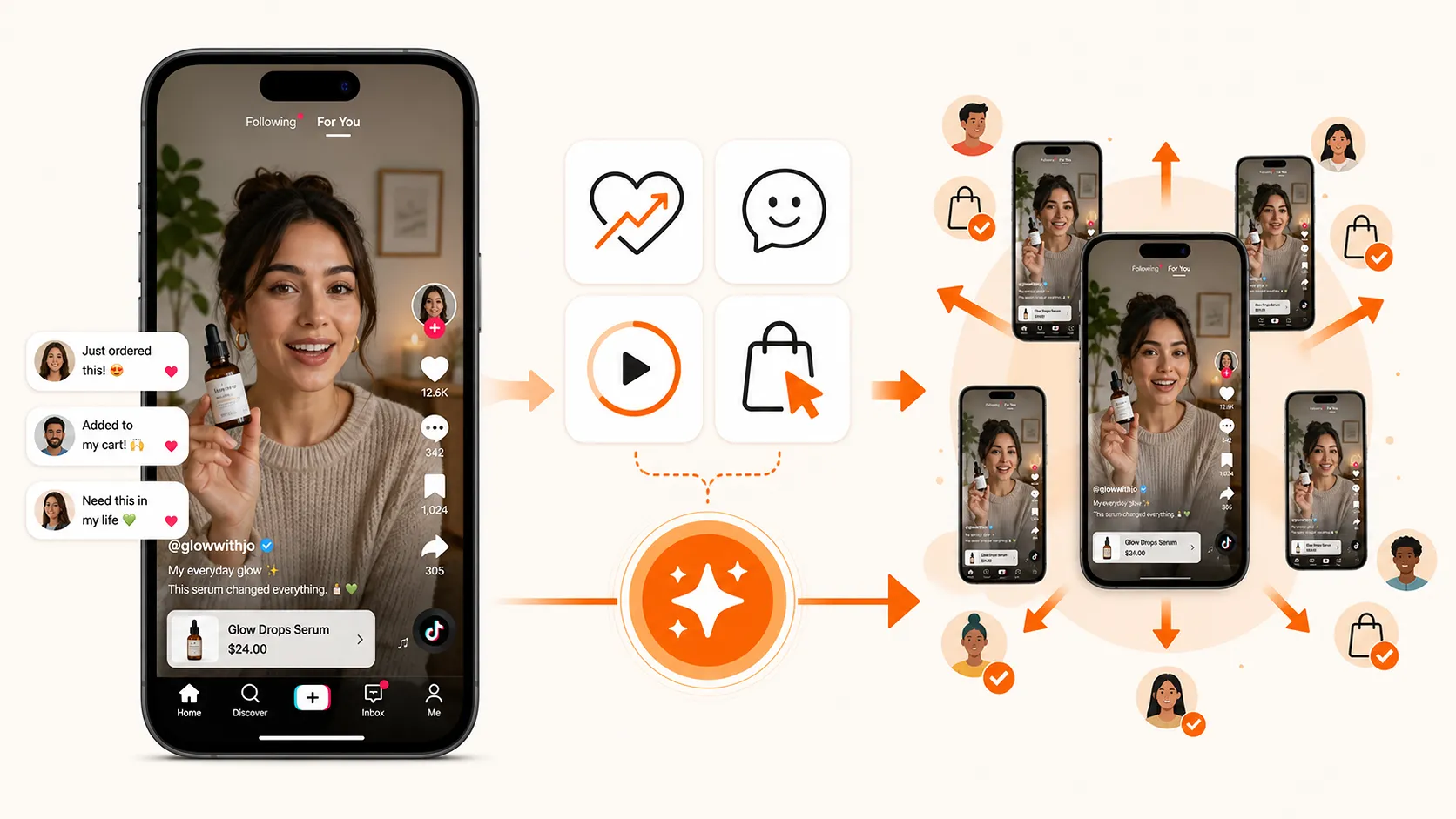
Affiliate authenticity is not just a soft benefit. Audiences on TikTok have developed a finely tuned sensitivity to polished, brand-produced creative, and that skepticism shows up in engagement metrics. Affiliate creators speak to their audiences in a register that resonates — they demonstrate products in real environments, address genuine objections, and bring existing trust relationships to the table. When that content is then amplified through paid distribution, it carries the credibility of organic discovery while gaining the reach of a media buy. The result is an audience that is far more likely to complete a purchase because the recommendation feels earned rather than manufactured.
The math reinforces the intuition. Leveraging high-performing organic affiliate videos as video shopping ads resulted in a 3.2x return on ad spend (ROAS) and a 409% increase in cost per acquisition — a result that is difficult to replicate with cold creative built from scratch. Pre-validated organic content has already survived the platform’s natural selection process; it earned views and engagement without paid support. Putting budget behind it means you are not testing whether the concept works — the algorithm has already answered that question.
Identifying which affiliate videos deserve ad spend comes down to a clear set of signals:
- Organic engagement rate — videos that have outperformed the creator’s average without paid amplification signal genuine audience resonance
- Comment sentiment — positive, purchase-intent comments (“where do I get this?”, “just ordered”) indicate the content is converting curiosity into action
- Watch-through rate — high completion percentages suggest the hook and pacing are strong enough to hold attention through to the call to action
- Product click-through data — within TikTok Shop’s affiliate dashboard, click and GMV data tied to individual posts reveals which creators are already driving commercial outcomes organically
Once you have identified the strongest performers using those criteria, the decision to boost is low-risk by definition. The creative has already proven itself. What paid distribution adds is scale and targeting precision — and that is precisely what the TikTok Shop Ads Manager workflow is designed to deliver, a subject worth examining in detail next.
Navigating the TikTok Shop Ads Manager Workflow
Getting the technical foundation right inside TikTok Shop Ads Manager is what separates campaigns that scale from campaigns that stall at the first optimization cycle.
As covered in the previous sections, short-form video and affiliate creative are the creative fuel — but the engine itself runs through the Ads Manager setup. The decisions made here determine whether your catalog, creative, and targeting work in concert or against each other.
The Product Sales objective is the starting point. When creating a new campaign, selecting “Product Sales” signals to the TikTok algorithm that the goal is direct purchase, not awareness or traffic. This unlocks the shopping-specific ad formats and attribution tools that standard campaign objectives simply do not surface. Choosing any other objective here is one of the most common structural mistakes brands make early on.
Catalog integration is the next critical layer, and it deserves careful attention. Your TikTok Shop catalog must be correctly synced before any shopping ad can run — product IDs, pricing, and inventory data all feed directly into ad delivery. A mismatched or incomplete catalog creates broken product links, disapproved ads, and wasted budget. The practical approach is to audit the catalog connection at the product level, not just confirm the top-level integration is active.
Retention insight: TikTok Shop repeat purchase rates reached 81.3% in early 2024, which means the catalog experience — accurate imagery, clean product titles, correct pricing — shapes not just the first conversion but the long-term customer relationship.
Product Shopping Ads (PSA) vs. Video Shopping Ads (VSA) represent two distinct placements with different strategic uses. PSAs appear in the Shop tab and search results, functioning more like a product discovery feed, while VSAs run in-feed alongside organic content and leverage video creative directly. In practice, VSAs tend to generate stronger top-of-funnel momentum, while PSAs capture demand from users already in a buying mindset.
Targeting within the Shop context operates differently than standard TikTok campaigns. Broad targeting — letting the algorithm self-optimize — often outperforms rigid interest-based segmentation when catalog data and pixel signals are strong. However, interest-based targeting remains useful during the early testing phase when purchase history data is still thin. The signal-rich environment of TikTok Shop means the algorithm learns quickly, which makes understanding when to loosen targeting controls a genuine competitive advantage — and one that connects directly to the intelligence layer the next section addresses.
Competitive Intelligence: The Missing Layer in TikTok Strategy
The most overlooked gap in any tiktok shop strategy is not creative quality or budget — it is the absence of competitive intelligence that tells you what is already working before you spend a dollar.
The native TikTok Creative Center is a useful starting point, but its limitations become apparent quickly. The library surfaces trending ads and popular sounds, yet it strips out the data points that actually matter for strategic decisions: estimated spend, reach, and longevity signals. You can see that an ad exists; you cannot see whether it drove meaningful volume or fizzled after two days. That gap forces advertisers into expensive guesswork, testing creative variations without knowing if the underlying angle has already been validated at scale by a competitor.
For advertisers who want a more actionable view of competitor activity, tools like PrimeSpy can help turn ad research into a repeatable workflow rather than a one-off browse through TikTok Creative Center. By tracking creative patterns, spend signals, reach estimates, duplicates, and market movement across platforms, PrimeSpy gives TikTok Shop sellers a faster way to spot angles worth testing before committing budget.
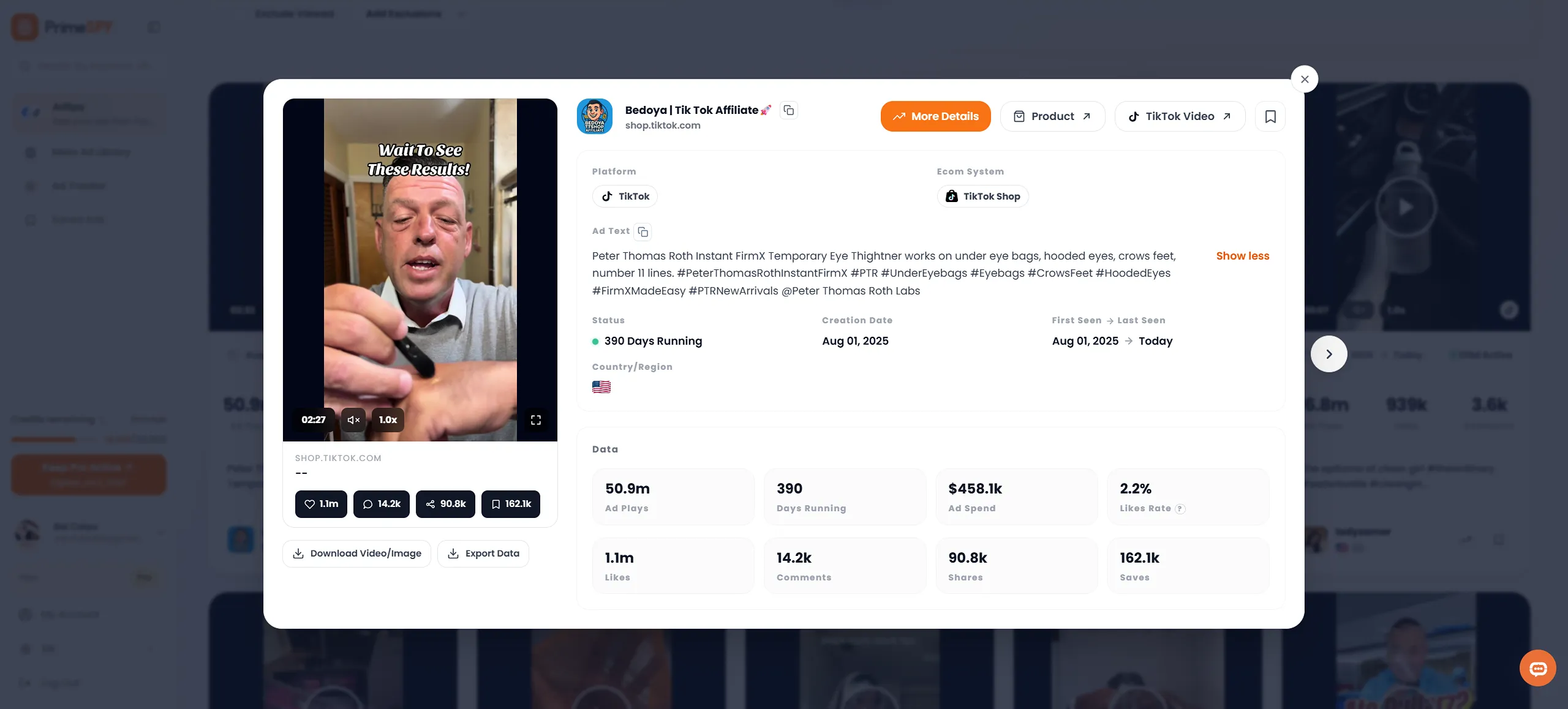
Reverse-engineering winning hooks is where external ad intelligence tools earn their keep. Rather than building hypotheses from scratch, experienced advertisers study the structural DNA of high-performing competitor ads — the opening three seconds, the tension-and-resolution arc, the specific product claim that triggers a pause. When you can analyze 120M+ ads with spend and reach estimation, patterns emerge fast. A hook that leads with a transformation result, for example, tends to outperform one that opens on product features in beauty and wellness categories. Identifying that pattern before testing saves weeks of iteration.
Trend spotting is a second, equally valuable application. Emerging product angles follow a predictable curve: early adopters capture outsized returns before saturation drives CPMs up and conversion rates down. Ad intelligence data reveals which angles are gaining spend velocity right now, giving you a window to enter a trend during its growth phase rather than its decline. This is how smaller brands consistently outmaneuver larger competitors on TikTok — not through bigger budgets, but through faster signal detection.
Validating product angles through cross-channel reach and duplicate ad data adds a final layer of confidence. When the same creative concept appears across multiple accounts with consistent spend behind it, that is a strong signal the angle resonates broadly — not a fluke tied to one brand’s audience. On the other hand, angles appearing only in isolated tests with low reach estimates warrant more caution before you commit production resources.
Together, these intelligence layers shift creative testing from a cost center into a compounding asset — and that shift is central to how the most effective TikTok Shop advertisers are building durable growth right now.
The Bottom Line: Scaling TikTok Shop in 2026
TikTok Shop conversion rates and platform stickiness are reshaping what a high-performing e-commerce funnel looks like — and the brands that adapt now will hold a structural advantage through 2026 and beyond.
The evidence points in one direction. Short-form video is not a supporting channel; it is the primary GMV driver on TikTok Shop. A product demonstrated in a 30-second clip by a credible creator routinely outperforms static ad creative by a significant margin, because the format collapses the distance between discovery and purchase intent. Prioritizing video output — whether through owned content or creator partnerships — is no longer optional for sellers serious about scale.
Affiliate-led creative tends to deliver higher ROAS than brand-produced content, precisely because audiences respond to authentic voices over polished ad aesthetics. The practical implication is that allocating a meaningful share of your creative budget toward affiliate seeding and commission structures often returns more than equivalent spend on production. And as covered earlier in this article, the Ads Manager’s collaboration tools are built to support exactly this workflow — making it easier to manage affiliate relationships at scale without losing attribution visibility.
Competitive intelligence is the de-risking layer that most advertisers skip until they have already burned through test budgets. Analyzing what formats, hooks, and product angles competitors are running before committing to creative production shortens the feedback loop considerably. In practice, this means treating creative testing as a hypothesis exercise informed by market data, not a guessing game.
Repeat purchase optimization is where long-term unit economics are won. TikTok Shop’s repeat purchase rate climbed from 64% to 81.3% in a short window, which signals that the platform has genuine retention power when brands stay active and consistent. Building post-purchase sequences — follow-up creator content, loyalty incentives, and retargeting audiences — turns a single conversion into a compounding revenue stream.
Taken together, these four levers form a coherent scaling framework. But executing them cleanly requires avoiding the operational and strategic mistakes that quietly drain performance — which is exactly where many TikTok Shop sellers lose ground.
Common Pitfalls and User Concerns
The most common reason TikTok Shop campaigns stall — whether for sellers or affiliates — is not the platform itself, but a fundamental mismatch between what the content offers and what the audience expects.
Dropshipping creative failure is arguably the most widespread issue. Sellers running generic product ads lifted directly from supplier footage see declining results because TikTok’s algorithm rewards native-feeling content — not polished catalog imagery. In practice, ads that look like ads get scrolled past. The shops that gain traction tend to use original creator footage, authentic product demonstrations, or affiliate partnerships where real people speak to real use cases. Creative originality is not a nicety; it is the functional unit of performance on this platform.
From the consumer side, the question of how to stop seeing TikTok Shop ads is a genuine friction point — and one worth acknowledging honestly. Users can long-press any ad and select “Not interested” to reduce frequency for similar placements. TikTok also provides ad preference settings under the privacy menu. But the reality is that TikTok’s shopping ad formats are designed to blend into organic content, which means some exposure is inherent to the feed experience. Transparency matters here: the platform is built around discovery commerce, and that shapes what the feed looks like for everyone.
New shop owners facing zero sales often misdiagnose the problem as low traffic when the actual issue is trust. A shop with no reviews, no creator content, and a sparse storefront rarely converts — regardless of ad spend. One practical approach is to seed the product through affiliate creators before running paid campaigns, so social proof exists before paid traffic arrives.
Payout expectations also deserve a reality check. Viral reach does not equal revenue. A video hitting one million views with a weak product-to-audience fit will underperform a smaller, targeted campaign aimed at a category-specific audience. Understanding the full structure of TikTok Shop ad types — and aligning spend with realistic conversion benchmarks — is what separates sustainable sellers from one-hit wonders. The opportunity is real; the results depend on execution.