Google Ads vs Facebook Ads: Which Is Better for Your Business?
- Author
- PrimeSpy Research Team
- Published
- Jul 15, 2026
- Updated
- Jul 16, 2026

Summary: Google Ads and Facebook Ads serve different roles in the buying journey: Google captures existing search demand, while Facebook creates demand through discovery, creative, and retargeting. This guide explains how both platforms differ in intent, cost, ROI, attribution, campaign fit, and tracking needs so advertisers can decide where to invest first.
Choosing between Google Ads and Facebook Ads is not just a media buying decision. It affects how you capture leads, where your budget goes, how fast you can convert customers and what kind of tracking you need before you scale.
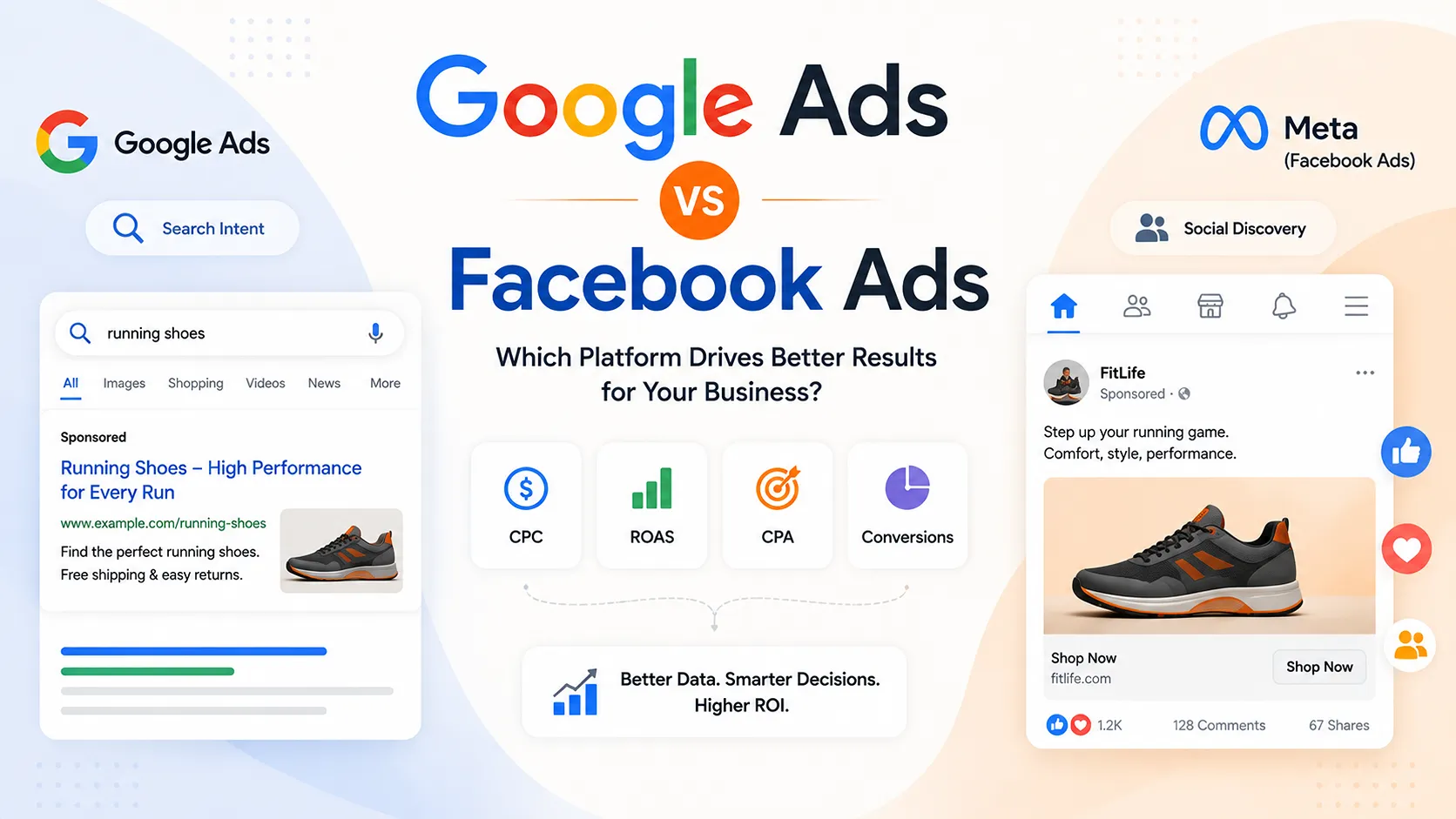
The challenge is that both platforms can work, but they work in different ways. Google Ads helps you reach people who are already searching for a product, service or solution. Facebook Ads, now part of Meta Ads, helps you reach people while they are scrolling, watching and discovering content.
This guide breaks down how each platform works, the pros and cons of both, the key differences between Google Ads and Facebook Ads cost, ROI and attribution, and how to decide which platform should get your budget first.
TL;DR: Google Ads vs Facebook Ads
If you need a quick answer, use Google Ads when people already search for what you sell. Use Facebook Ads when people need to discover, understand or want your offer before they search for it.
Google Ads is often stronger for high-intent searches, urgent services, product searches, competitor terms and bottom-funnel lead generation. Facebook Ads is often stronger for visual products, new offers, demand creation, retargeting and creative testing. Many businesses eventually use both, but small budgets usually perform better when you start with one clear job.
Quick takeaways:
- Google Ads captures existing demand from search behavior.
- Facebook Ads creates demand through audience discovery and creative.
- Google clicks often cost more because users are closer to action.
- Facebook clicks can look cheaper, but lead quality needs careful tracking.
- The better platform depends on search demand, offer familiarity, creative strength and sales cycle length.
| Question | Google Ads | Facebook Ads |
|---|---|---|
| Best for | Capturing active demand | Creating and warming demand |
| User mindset | “I am searching for this now” | “This looks relevant to me” |
| Main targeting logic | Keywords, search terms, feeds and signals | Audiences, behavior, creative and conversion signals |
| Common formats | Search, Shopping, YouTube, Display, Performance Max, Demand Gen | Feed, Stories, Reels, video, carousel, Lead Ads, Advantage+ |
| Main risk | High CPC with weak landing page fit | Cheap clicks or leads with weak buying intent |
| Best metric | CPA, ROAS, qualified lead cost | CPL, CPA, lead quality, creative fatigue |
What Is Google Ads?
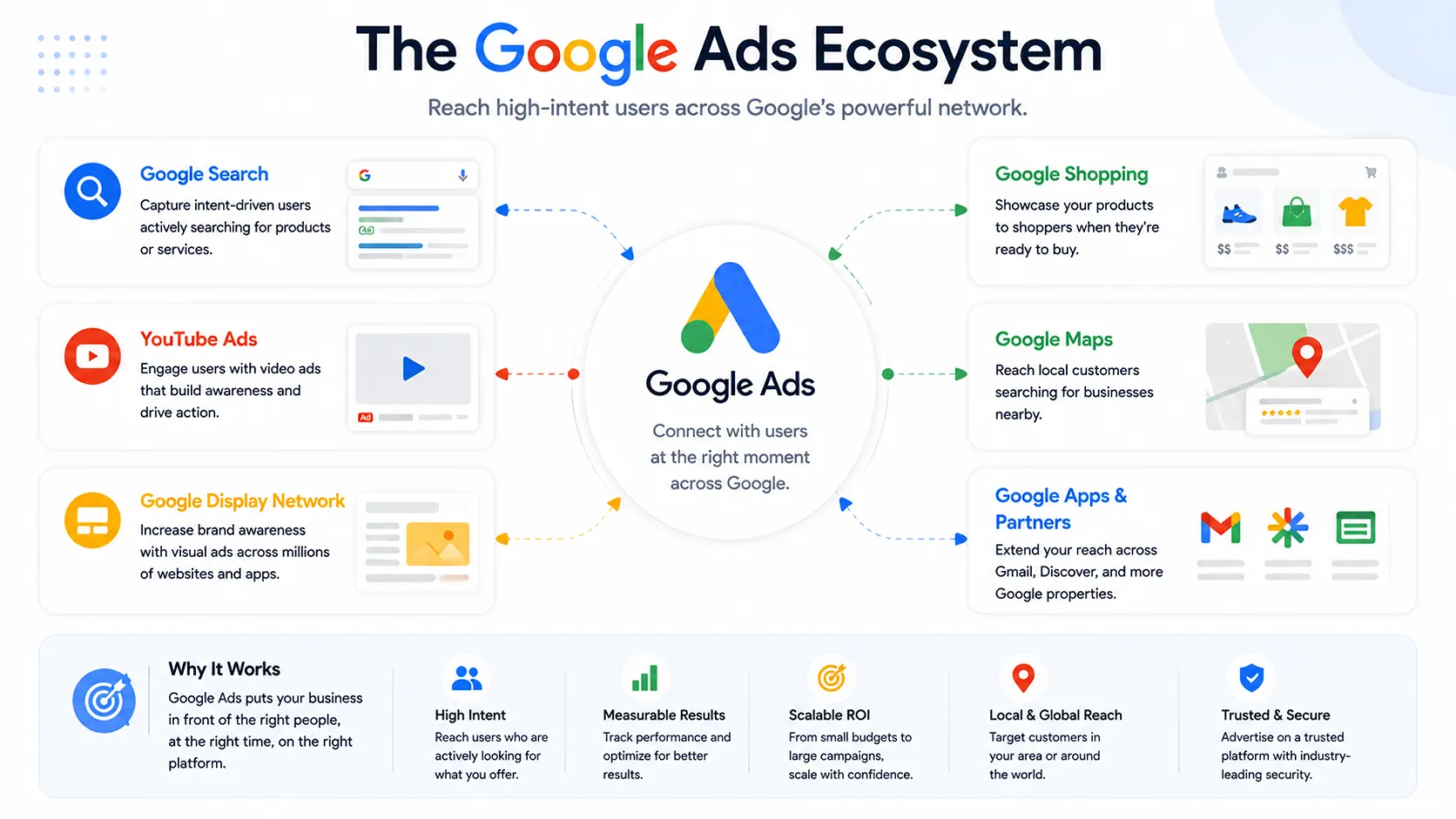
Google Ads is Google’s advertising platform for showing paid ads across Google Search, YouTube, Shopping, Maps, Gmail, Discover, Display and other Google surfaces. Most advertisers start with Search ads because they let you show ads when people search for terms related to your business.
The platform is built around intent. A user types a query, Google matches the query with relevant ads and advertisers compete in an auction. That makes Google Ads useful when buyers already know the problem, product category or service they need. It also makes setup important. If your keywords, ad copy, landing page and conversion tracking do not match, the platform can spend quickly without producing useful leads.
How Google Ads Works
Google Ads works through campaign goals, targeting inputs, bidding, ad assets and conversion data. In Search campaigns, your ads can appear near search results when someone searches terms related to your keywords.
Search is not the only part of Google Ads. Shopping uses product feed data, Performance Max uses your goals and assets across Google channels, and Demand Gen uses visual placements across YouTube, Discover, Gmail and the Google Display Network. The better your inputs are, the easier it is for Google to find useful traffic.
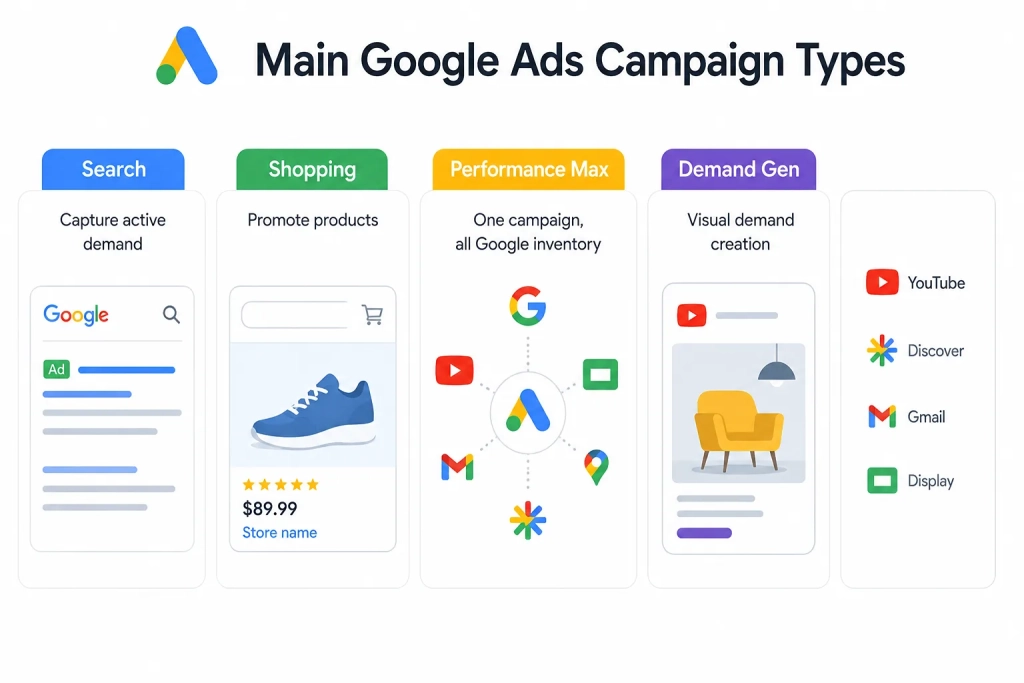
Main Google Ads Campaign Types
Google Ads has several campaign types, and each one serves a different job. Search campaigns capture active demand from keywords. Shopping campaigns promote products using Merchant Center data, including product photos, titles, prices and store names. Google says this helps users understand products before they click.
Performance Max gives advertisers access to Google inventory from one campaign, including Search, YouTube, Display, Discover, Gmail and Maps. Demand Gen focuses more on visual demand creation across YouTube, Discover, Gmail and the Display Network.
Google Ads Pros and Cons
Google Ads works well when buyers already have intent. You can capture people searching for product names, service needs, problem keywords, competitor brands or local intent. This makes it useful for high-value leads and clear purchase paths.
The downside is cost and competition. Search clicks can be expensive when many advertisers bid on the same keywords. Google Ads can also struggle when your category is new and search volume is low.
Google Ads pros and cons:
- Pros: strong purchase intent, clear keyword data, fast conversion potential, strong local search fit and useful Shopping ads.
- Cons: higher CPCs, limited volume in niche markets, weaker fit for unfamiliar offers and a real learning curve around tracking.
- Best practice: connect campaigns to qualified conversions, not just form fills or cheap clicks.
Best-Fit Use Cases for Google Ads
Google Ads is a strong fit when people already search before they buy. Local services, urgent needs, software categories, ecommerce product searches, branded search and competitor searches often fit this pattern.
It is also useful when your landing page can answer a clear query. A search for “emergency roof repair” needs proof, location, availability and a direct call option. A search for “best CRM for small business” needs comparison, features, pricing and a next step. Google Ads performs best when the ad and page match the searcher’s stage.
What Are Facebook Ads?
Facebook Ads are paid ads managed through Meta Ads Manager. Even though many advertisers still say Facebook Ads, the same system can run ads across Facebook, Instagram, Messenger, WhatsApp, Threads and Meta Audience Network, depending on placements and campaign settings.
The platform is built around discovery. People usually do not open Facebook or Instagram to search for a product. They scroll through content, watch videos, react to posts and discover brands through creative. That makes Facebook Ads useful when the offer needs visual proof, education, repeat exposure or social context before someone is ready to buy.
How Facebook Ads Works
Facebook Ads starts with a campaign objective. Meta’s official objective options include awareness, traffic, engagement, leads, app promotion and sales. The objective tells Meta what action to optimize for.
After that, Meta uses your budget, audience settings, placements, creative and conversion signals to decide who sees your ads. Targeting can include broad audiences, custom audiences, lookalike audiences, location, demographics, interests and behavior signals. In practice, creative does a lot of the work. The right hook, video, offer or product angle can qualify the audience before the click.
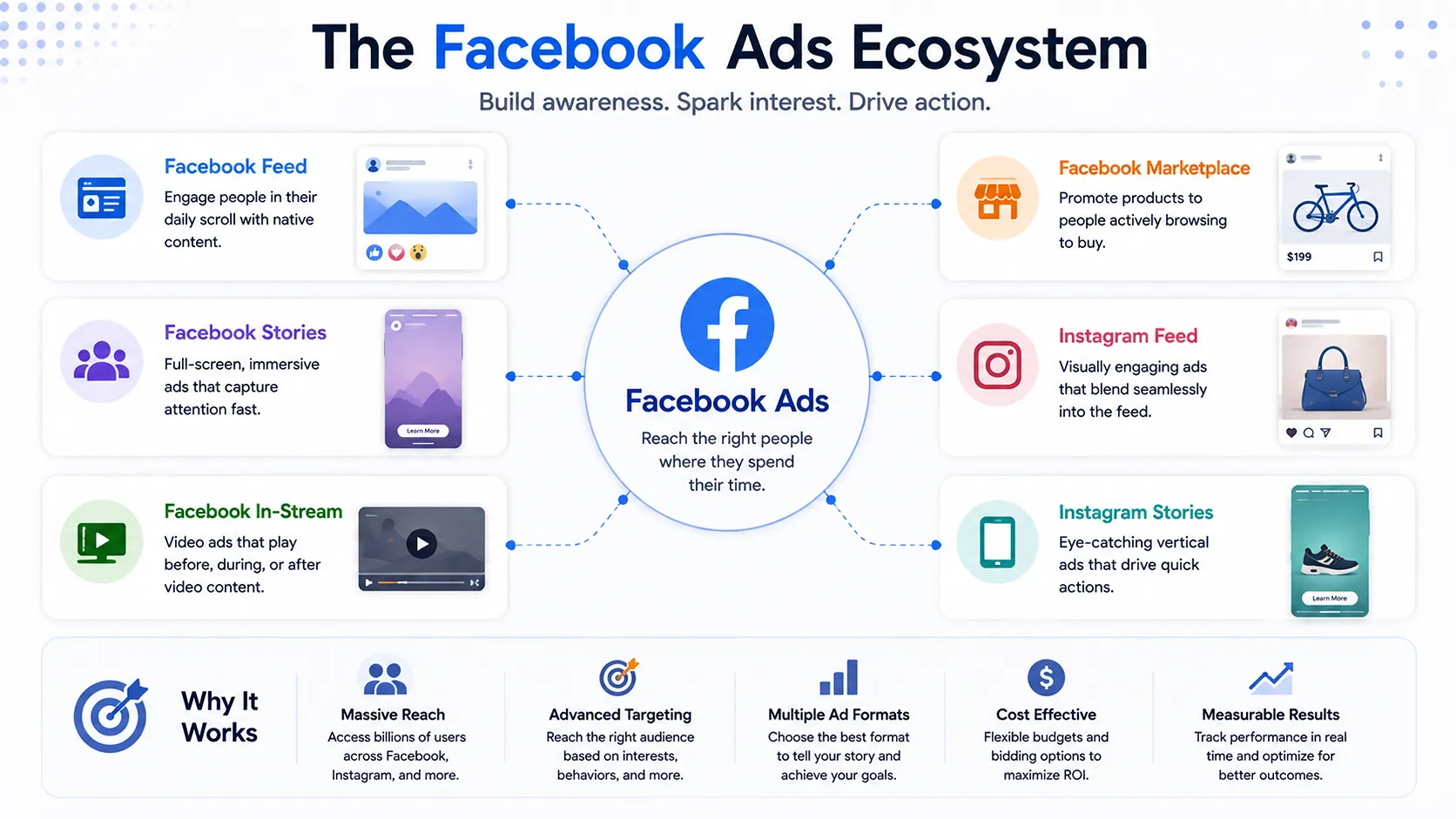
Main Facebook and Meta Ad Placements
Meta placements are the places where ads can appear. Depending on the objective, ads may show across Facebook, Instagram, Messenger, WhatsApp, Threads and Meta Audience Network.
Common placements include Facebook Feed, Instagram Feed, Stories, Reels, Marketplace, Messenger and in-stream video. Meta also supports formats such as image, video, carousel and collection ads. The Meta Ads Guide gives current specs by format and placement. Lead Ads with Instant Forms can collect and qualify leads inside Meta without sending users to an external page.
Facebook Ads Pros and Cons
Facebook Ads works well when the buyer needs to see the product before searching for it. It is strong for visual products, creator-style demos, retargeting, lead magnets, impulse-friendly offers and new categories that need education.
The downside is intent. A click from Facebook does not always mean the person is ready to buy. People may be curious, distracted or early in the journey. Creative also wears out faster than search keywords, so teams need a steady testing process.
Facebook Ads pros and cons:
- Pros: strong visual storytelling, broad reach, useful retargeting, fast creative testing and lower entry cost for some campaigns.
- Cons: weaker purchase intent, creative fatigue, tracking noise and possible low-quality leads if forms are too easy.
- Best practice: measure lead quality and revenue, not only CPL.
Best-Fit Use Cases for Facebook Ads
Facebook Ads is a strong fit when your product can be explained through images, videos, testimonials, demos or before-and-after content. Ecommerce, beauty, fitness, home goods, education, local offers, creator products and some B2B lead magnets can all work well.
It is also useful for retargeting. People who watched a video, visited a product page, opened a form, added to cart or engaged with Instagram can see a follow-up ad. For ecommerce sales campaigns, Meta positions Advantage+ shopping campaigns as an automated option for optimizing delivery and creative toward sales.
Google Ads vs Facebook Ads: Core Differences
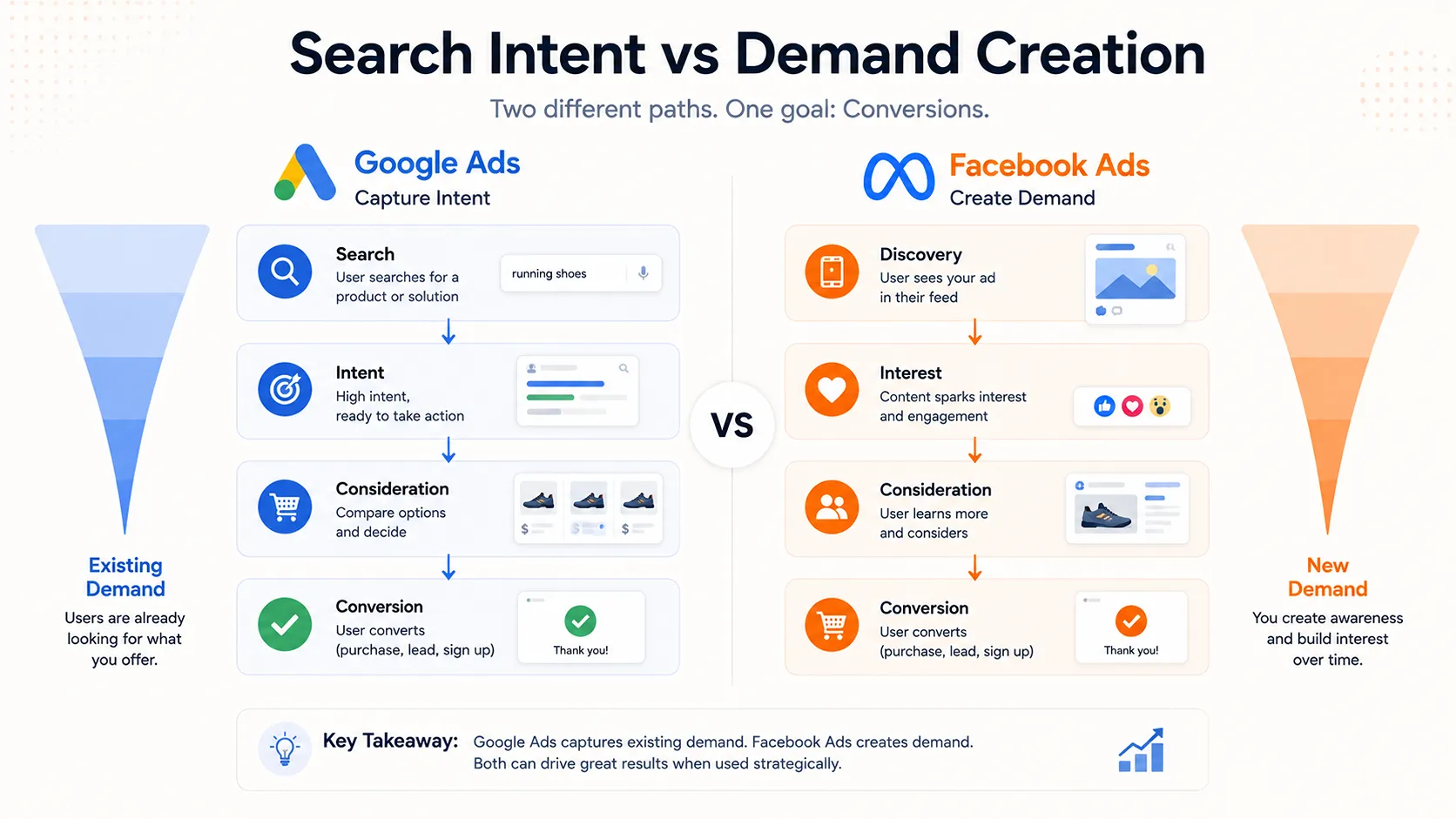
The main difference between Google Ads and Facebook Ads is not cost. It is how each platform finds buyers. Google starts with expressed demand. Facebook starts with attention.
That difference affects everything else. Google Ads needs strong keyword intent, relevant landing pages and clean conversion tracking. Facebook Ads needs strong creative, clear audience signals, enough conversion data and a follow-up path. A business can fail on one platform and succeed on the other without changing the product. The channel simply may not match the way customers buy.
Search Intent vs Audience Discovery
Google Ads captures people who are already searching. That gives you a clearer signal of intent. If someone searches for “same day pest control,” they are probably closer to booking than someone who scrolls past a pest control ad in a feed.
Facebook Ads works earlier in the journey. It can introduce a problem, show a product in use or build trust before search begins. That makes it useful for offers people do not know to search for yet. The tradeoff is that discovery traffic often needs more nurturing.
Keyword Targeting vs Audience and Behavior Signals
Google Search campaigns rely heavily on keywords and search terms. You choose the types of searches you want to match, then use ads and landing pages to capture that demand. Shopping and Performance Max use more product feed data, assets and automation.
Facebook Ads uses audience and behavior signals. You can define audiences, but Meta also learns from engagement, clicks, conversions and creative response. This means Facebook advertisers should not think only about targeting settings. The ad itself helps attract or repel the right buyers.
Search Results vs Visual Social Feeds
Google Search ads usually compete inside a search results page. The user is comparing options, so clarity matters. Your ad needs to match the query and your landing page needs to answer the next question.
Facebook Ads competes inside a visual feed. The ad has to stop the scroll before it can sell. This puts more pressure on the first frame, product shot, headline, creator, offer and message angle. A weak landing page hurts both platforms, but weak creative hurts Facebook much earlier.
Conversion Speed vs Demand Creation
Google Ads can convert faster because the user is often closer to action. Search traffic may move from query to click to form fill or purchase in one session, especially for urgent services or known product categories.
Facebook Ads often needs more touches. A user may watch a video, visit the site, leave, see retargeting, search the brand later and then convert. This does not make Facebook weaker. It means Facebook may create demand before another channel captures the final click.
Landing Page Fit vs Creative Fit
Google Ads exposes landing page fit quickly. If the user searches for one thing and lands on a page that talks about something else, performance drops. Message match matters.
Facebook Ads exposes creative fit first. If people do not stop, click or engage, the landing page never gets a chance. Teams should diagnose the right bottleneck. For Google, check search terms and landing page intent. For Facebook, check hooks, formats, offers and creative fatigue before blaming the channel.
Cost, ROI, and Attribution Differences
Google Ads vs Facebook Ads cost comparisons can be useful, but they are easy to misread. Facebook can produce lower CPCs in many campaigns because it often reaches people earlier in the journey. Google can cost more because many searches happen closer to purchase intent.
That does not mean Facebook is always cheaper or Google is always more profitable. The right comparison is not CPC alone. You need to measure CPA, CPL, ROAS, close rate, customer value and payback period. You also need to understand attribution, because Facebook may create demand that Google later captures.
Why CPC Alone Does Not Tell the Full Story
CPC tells you how much a click costs. It does not tell you whether the click can become revenue. That is why comparing Google Ads vs Facebook Ads cost only by CPC can lead to the wrong decision.
WordStream’s 2026 Google Ads benchmark reported an average CPC of $5.42, while its 2025 Facebook traffic campaign benchmark reported an average CPC of $0.70 (WordStream Google Ads benchmarks, WordStream Facebook Ads benchmarks). That gap looks large. But if Google clicks convert at a higher rate or produce better customers, the higher CPC may still be the better buy.
How to Compare CPA, CPL, and ROAS
CPA, CPL and ROAS are closer to business outcomes than CPC. CPL tells you what a lead costs. CPA tells you what a conversion costs. ROAS tells you how much revenue you get back from ad spend.
Each metric has limits. CPL can look good while lead quality is poor. ROAS can look strong while margin is weak. CPA can hide refund rate or poor customer retention. The best comparison connects ad platform data to CRM, ecommerce, phone, pipeline or payment data.
| Metric | What it tells you | What it can hide |
|---|---|---|
| CPC | Cost to get a click | Lead quality and purchase intent |
| CPL | Cost to get a lead | Close rate and sales quality |
| CPA | Cost to get a conversion | Margin, refunds and retention |
| ROAS | Revenue from ad spend | Profit and attribution gaps |
Why Facebook Ads Can Look Cheaper at First
Facebook Ads can look cheaper because the platform can buy attention before the buyer is ready. That can lower click costs, especially in traffic campaigns. But cheap attention does not always mean cheap customers.
For lead campaigns, WordStream’s 2025 Facebook benchmark reported an average CPC of $1.92, average conversion rate of 7.72% and average CPL of $27.66 across industries. Those numbers can make Facebook attractive for lead generation. Still, teams should check whether the leads answer calls, book meetings, buy products or stay active after the first conversion.
Why Google Ads Can Convert Faster but Cost More
Google Ads can convert faster because many searches contain intent. A user who searches “book emergency dentist” or “CRM software pricing” is already describing a need. Advertisers compete for those moments, which can push CPC up.
WordStream’s 2026 Google Ads benchmark reported an average conversion rate of 8.18% and average cost per lead of $66.69 across industries. The higher CPL does not automatically make Google worse. In categories with high customer value, one qualified search lead can justify a much higher acquisition cost.
Attribution Challenges on Both Platforms
Both platforms can mislead you if you only trust in-platform reporting. Google may get credit for demand another channel created. Facebook may influence buyers early but lose credit when they return through branded search, direct traffic or email.
Use platform reports as one view, not the whole truth. Compare them with CRM data, ecommerce revenue, call tracking, customer surveys and blended CAC. If Facebook spend rises and branded search rises later, Facebook may be creating demand. If Google conversions rise but total revenue does not, you may be paying for demand you already had.
How to Choose Between Google Ads and Facebook Ads
The best platform depends on how your customers move from problem to purchase. Start with the buying journey, not the channel. Do people search before buying? Do they need to see the product in action? Is your offer familiar? Can you create enough strong ads? Do you have tracking that shows lead quality after the form fill?
This is where many teams make mistakes. They choose Facebook because CPC is lower. Or they choose Google because search feels safer. A better approach is to match the platform to the strongest signal in your market.
Existing Search Demand
Existing search demand favors Google Ads. If buyers search for your category, service, product, brand or competitors, Google gives you a direct way to capture that demand. This is especially useful when the search has commercial intent.
Check this before you spend. Use Keyword Planner, Search Console, customer interviews, marketplace search data and competitor SERPs. If your terms show clear volume and buying intent, start with Google Ads. If search volume is weak because the category is new, Facebook Ads may be better for building demand first.
Offer Familiarity
Offer familiarity affects how fast ads can convert. If people already understand what you sell, Google Ads can work quickly. The buyer does not need much education. They need proof, price, availability and a clear next step.
If your offer is new or hard to explain in search terms, Facebook Ads may be a better starting point. A video can show the problem, the product and the outcome in a way a search ad cannot. For new categories, demand often has to be created before it can be captured.
Buyer Intent
Buyer intent is one of the strongest reasons to start with Google Ads. Search queries can reveal urgency, comparison behavior or purchase readiness. That is why Google is often strong for local services, B2B software, insurance, legal, healthcare and high-intent ecommerce.
Facebook can still support those businesses, but usually in a different role. It can retarget visitors, warm cold audiences, promote proof and create repeat exposure. If your main goal is to capture buyers who are ready now, Google usually has the cleaner signal.
Creative Strength
Creative strength favors Facebook Ads. If your team can produce videos, product demos, creator content, testimonials, comparison ads and fresh hooks, Facebook gives you more room to learn from the market.
This is also where competitor research helps. A tool like PrimeSpy can help you organize competitor ad examples and spot repeated hooks, formats and offers in your category. Use that as research, not as copy. The goal is to understand what the market is testing, then build your own angle around your product, margin and audience.
Sales Cycle Length
Short sales cycles often favor Google Ads. If someone searches, clicks and buys within a short window, search intent gives you a strong starting point. This is common for urgent services, simple ecommerce products and clear category searches.
Longer sales cycles often need both platforms. Facebook can introduce the offer and build trust. Google can capture later searches for the category, brand or competitor terms. For B2B, high-ticket services or considered purchases, one platform may not cover the whole journey.
Budget and Tracking Readiness
Budget and tracking decide whether you should test one platform or both. If your budget is small, splitting it across two platforms may create two weak tests. Start with the platform that has the strongest buying signal.
Tracking matters just as much. Google Ads needs clean conversion actions, search term review and landing page alignment. Facebook Ads needs pixel events, Conversion API where possible, clear campaign objectives and creative tracking. If you cannot tell which leads become customers, both platforms will feel harder to judge.
When Google Ads and Facebook Ads Work Better Together
Many businesses should not treat Google Ads vs Facebook Ads as a permanent choice. The platforms often work better together because they influence different parts of the buying journey.
A customer may first see a Facebook video, visit your website, leave, search your brand on Google, compare reviews and return through a Shopping ad. A B2B lead may click a Google Search ad, ignore sales outreach and respond later after seeing retargeting on Instagram. Real buying paths are messy. Your channel strategy should allow for that.
Facebook Creates Demand, Google Captures It
Facebook can introduce products, problems and offers before people know what to search. This is useful for visual products, new categories and brands that need repeated exposure.
Google can capture the demand that Facebook helps create. After seeing a paid social ad, a buyer may search your brand, product type or problem later. If you only measure last click, Google may look like it did all the work. A better view looks at assisted conversions, branded search lift and total revenue movement.
Google Search Data Can Improve Facebook Messaging
Google search data shows how buyers describe their problems. Search terms can reveal phrases like “easy setup,” “near me,” “no contract,” “for small business” or “same day.” Those phrases can improve Facebook hooks, captions, landing pages and video scripts.
Use search data as voice-of-customer input. Facebook creative should not sound like a search ad, but it should use language buyers already understand. This keeps ads specific and reduces vague messaging.
Retargeting Connects Both Platforms
Retargeting helps you follow up with people who showed interest. Google can retarget across YouTube, Display and Demand Gen. Facebook can retarget site visitors, video viewers, engaged users, form openers and cart abandoners.
The key is message match. A first-time visitor may need proof. A cart abandoner may need reassurance. A demo page visitor may need a case study. Retargeting works better when the ad reflects the last meaningful action, not just the fact that someone visited your site.
Different Funnel Stages Need Different KPIs
Do not judge every campaign by the same metric. A cold Facebook video campaign and a branded Google Search campaign are not doing the same job. One may create attention. The other may capture demand.
Use different KPIs by funnel stage:
- Awareness: reach, video views, engaged visits and branded search movement.
- Consideration: landing page views, product views, content signups and qualified leads.
- Conversion: purchases, CPA, ROAS, booked calls and close rate.
- Retargeting: return visits, recovered carts, assisted conversions and incremental revenue.
Final Verdict: Google Ads or Facebook Ads?
Choose Google Ads if people already search for your product, service or problem and you can send them to a page that matches that intent. Choose Facebook Ads if your offer needs visual explanation, discovery, education or repeated exposure before buyers are ready.
Choose both when you have enough budget, creative and tracking to manage the full journey. Facebook can create demand. Google can capture it. The wrong move is treating them as identical traffic sources. They are different systems with different strengths, inputs and risks.
| Situation | Better first choice | Why |
|---|---|---|
| Buyers already search for the product | Google Ads | Search intent is already visible |
| Product needs visual explanation | Facebook Ads | Creative can create demand |
| Local or urgent service | Google Ads | Users often search at the moment of need |
| New brand with low search volume | Facebook Ads | Discovery comes before search |
| Strong video or creator content | Facebook Ads | Feed-based ads reward strong creative |
| Full-funnel budget and tracking | Both | Each platform supports a different stage |
FAQs About Google Ads vs Facebook Ads
These are the questions advertisers usually ask after they understand the basic difference. The short answer is useful, but the right decision still depends on your market, offer, conversion path and tracking setup.
Use these answers as a starting point. Then check your own data. Search demand, creative performance, landing page conversion rate, lead quality and customer value will tell you more than any average benchmark.
Is Google Ads better than Facebook Ads?
Google Ads is better when buyers already search before they buy. It is strong for high-intent searches, local services, comparison queries, product searches and branded demand.
Facebook Ads is better when buyers need to discover or understand the offer first. It is strong for visual products, new offers, creator content, retargeting and demand creation. The better platform depends on the buying stage you need to influence.
Is Facebook Ads cheaper than Google Ads?
Facebook Ads often has lower CPCs, especially for traffic campaigns. WordStream reported an average CPC of $0.70 for Facebook traffic campaigns in its 2025 benchmark.
That does not mean Facebook customers are always cheaper. Lower CPC can come with lower intent. Google Ads may cost more per click, but those clicks may convert faster. Compare CPL, CPA, ROAS and customer value before deciding which platform is cheaper.
Which platform has better ROI?
Neither platform has better ROI in every case. Google Ads can produce strong ROI when search intent is clear, the landing page matches the query and customer value supports the CPC.
Facebook Ads can produce strong ROI when creative is strong, the offer is easy to understand and retargeting is well structured. ROI also depends on attribution. Facebook may create demand that Google later captures, so last-click reporting can distort the comparison.
Should small businesses start with Google Ads or Facebook Ads?
Small businesses should start with the clearest buying signal. If people search for your service or product, Google Ads is often the cleaner first test. This applies to many local services, professional services and known product categories.
If your product needs to be seen before people want it, Facebook Ads may be the better first test. This applies to many visual products, creator-led offers, new brands and lead magnets.
Can I run both with a small budget?
You can, but it is often better to start with one focused test. A small budget split across two platforms may not give either platform enough data to optimize or enough conversions to judge.
If you run both, give each platform a different job. For example, use Google Search for high-intent keywords and Facebook retargeting for visitors who did not convert. Avoid running two vague campaigns with the same goal.
Are Facebook Ads the same as Meta Ads?
In common marketing language, many people still say Facebook Ads. Technically, Meta Ads is the broader system because ads can run across Facebook, Instagram, Messenger, WhatsApp, Threads and Meta Audience Network.
Meta Ads Manager is the current ad management platform. For SEO and search behavior, “Facebook Ads vs Google Ads” is still a common phrase, but advertisers should understand that the platform now covers more than Facebook.
Which is better for lead generation?
Google Ads is often better for high-intent lead generation when people search for a service, product or solution. The lead may cost more, but it can be closer to purchase.
Facebook Ads can be strong for lead generation when the offer is simple and the form is easy to complete. The risk is lead quality. Track booked calls, close rate, revenue and customer value before deciding which platform wins.
Which is better for ecommerce?
For ecommerce, Google Ads works well when shoppers search for the product, compare options or use Shopping results before buying. Shopping and Performance Max can help retailers show product images, prices and store information before the click.
Facebook Ads works well when the product is visual, new, giftable, impulse-friendly or suited to video demos. Many ecommerce brands use both: Facebook for discovery and retargeting, Google for Shopping, branded search and high-intent product queries.