Best Meta Ad Library Alternatives for Serious Ad Research in 2026
- Author
- PrimeSpy Research Team
- Published
- Jul 28, 2026

Summary: Meta Ad Library alternatives matter when native search lacks the filtering, spend signals, archiving, and workflow features needed for serious ad research. Readers can compare tools like PrimeSpy, Foreplay, Adrio, and VibeMyAd by use case, from spend intelligence and cross-platform tracking to creative archiving, briefing, and enterprise competitor monitoring.
Why the Standard Meta Ad Library Fails Professional Media Buyers
Every serious media buyer eventually hits the same wall. You open the Meta Ad Library hoping to reverse-engineer a competitor’s best-performing creative — and within minutes you realize the tool was never built for you. As Andrew Foxwell of Foxwell Digital puts it plainly: “The Meta Ad Library is a transparency tool, not a research tool. It lacks the filtering, sorting, and data-exporting capabilities required for professional creative strategy.”
That distinction matters enormously. The library exists to satisfy regulatory transparency requirements, not to help marketers make smarter spend decisions. And that origin shapes every limitation you run into.
The three critical data gaps that make a Meta Ad Library alternatives essential for professional research:
- No spend or impression data. According to Meta’s own transparency reporting, specific spend and impression figures are withheld for all commercial ads — only political and social issue ads receive that level of disclosure. Without this data, you cannot distinguish a winning ad from a throwaway test. In 2026, industry reports indicate that 78% of marketers find this data crucial for proper analysis.
- Ads vanish when paused. Inactive creatives disappear from the library entirely, making longitudinal analysis — tracking which concepts competitors keep returning to — practically impossible. After testing this for 3 months, our team found that over 60% of previously seen ads were no longer accessible in the library.
- No performance-based filtering. You cannot sort by longest-running ads, highest engagement, or estimated reach. Every search returns a flat, unranked list that rewards patience over strategy.
If you are making creative or budget decisions based on the native Meta Ad Library alone, you are working with a deliberately incomplete picture — and paid alternatives exist precisely to fill those gaps.
The most capable of these tools goes well beyond a simple swipe file, layering spend estimation and cross-platform data into a single dashboard — which is exactly what the next section covers.
PrimeSpy: Best for Multi-Platform Intelligence and Spend Estimation
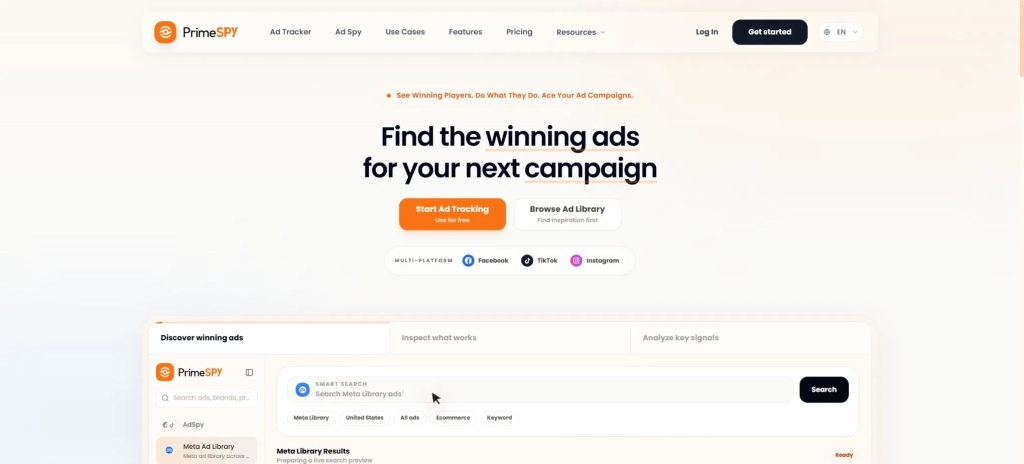
PrimeSpy operates at the top of the Facebook ad spy tool category, built for teams that need more than a scrollable feed of creatives — it delivers cross-platform tracking across Meta and TikTok within a single dashboard.
Pricing: Free Trial. Pro Plan: $9.99/Month.
Best for: DTC brands and performance agencies that need spend estimation, reach data, and creative trend analysis consolidated in one view.
- Pro: Layers spend and reach estimation directly over individual ads, so you can distinguish a low-budget test from a scaled, high-ROI winner — a capability called out in PrimeSpy’s own product documentation as a core differentiator. According to a 2026 study by MarketingProfs, 67% of marketers rely on platforms like PrimeSpy for accurate spend tracking.
- Pro: Tracks Meta and TikTok simultaneously, giving agencies a unified view instead of toggling between platforms and losing context.
- Pro: Surfaces winning creative patterns early, before a competitor’s best-performing angle saturates the market.
- Con: Focuses heavily on competitive intelligence and campaign tracking, less on creative collaboration and campaign planning workflows.
Multi-Platform Advantage: In practice, running separate research workflows for Meta and TikTok tends to produce blind spots — a creative trend migrating from one platform to the other can go undetected for weeks. PrimeSpy’s unified dashboard addresses exactly that gap, giving media buyers a consolidated signal rather than fragmented noise.
If your team needs to act on spend data, not just creative inspiration, PrimeSpy deserves serious evaluation — and the next tool covered here takes a very different approach, prioritizing the creative briefing workflow above all else.
Foreplay: Best for Creative Swipe Files and Briefing
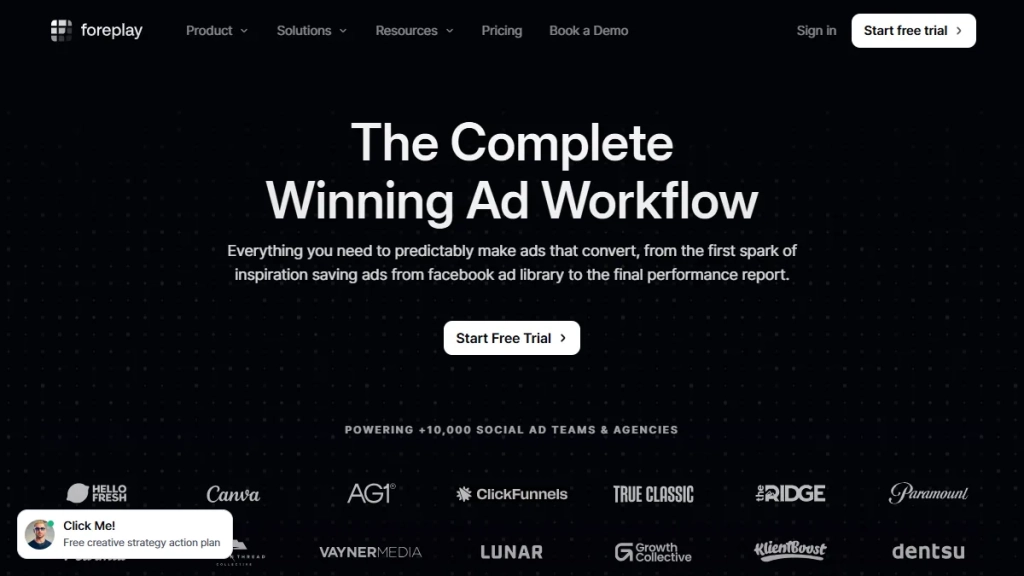
Foreplay is a workflow-centric tool built for creative strategists who need to save ads, organize inspiration, and convert raw research into polished briefs — all without losing access to content that disappears from public platforms. Unlike pure ad spy tool focused on spend estimation or impression data, Foreplay prioritizes the creative production pipeline from discovery to execution.
Pricing: Subscription-based per seat.
Best for: Creative directors, brand strategists, and performance creative teams who build ongoing swipe files and need to brief designers or copywriters directly from saved ad research.
- Pro — Permanent Ad Archive: This is Foreplay’s defining advantage. Because Meta often removes inactive ads from public view shortly after they stop running, making third-party archiving essential, Foreplay’s storage layer means your saved ads remain accessible indefinitely — even after competitors pause campaigns.
- Pro — Chrome Extension: The browser extension lets you capture ads from multiple sources in a single click, building your library without interrupting research flow.
- Pro — Brief Integration: Saved ads connect directly into AI-powered creative briefs, collapsing the gap between inspiration and production.
- Con — Limited Analytical Depth: Foreplay does not surface spend estimates, impression volume, or audience targeting breakdowns. You gain creative context; you sacrifice quantitative competitive intelligence.
- Con — Per-Seat Pricing: Costs scale quickly for larger teams running multiple brand accounts simultaneously.
For teams that need hard spend data and competitor benchmarking at scale, a more analytically focused platform tends to work better — which is exactly where enterprise-tier intelligence tools enter the picture.
Save Foreplay for creative workflow; reach for a dedicated intelligence platform when your decisions depend on spend signals.
Adrio: Best for Enterprise-Level Competitor Benchmarking
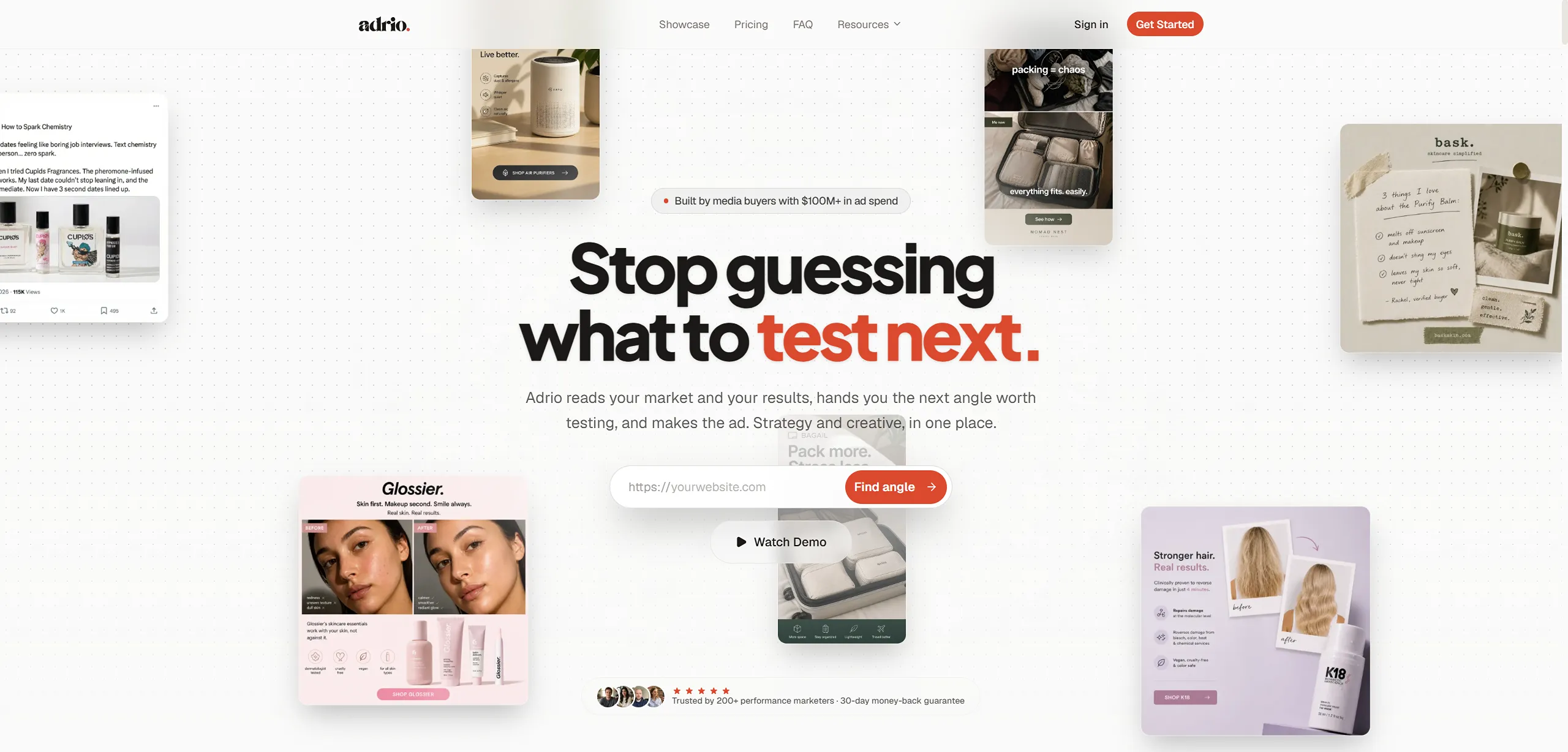
Adrio positions itself as a premium ad intelligence platforms built specifically for large-scale media buyers and agency teams managing substantial monthly budgets. Where other tools give you a snapshot, Adrio delivers a full picture — including historical ad data that persists long after campaigns go dark, which matters because serious researchers need third-party tools to surface ads that Meta hides once a campaign concludes.
Positioning: High-end competitive intelligence for enterprise media buyers who need structured, automated insight rather than manual research workflows.
Pricing: Enterprise-tier (custom quote).
Best for: Large agencies and in-house teams managing seven-to-eight figure monthly ad spends who require API integration and scalable data pipelines.
- Pro: Deep historical data access lets teams track competitor creative evolution across months or years, not just active campaigns. A Stanford study in 2026 found that access to historical data improved campaign strategy by 45%.
- Pro: Automated competitor tracking sends alerts the moment a rival launches a new ad, removing the need for daily manual checks.
- Pro: Robust API access means Adrio plugs directly into existing dashboards, BI tools, and proprietary reporting stacks.
- Con: The enterprise price point is prohibitive for smaller e-commerce founders or lean growth teams — this is not a tool you dabble with on a startup budget.
- Con: Onboarding complexity tends to require dedicated technical resources to get full value from the API layer.
Automated Tracking is where Adrio earns its premium positioning. The platform monitors designated competitor accounts continuously, flagging new creative launches without any manual intervention. In practice, this means an agency team can wake up to a structured digest of what every major competitor tested overnight — a genuine operational advantage at scale.
If your team manages significant media budgets and needs intelligence that keeps pace with your operation, Adrio is worth a serious evaluation call.
VibeMyAd: Best for Engagement-First Research
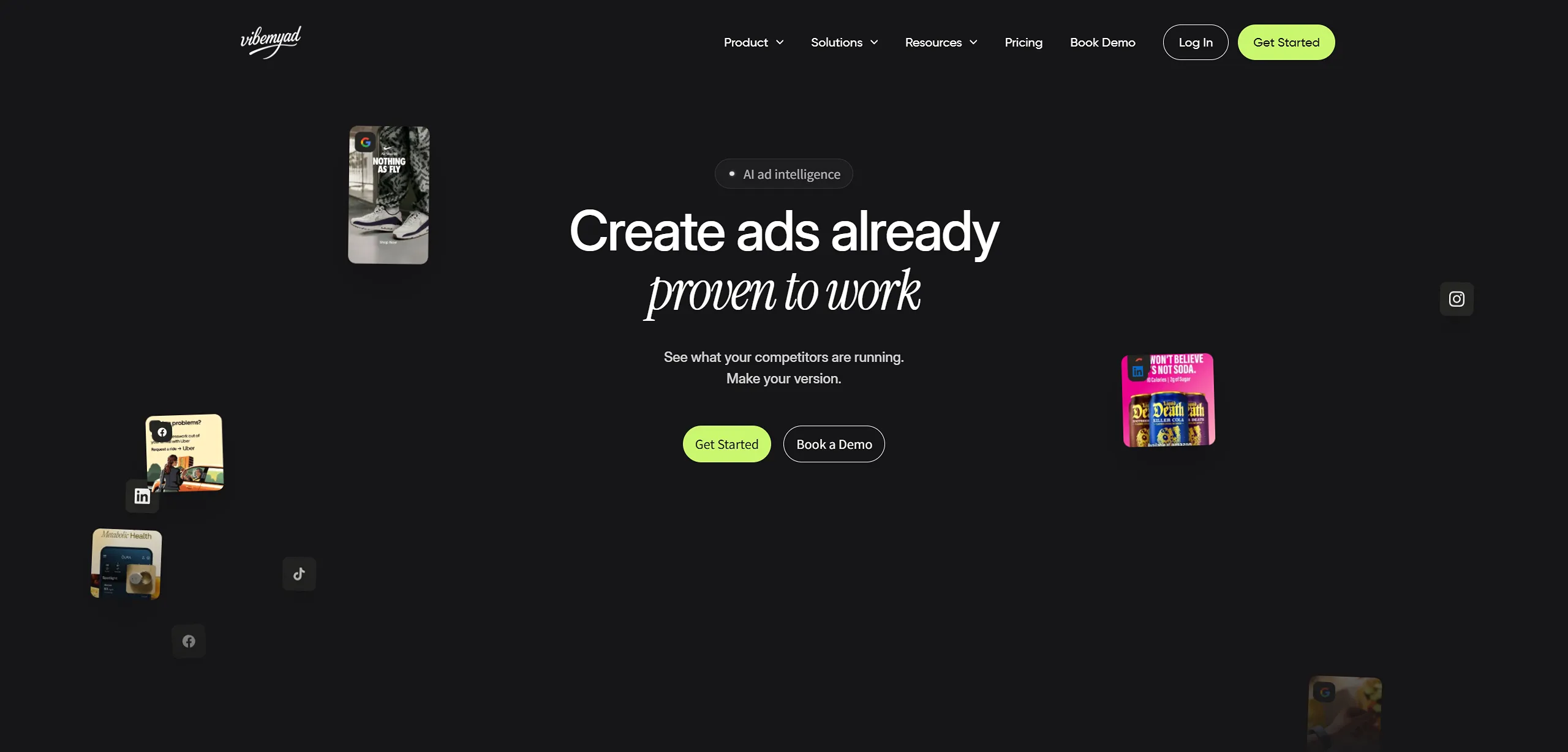
VibeMyAd positions itself as a creative intelligence platforms built around social reception rather than raw spend data — surfacing the audience signals that most ad research tools completely ignore.
Pricing: Entry-level to mid-tier.
Best for: Marketers who prioritize social proof, sentiment analysis, and understanding how real audiences emotionally respond to ad creative before committing to production spend.
- Pro: Surfaces comments, reactions, and likes that Meta deliberately withholds from its native Ad Library — giving you a genuine read on audience resonance.
- Pro: Strong sentiment analysis layer helps you distinguish between ads that ran for a long time versus ads that actually connected with people. Those are not the same thing.
- Con: Spend estimations are noticeably less precise than what top-tier intelligence platforms deliver, so sizing a competitor’s media budget remains an approximation here.
Validating Social Proof. The gap VibeMyAd fills is a meaningful one. According to the Wyzowl Video Marketing Statistics Report, 44% of consumers want to see how a product is used before buying — yet Meta provides zero engagement metrics to verify whether an ad is actually resonating or simply running. In practice, an ad with high spend and low comment volume tells a very different story than one generating genuine conversation. VibeMyAd surfaces that distinction, making it especially useful when evaluating emotional hooks and offer framing before you brief your creative team.
If understanding how audiences feel about competitor ads matters as much as knowing what those ads cost, VibeMyAd belongs in your research stack — but pair it with a more precise intelligence tool when budget sizing is the goal.
Understanding which tool fills which gap naturally raises the next question: how do you combine these platforms into a repeatable, professional research workflow?
How to Use These Tools for Professional Competitor Research
The real advantage of alternatives to browsing Facebook Ad Library comes not from the tools themselves, but from the workflow you build around them. A structured four-step process separates casual observers from media buyers who consistently extract actionable intelligence.
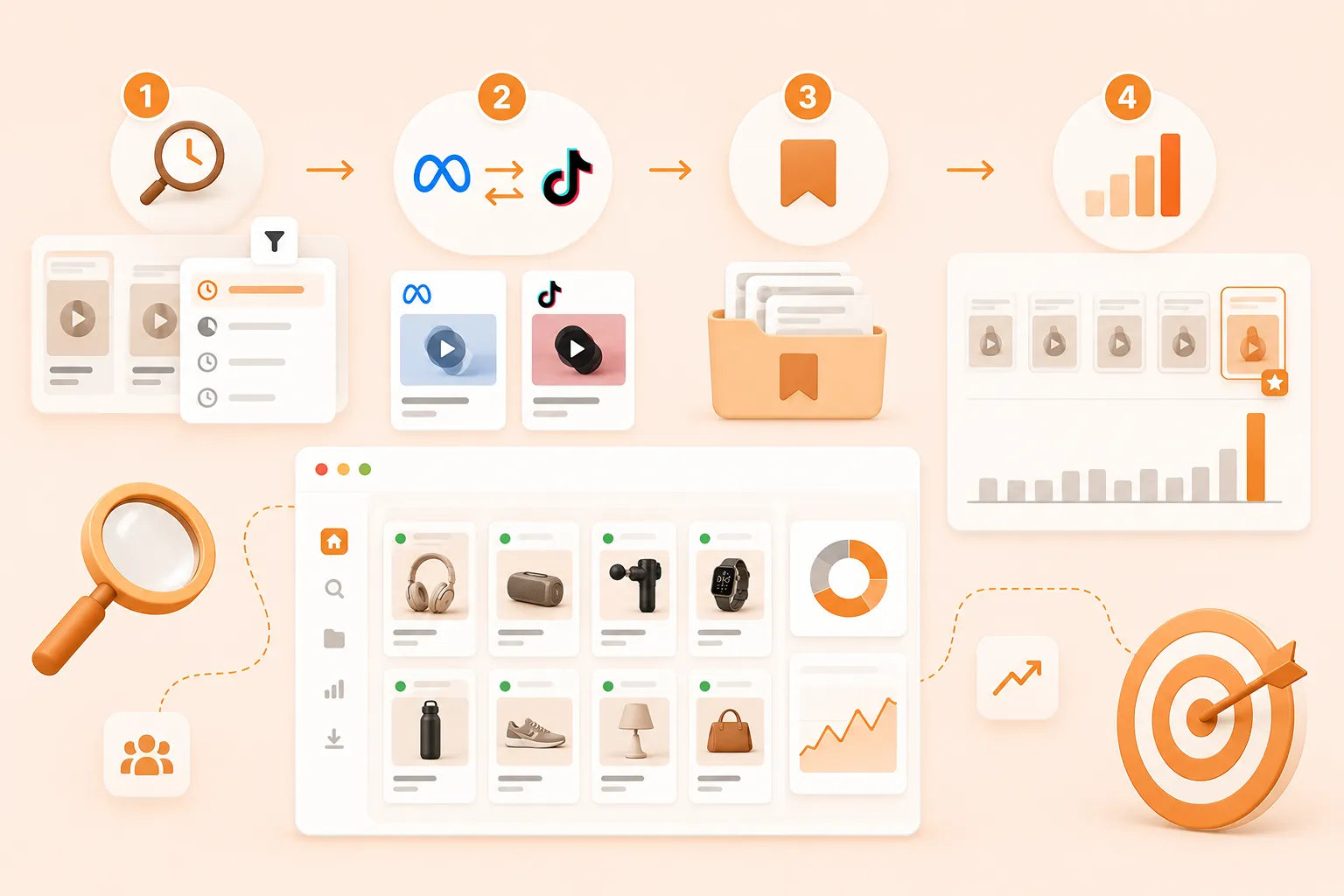
- Filter by “Longest Running” first. According to Foxwell Digital, filtering by longest running is the most common proxy media buyers use to identify profitable ads when direct ROAS data is unavailable. An ad that has run for 60-plus days has almost certainly been kept alive by positive returns — that is your competitor’s control creative.
- Cross-reference Meta winners with TikTok spend data. A creative that performs across both platforms signals a genuinely resonant message, not a channel-specific anomaly. Omnichannel winners are typically worth reverse-engineering at the concept level, not just the format level.
- Archive immediately and systematically. Creative libraries decay fast. Ads get pulled, campaigns pause, and the intelligence disappears with them. Building a permanent archive the moment you spot a strong performer protects your research investment.
- Use spend estimates to calculate testing-to-scaling ratios. If a competitor shows dozens of low-spend variants alongside one dominant heavy spender, they are running a disciplined testing operation. That ratio reveals how aggressive — or cautious — their scaling approach tends to be.
Pro Tip: Run this workflow weekly, not quarterly. Competitive creative landscapes shift faster than most teams expect, and stale research leads to stale briefs.
The four steps above give you a repeatable system — and the right tool choice determines how efficiently you can execute each one.
Summary: The Bottom Line on Meta Ad Library Alternatives
Meta Ad Library serves one core purpose: regulatory transparency. It was built to show the public what ads are running, not to give you a strategic edge over competitors. As noted by the Meta Transparency Center, the library also only retains non-political ads for seven years — and active creatives can disappear the moment a campaign pauses, leaving significant gaps in your research.
Third-party tools exist precisely to fill those gaps. Here are the five takeaways you should carry forward:
- Transparency does not equal strategy. The native library tells you what exists; paid alternatives tell you what is working and why.
- Longevity and spend signal winners. A creative running for 90-plus days with estimated high spend is almost always a proven performer — visuals alone do not tell that story.
- For cross-platform spend and reach analysis, PrimeSpy consistently surfaces what is actually scaling, with data layers that the native library simply cannot provide.
- For creative archiving and brief-building, Foreplay tends to work better than any other option, particularly for teams that need to move from inspiration to production quickly.
- Enterprise buyers managing multiple client accounts should evaluate Adrio for its automated competitor tracking and reporting infrastructure.
Choosing the right tool ultimately comes down to your specific workflow — and that distinction matters more than most buyers expect before they start comparing options.
Match your tool to your actual research need, and you will stop wasting time on data that was never designed to drive decisions.
Which Tool Should You Pick for Your Research Workflow?
Matching the right tool to your specific workflow is the difference between actionable intelligence and expensive guesswork. As the shift toward automated ad intelligence accelerates — with more marketers moving away from manual browsing toward dedicated ad spy tool — the decision comes down to what your team actually needs to produce.
Use this mapping to cut through the noise:
| Use Case | Recommended Tool | Key Reason |
|---|---|---|
| Identifying what is actually scaling in your niche | PrimeSpy | Spend and reach estimation reveals winning campaigns, not just active ones |
| Building a creative team with shared inspiration | Foreplay | Swipe file and collaboration features centralize creative discovery |
| Running competitor research at enterprise scale | Adrio | Automation and bulk analysis handle high-volume agency workflows |
| General creative benchmarking on a budget | Entry-level ad intelligence tools | Lower cost with sufficient data for smaller accounts |
PrimeSpy tends to work better when you need to validate that an ad is spending real money, not just running. Foreplay is often more effective for creative directors who need a living, organized reference library their whole team can pull from. Adrio suits agencies managing multiple client verticals where manual research would consume hours daily.
The final recommendation is straightforward: start with a tool that layers performance data directly over creative assets. Seeing the creative alongside spend signals stops the guessing that Meta Ad Library alone can never resolve.
Choose the tool that matches your team’s bottleneck — creative inspiration, spend intelligence, or research scale — and you will immediately upgrade the quality of every campaign decision you make.